

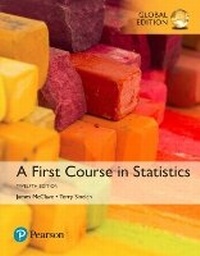
First Course in Statistics, A, Global Edition
12th Edition
Published on 9. January 2018
Book
Paperback/Softback
648 pages
978-1-292-16541-7 (ISBN)
Description
For courses in introductory statistics.
A Contemporary Classic
Classic, yet contemporary; theoretical, yet applied--McClave & Sincich's A First Course in Statistics gives you the best of both worlds. This text offers a trusted, comprehensive introduction to statistics that emphasises inference and integrates real data throughout. The authors stress the development of statistical thinking, the assessment of credibility, and value of the inferences made from data. This new edition is extensively revised with an eye on clearer, more concise language throughout the text and in the exercises.
Ideal for one- or two-semester courses in introductory statistics, this text assumes a mathematical background of basic algebra. Flexibility is built in for instructors who teach a more advanced course, with optional footnotes about calculus and the underlying theory.
A Contemporary Classic
Classic, yet contemporary; theoretical, yet applied--McClave & Sincich's A First Course in Statistics gives you the best of both worlds. This text offers a trusted, comprehensive introduction to statistics that emphasises inference and integrates real data throughout. The authors stress the development of statistical thinking, the assessment of credibility, and value of the inferences made from data. This new edition is extensively revised with an eye on clearer, more concise language throughout the text and in the exercises.
Ideal for one- or two-semester courses in introductory statistics, this text assumes a mathematical background of basic algebra. Flexibility is built in for instructors who teach a more advanced course, with optional footnotes about calculus and the underlying theory.
More details
Edition
12th edition
Language
English
Place of publication
Harlow
United Kingdom
Target group
College/higher education
Dimensions
Height: 275 mm
Width: 220 mm
Thickness: 20 mm
Weight
1251 gr
ISBN-13
978-1-292-16541-7 (9781292165417)
Copyright in bibliographic data is held by Nielsen Book Services Limited or its licensors: all rights reserved.
Schweitzer Classification
Other editions
Additional editions
James T. McClave | Terry T. Sincich
First Course in Statistics, A, Global Edition
E-Book
01/2018
12th Edition
Pearson
from
€60.69
Available for download
Previous edition
James T. McClave | Terry Sincich
First Course in Statistics, A, Global Edition + MyLab Statistics with Pearson eText
Book
02/2018
12th Edition
Pearson Education Limited
€127.72
Shipment within 10-20 days
Content
1. Statistics, Data, and Statistical Thinking
1.1 The Science of Statistics
1.2 Types of Statistical Applications
1.3 Fundamental Elements of Statistics
1.4 Types of Data
1.5 Collecting Data: Sampling and Related Issues
1.6 The Role of Statistics in Critical Thinking and Ethics
Statistics in Action: Social Media Network Usage-Are You Linked In?
Using Technology: MINITAB: Accessing and Listing Data
2. Methods for Describing Sets of Data
2.1 Describing Qualitative Data
2.2 Graphical Methods for Describing Quantitative Data
2.3 Numerical Measures of Central Tendency
2.4 Numerical Measures of Variability
2.5 Using the Mean and Standard Deviation to Describe Data
2.6 Numerical Measures of Relative Standing
2.7 Methods for Detecting Outliers: Box Plots and z-Scores
2.8 Graphing Bivariate Relationships (Optional)
2.9 Distorting the Truth with Descriptive Statistics
Statistics in Action: Body Image Dissatisfaction: Real or Imagined?
Using Technology: MINITAB: Describing Data
TI-83/TI-84 Plus Graphing Calculator: Describing Data
3. Probability
3.1 Events, Sample Spaces, and Probability
3.2 Unions and Intersections
3.3 Complementary Events
3.4 The Additive Rule and Mutually Exclusive Events
3.5 Conditional Probability
3.6 The Multiplicative Rule and Independent Events
Statistics in Action: Lotto Buster! Can You Improve Your Chance of Winning?
Using Technology: TI-83/TI-84 Plus Graphing Calculator: Combinations and Permutations
4. Random Variables and Probability Distributions
4.1 Two Types of Random Variables
4.2 Probability Distributions for Discrete Random Variables
4.3 The Binomial Random Variable
4.4 Probability Distributions for Continuous Random Variables
4.5 The Normal Distribution
4.6 Descriptive Methods for Assessing Normality
4.7 Approximating a Binomial Distribution with a Normal Distribution (Optional)
4.8 Sampling Distributions
4.9 The Sampling Distribution of x? and the Central Limit Theorem
Statistics in Action: Super Weapons Development - Is the Hit Ratio Optimized?
Using Technology: MINITAB: Discrete Probabilities
5. Inferences Based on a Single Sample
5.1 Identifying and Estimating the Target Parameter
5.2 Confidence Interval for a Population Mean: Normal (z) Statistic
5.3 Confidence Interval for a Population Mean: Student's t-Statistic
5.4 Large-Sample Confidence Interval for a Population Proportion
5.5 Determining the Sample Size
5.6 Confidence Interval for a Population Variance (Optional)
Statistics in Action: Medicare Fraud Investigations
Using Technology: MINITAB: Confidence Intervals
6. Inferences Based on a Single Sample
6.1 The Elements of a Test of Hypothesis
6.2 Formulating Hypotheses and Setting Up the Rejection Region
6.3 Observed Significance Levels: p-values
6.4 Test of Hypothesis about a Population Mean: Normal (z) Statistic
6.5 Test of Hypothesis about a Population Mean: Student's t-Statistic
6.6 Large-Sample Test of Hypothesis about a Population Proportion
6.7 Test of Hypothesis about a Population Variance (Optional)
6.8 A Nonparametric Test about a Population Median (Optional)
Statistics in Action: Diary of a KLEENEX User How Many Tissues in a Box?
Using Technology: MINITAB: Tests of Hypotheses
TI-83/TI-84 Plus Graphing Calculator: Tests of Hypotheses
7. Comparing Population Means
7.1 Identifying the Target Parameter
7.2 Comparing Two Population Means: Independent Sampling
7.3 Comparing Two Population Means: Paired Difference Experiments
7.4 Determining the Samp
1.1 The Science of Statistics
1.2 Types of Statistical Applications
1.3 Fundamental Elements of Statistics
1.4 Types of Data
1.5 Collecting Data: Sampling and Related Issues
1.6 The Role of Statistics in Critical Thinking and Ethics
Statistics in Action: Social Media Network Usage-Are You Linked In?
Using Technology: MINITAB: Accessing and Listing Data
2. Methods for Describing Sets of Data
2.1 Describing Qualitative Data
2.2 Graphical Methods for Describing Quantitative Data
2.3 Numerical Measures of Central Tendency
2.4 Numerical Measures of Variability
2.5 Using the Mean and Standard Deviation to Describe Data
2.6 Numerical Measures of Relative Standing
2.7 Methods for Detecting Outliers: Box Plots and z-Scores
2.8 Graphing Bivariate Relationships (Optional)
2.9 Distorting the Truth with Descriptive Statistics
Statistics in Action: Body Image Dissatisfaction: Real or Imagined?
Using Technology: MINITAB: Describing Data
TI-83/TI-84 Plus Graphing Calculator: Describing Data
3. Probability
3.1 Events, Sample Spaces, and Probability
3.2 Unions and Intersections
3.3 Complementary Events
3.4 The Additive Rule and Mutually Exclusive Events
3.5 Conditional Probability
3.6 The Multiplicative Rule and Independent Events
Statistics in Action: Lotto Buster! Can You Improve Your Chance of Winning?
Using Technology: TI-83/TI-84 Plus Graphing Calculator: Combinations and Permutations
4. Random Variables and Probability Distributions
4.1 Two Types of Random Variables
4.2 Probability Distributions for Discrete Random Variables
4.3 The Binomial Random Variable
4.4 Probability Distributions for Continuous Random Variables
4.5 The Normal Distribution
4.6 Descriptive Methods for Assessing Normality
4.7 Approximating a Binomial Distribution with a Normal Distribution (Optional)
4.8 Sampling Distributions
4.9 The Sampling Distribution of x? and the Central Limit Theorem
Statistics in Action: Super Weapons Development - Is the Hit Ratio Optimized?
Using Technology: MINITAB: Discrete Probabilities
5. Inferences Based on a Single Sample
5.1 Identifying and Estimating the Target Parameter
5.2 Confidence Interval for a Population Mean: Normal (z) Statistic
5.3 Confidence Interval for a Population Mean: Student's t-Statistic
5.4 Large-Sample Confidence Interval for a Population Proportion
5.5 Determining the Sample Size
5.6 Confidence Interval for a Population Variance (Optional)
Statistics in Action: Medicare Fraud Investigations
Using Technology: MINITAB: Confidence Intervals
6. Inferences Based on a Single Sample
6.1 The Elements of a Test of Hypothesis
6.2 Formulating Hypotheses and Setting Up the Rejection Region
6.3 Observed Significance Levels: p-values
6.4 Test of Hypothesis about a Population Mean: Normal (z) Statistic
6.5 Test of Hypothesis about a Population Mean: Student's t-Statistic
6.6 Large-Sample Test of Hypothesis about a Population Proportion
6.7 Test of Hypothesis about a Population Variance (Optional)
6.8 A Nonparametric Test about a Population Median (Optional)
Statistics in Action: Diary of a KLEENEX User How Many Tissues in a Box?
Using Technology: MINITAB: Tests of Hypotheses
TI-83/TI-84 Plus Graphing Calculator: Tests of Hypotheses
7. Comparing Population Means
7.1 Identifying the Target Parameter
7.2 Comparing Two Population Means: Independent Sampling
7.3 Comparing Two Population Means: Paired Difference Experiments
7.4 Determining the Samp