

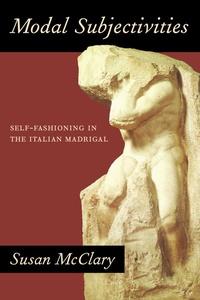
Modal Subjectivities
Self-Fashioning in the Italian Madrigal
1st Edition
Will be published approx. on 13. December 2004
Book
Hardback
386 pages
978-0-520-23493-2 (ISBN)
Description
In this boldly innovative book, renowned musicologist Susan McClary presents an illuminating cultural interpretation of the Italian madrigal, one of the most influential repertories of the Renaissance. A genre that sought to produce simulations in sound of complex interiorities, the madrigal introduced into music a vast range of new signifying practices: musical representations of emotions, desire, gender stereotypes, reason, madness, tensions between mind and body, and much more. In doing so, it not only greatly expanded the expressive agendas of European music but also recorded certain assumptions of the time concerning selfhood, making it an invaluable resource for understanding the history of Western subjectivity. Modal Subjectivities covers the span of the sixteenth-century polyphonic madrigal, from its early manifestations in Philippe Verdelot's settings of Machiavelli in the 1520s through the tortured chromatic experiments of Carlo Gesualdo. Although McClary takes the lyrics into account in shaping her readings, she focuses particularly on the details of the music itself - the principal site of the genre's self-fashionings.
In order to work effectively with musical meanings in this pretonal repertory, she also develops an analytical method that allows her to unravel the sophisticated allegorical structures characteristic of the madrigal. This pathbreaking book demonstrates how we might glean insights into a culture on the basis of its nonverbal artistic enterprises.
In order to work effectively with musical meanings in this pretonal repertory, she also develops an analytical method that allows her to unravel the sophisticated allegorical structures characteristic of the madrigal. This pathbreaking book demonstrates how we might glean insights into a culture on the basis of its nonverbal artistic enterprises.
Reviews / Votes
"This revelatory book distills thirty years of reflection on the sixteenth-century madrigal with an inimitable mixture of empathy, vivacity, conceptual boldness, and downright wisdom. Susan McClary renovates our understanding of the genre in the most fundamental terms and in the process rewrites a key chapter in the history of early modern culture. McClary gives us a different sixteenth-century Europe than the one we thought we knew. By asking what we can learn about the era from its music, and not just the other way around, she unveils a world of luxuriant introspection and complex self-division that we can actually learn to hear in the body of music for which she is now our most eloquent advocate." - Lawrence Kramer, author of Musical Meaning"More details
Edition
First Edition
Language
English
Place of publication
Berkerley
United States
Target group
Professional and scholarly
Product notice
Cloth over boards
Illustrations
75 music examples
Dimensions
Height: 229 mm
Width: 152 mm
Thickness: 30 mm
Weight
680 gr
ISBN-13
978-0-520-23493-2 (9780520234932)
Copyright in bibliographic data and cover images is held by Nielsen Book Services Limited or by the publishers or by their respective licensors: all rights reserved.
Schweitzer Classification
Other editions
Additional editions
Book
09/2019
1st Edition
University of California Press
€42.50
Shipment within 10-20 days
E-Book
12/2004
1st Edition
Naval Institute Press
€38.99
Available for download
Person
Susan McClary is Professor of Musicology at the University of California, Los Angeles. She is the author of Feminine Endings: Music, Gender, and Sexuality (2002), Conventional Wisdom: The Content of Musical Form (California, 2000), and Georges Bizet: Carmen (1992).
Content
List of Examples Acknowledgments 1 Introduction: The Cultural Work of the Madrigal 2 Night and Deceit: Verdelot's Machiavelli 3 The Desiring Subject, or Subject to Desire: Arcadelt 4 Radical Inwardness: Willaert's Musica nova 5 The Prisonhouse of Mode: Cipriano de Rore 6 The Coney Island of the Madrigal: Wert and Marenzio 7 The Luxury of Solipsism: Gesualdo 8 The Mirtillo/Amarilli Controversy: Monteverdi 9 I modi Appendix: Examples Index