

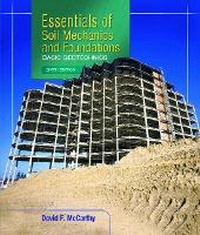
Essentials of Soil Mechanics and Foundations
Basic Geotechnics
6th Edition
Published on 5. July 2001
Book
Hardback
788 pages
978-0-13-030383-7 (ISBN)
Description
For undergraduate courses in Civil Engineering Technology and Civil Technology, Environmental Engineering, Construction Management, Architectural Engineering and all other applications-oriented engineering courses in Soil Mechanics/Foundations, Soils Engineering, and Geotechnical Engineering.
Written by an experienced professor/practitioner, this popular introductory book provides coverage on a broad range of state-of-the-art geotechnics material accepted and used by today's engineering professionals. Easy to understand and loaded with illustrative examples, it explores everything from the most basic of concepts to the latest developments, giving students a real-life working knowledge of soil mechanics and foundations. The philosophy and logic of soils and foundations is discussed in practical terms to enhance understanding, and a presentation of design charts, tables, and equations-utilized by today's practitioners-encompasses not just the nuts and bolts, but explicit instructions and applications as well.
Written by an experienced professor/practitioner, this popular introductory book provides coverage on a broad range of state-of-the-art geotechnics material accepted and used by today's engineering professionals. Easy to understand and loaded with illustrative examples, it explores everything from the most basic of concepts to the latest developments, giving students a real-life working knowledge of soil mechanics and foundations. The philosophy and logic of soils and foundations is discussed in practical terms to enhance understanding, and a presentation of design charts, tables, and equations-utilized by today's practitioners-encompasses not just the nuts and bolts, but explicit instructions and applications as well.
Reviews / Votes
"Well presented, highly readable with understandable discussions and examples." -- Charles A. Matrosic, PE, Ferris State UniversityMore details
Edition
6th edition
Language
English
Place of publication
United States
Publishing group
Pearson Education (US)
Target group
Professional and scholarly
Dimensions
Width: 240 mm
Thickness: 34 mm
Weight
1373 gr
ISBN-13
978-0-13-030383-7 (9780130303837)
Copyright in bibliographic data and cover images is held by Nielsen Book Services Limited or by the publishers or by their respective licensors: all rights reserved.
Schweitzer Classification
Other editions
New editions
Book
10/2006
7th Edition
Pearson
€134.77
Article is exhausted; no reprint
Previous edition

Book
11/1997
5th Edition
Pearson
€44.56
Article exhausted; check for reprint
Content
I. BACKGROUND AND BASICS.
1. The Soil and Rock of Planet Earth: Geologic Overview.
2. Soil Composition: Terminology and Definitions.
3. Soil Types and Soil Structure.
4. Index Properties and Classification Tests, and Soil Classification Systems.
5. Site Investigations: Purpose and Methods, Information and Procedures Available.
II. ENGINEERING PROPERTIES AND BEHAVIOR OF SOIL DEPOSITS.
6. Movement of Water through Soil: Basic Hydrogeology, Subsurface Flow, Permeability, Capillarity.
7. Movement of Water through Soil: Practical Effects: Seepage, Drainage, Frost Heave, Contamination.
8. Combined Stresses in Soil Masses: Stress at a Point and Mohr's Circle.
9. Subsurface Stresses.
10. Settlement: Soil Compression, Volume Distortion, Consolidation.
11. Shear Strength Theory.
III. APPLICATION OF SOIL MECHANICS THEORIES.
12. Foundations: Introductory Concepts.
13. Foundations: Design Considerations and Methods.
14. Site Improvement: Earth Moving, Compaction, and Stabilization.
15. Stability of Unsupported Slopes.
16. Lateral Pressures and Retaining Structures.
Appendix A. Application of LaPlace Equation to Flow Nets.
Appendix B. Laboratory Procedure to Determine Coefficient of Consolidation.
Appendix C. Mathematical Development of the Bishop Equation for Slope Stability.
Bibliography.
Answers to Selected Problems.
Index.
1. The Soil and Rock of Planet Earth: Geologic Overview.
2. Soil Composition: Terminology and Definitions.
3. Soil Types and Soil Structure.
4. Index Properties and Classification Tests, and Soil Classification Systems.
5. Site Investigations: Purpose and Methods, Information and Procedures Available.
II. ENGINEERING PROPERTIES AND BEHAVIOR OF SOIL DEPOSITS.
6. Movement of Water through Soil: Basic Hydrogeology, Subsurface Flow, Permeability, Capillarity.
7. Movement of Water through Soil: Practical Effects: Seepage, Drainage, Frost Heave, Contamination.
8. Combined Stresses in Soil Masses: Stress at a Point and Mohr's Circle.
9. Subsurface Stresses.
10. Settlement: Soil Compression, Volume Distortion, Consolidation.
11. Shear Strength Theory.
III. APPLICATION OF SOIL MECHANICS THEORIES.
12. Foundations: Introductory Concepts.
13. Foundations: Design Considerations and Methods.
14. Site Improvement: Earth Moving, Compaction, and Stabilization.
15. Stability of Unsupported Slopes.
16. Lateral Pressures and Retaining Structures.
Appendix A. Application of LaPlace Equation to Flow Nets.
Appendix B. Laboratory Procedure to Determine Coefficient of Consolidation.
Appendix C. Mathematical Development of the Bishop Equation for Slope Stability.
Bibliography.
Answers to Selected Problems.
Index.