

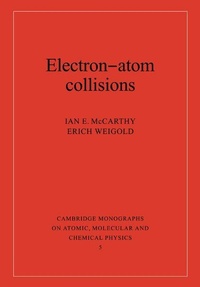
Electron-Atom Collisions
Published on 15. September 2005
Book
Paperback/Softback
344 pages
978-0-521-01968-2 (ISBN)
Description
This book is a comprehensive introduction to electron-atom collisions, covering both theory and experiment. The interaction of electrons with atoms is the field that most deeply probes both the structure and reaction dynamics of a many-body system. The book begins with a short account of experimental techniques of cross-section measurement. It then introduces the essential quantum mechanics background needed. The following chapters cover one-electron problems (from the classic particle in a box to a relativistic electron in a central potential), the theory of atomic bound states, formal scattering theory, calculation of scattering amplitudes, spin-independent and spin-dependent scattering observables, ionisation and electron momentum spectroscopy. The connections between experimental and theoretical developments are emphasised throughout.
More details
Series
Language
English
Place of publication
Cambridge
United Kingdom
Target group
Professional and scholarly
Product notice
Paperback (trade)
Illustrations
21 Tables, unspecified; 90 Line drawings, unspecified
Dimensions
Height: 244 mm
Width: 170 mm
Thickness: 19 mm
Weight
595 gr
ISBN-13
978-0-521-01968-2 (9780521019682)
Copyright in bibliographic data and cover images is held by Nielsen Book Services Limited or by the publishers or by their respective licensors: all rights reserved.
Schweitzer Classification
Other editions
Additional editions
Ian E. McCarthy | Erich Weigold
Electron-Atom Collisions
Book
03/1995
Cambridge University Press
€80.47
Article exhausted; check for reprint
Previous edition
Ian E. McCarthy | Erich Weigold
Electron-Atom Collisions
Book
03/1995
Cambridge University Press
€80.47
Article exhausted; check for reprint
Persons
Content
Preface; 1. Introduction; 2. Experimental techniques for cross-section measurements; 3. Background quantum mechanics in the atomic context; 4. One-electron problems; 5. Theory of atomic bound states; 6. Formal scattering theory; 7. Calculation of scattering amplitudes; 8. Spin-independent scattering observables; 9. Spin-dependent scattering observables; 10. Ionisation; 11. Electron momentum spectroscopy; References; Index.