

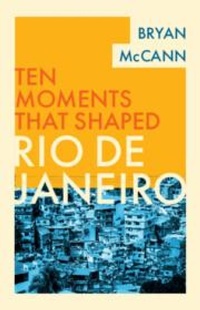
Rio de Janeiro
Published on 19. June 2025
Book
Hardback
325 pages
978-1-316-51544-0 (ISBN)
Description
What do nineteenth-century fiction, early twentieth-century popular music, 1930s soccer, 1950s film comedy, 1960s experimental art and 1970s soap operas have in common with one another? Each reveal the deep patterns structuring social and cultural life in Rio de Janeiro. Bringing a fresh perspective to one of the most visited cities in South America, Bryan McCann explores each manifestation in turn, mining their depths and drawing connections between artistic movements and political and economic transitions. The book explores the centrality of slavery to every aspect of life in nineteenth century Rio and its long legacy through to the current day, illuminating both the city's grinding inequality and violence, as well as its triumphant cultural expressions. Rio de Janeiro is a unique and fascinating city, and through ten pivotal moments, McCann reveals its boundless creativity and contradictions, and shows how it has been continually remade by newcomers, strivers, and tricksters.
Reviews / Votes
'A lucid tour de force, full of illuminating detours. This brilliant book captures the multi-faceted city for newcomers and invites seasoned experts to rediscover it.' Bruno Carvalho, author of Porous City: A Cultural History of Rio de Janeiro 'Lyrically written, creatively conceived, and bound to fascinate readers at every level of familiarity with Rio, the book draws together ten moments that range from the recent and well-known to less visible moments from the more distant past.' Benjamin A. Cowan, author of Moral Majorities across the Americas: Brazil, the United States, and the Creation of the Religious Right 'A Black city torn between formality and informality, Rio de Janeiro is a vivid portrait of its cultural history. Through McCann's compelling book, one can understand why Rio has for centuries reinvented itself at every corner.' Pedro Meira Monteiro, Arthur W. Marks '19 Professor of Spanish and Portuguese, Princeton University 'Part of Cambridge's Ten Moments That Shaped series, McCann's contribution on Rio de Janeiro is a delightful, accessible, and unique work on Brazil ... he provides a clear narrative that will be easily accessible to those new to Brazilian history while simultaneously providing original analysis and insights that will appeal to seasoned scholars of Brazil. His wide-ranging approach and events will interest not just historians but scholars of literature, art, music, cultural studies, sociology, and more ... Highly recommended.' C. M. Snider, ChoiceMore details
Series
Language
English
Place of publication
Cambridge
United Kingdom
Product notice
sewn/stitched
Cloth over boards
Illustrations
Worked examples or Exercises
Dimensions
Height: 205 mm
Width: 152 mm
Thickness: 24 mm
Weight
522 gr
ISBN-13
978-1-316-51544-0 (9781316515440)
Copyright in bibliographic data and cover images is held by Nielsen Book Services Limited or by the publishers or by their respective licensors: all rights reserved.
Schweitzer Classification
Other editions
Additional editions
Person
Bryan McCann is a leading social and cultural historian of Brazil. He is the author of several books about the history of Brazil and Rio de Janeiro in particular, including Hello, Hello Brazil: Popular Music in the Making of Modern Brazil (2004) and Hard Times in the Marvelous City: From Dictatorship to Democracy in the Favelas of Rio de Janeiro (2014). He is Professor and Chair of the Department of History at Georgetown University.
Content
Introduction; 1. Jean-Baptiste Debret in the streets of Rio (1826); 2. Capoeira and Machado de Assis (1862); 3. Chiquinha Gonzaga's 'Corta-jaca' (1895); 4. Flamengo, Fluminense and the best-of-three championship (1936); 5. Warning to sailors and chanchada film comedy (1950); 6. Inside out: Lygia Clark and Clarice Lispector (1960); 7. Favela removal and state-sponsored gentrification (1969); 8. Pavao-Pavaozinho, Leonel Brizola and favela upgrading (1983); 9. Moving the Feira de Sao Cristovao (2003); 10. Marielle Franco Street (2018); Epilogue; Acknowledgments; Note on sources; Further reading; Index.