

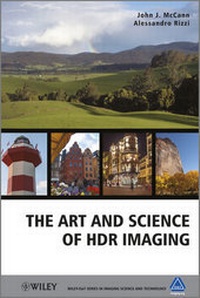
The Art and Science of HDR Imaging
Published on 4. November 2011
Book
Hardback
416 pages
978-0-470-66622-7 (ISBN)
Description
Rendering High Dynamic Range (HDR) scenes on media with limited dynamic range began in the Renaissance whereby painters, then photographers, learned to use low-range spatial techniques to synthesize appearances, rather than to reproduce accurately the light from scenes. The Art and Science of HDR Imaging presents a unique scientific HDR approach derived from artists' understanding of painting, emphasizing spatial information in electronic imaging.
Human visual appearance and reproduction rendition of the HDR world requires spatial-image processing to overcome the veiling glare limits of optical imaging, in eyes and in cameras. Illustrated in full colour throughout, including examples of fine-art paintings, HDR photography, and multiple exposure scenes; this book uses techniques to study the HDR properties of entire scenes, and measures the range of light of scenes and the range that cameras capture. It describes how electronic image processing has been used to render HDR scenes since 1967, and examines the great variety of HDR algorithms used today. Showing how spatial processes can mimic vision, and render scenes as artists do, the book also:
* Gives the history of HDR from artists' spatial techniques to scientific image processing
* Measures and describes the limits of HDR scenes, HDR camera images, and the range of HDR appearances
* Offers a unique review of the entire family of Retinex image processing algorithms
* Describes the considerable overlap of HDR and Color Constancy: two sides of the same coin
* Explains the advantages of algorithms that replicate human vision in the processing of HDR scenes
* Provides extensive data to test algorithms and models of vision on an accompanying website
www.wiley.com/go/mccannhdr
Reviews / Votes
"Overall, this book provides an excellent overview of the history of imaging, HDR imaging algorithms, and the abilities of the human visual system. The book is a great achievement for the authors, and it will be well appreciated by anyone who enjoys learning about a field from the key players. Most importantly, it will encourage the reader to think about how visual processing works, and how that process can serve as a model for imaging systems for HDR images." (Journal of Electronic Imaging, 1 September 2012)More details
Product info
gebunden
Series
Edition
1. Auflage
Language
English
Place of publication
New York
United States
Target group
Professional and scholarly
Product notice
sewn/stitched
Paper over boards
Dimensions
Height: 252 mm
Width: 174 mm
Thickness: 25 mm
Weight
928 gr
ISBN-13
978-0-470-66622-7 (9780470666227)
Schweitzer Classification
Other editions
Additional editions
John J. McCann | Alessandro Rizzi
The Art and Science of HDR Imaging
E-Book
10/2011
Wiley
€106.99
Available for download
John J. McCann | Alessandro Rizzi
The Art and Science of HDR Imaging
E-Book
09/2011
Wiley
€106.99
Available for download
Persons
John J. McCann, Consultant, McCann Imaging, USA
John McCann received a B.A. degree in Biology from Harvard University in 1964. He worked in, and later managed, the Vision Research Laboratory at Polaroid from 1961 to 1996. He has studied human color vision, digital image processing, large format instant photography and the reproduction of fine art. His 120 publications have studied Retinex theory, color from rod/Lcone interactions at low light levels, appearance with scattered light, and HDR imaging.
He has been a Fellow of the Society of Imaging Science and Technology (IS&T) since 1983. He is a past President of IS&T and the Artists Foundation, Boston. In 1996 he received the SID Certificate of Commendation. He is the IS&T/OSA 2002 Edwin H. Land Medalist, and IS&T 2005 Honorary Member, and is a 2008 Fellow of the Optical Society of America. He is currently consulting and continuing his research on color vision.
Alessandro Rizzi, Universita degli Studi di Milano, Italy
Professor Alessandro Rizzi holds a degree in Computer Science at University of Milano and received a PhD in Information Engineering at University of Brescia (Italy). He taught Information Systems and Computer Graphics at University of Brescia and at Politecnico di Milano. He is currently an assistant professor teaching Multimedia and Human-Computer Interaction, and senior research fellow at the Department of Information Technologies at University of Milano. Since 1990 he has researched in the field of digital imaging and vision. His main research topic is the use of color information in digital images with particular attention to color perception mechanisms. He is the coordinator of the Italian Color Group
Conference Chair of Color Conference at IS&T/SPIE Electronic Imaging, and a principle organizer of European Marie Curie Project CREATE.
John McCann received a B.A. degree in Biology from Harvard University in 1964. He worked in, and later managed, the Vision Research Laboratory at Polaroid from 1961 to 1996. He has studied human color vision, digital image processing, large format instant photography and the reproduction of fine art. His 120 publications have studied Retinex theory, color from rod/Lcone interactions at low light levels, appearance with scattered light, and HDR imaging.
He has been a Fellow of the Society of Imaging Science and Technology (IS&T) since 1983. He is a past President of IS&T and the Artists Foundation, Boston. In 1996 he received the SID Certificate of Commendation. He is the IS&T/OSA 2002 Edwin H. Land Medalist, and IS&T 2005 Honorary Member, and is a 2008 Fellow of the Optical Society of America. He is currently consulting and continuing his research on color vision.
Alessandro Rizzi, Universita degli Studi di Milano, Italy
Professor Alessandro Rizzi holds a degree in Computer Science at University of Milano and received a PhD in Information Engineering at University of Brescia (Italy). He taught Information Systems and Computer Graphics at University of Brescia and at Politecnico di Milano. He is currently an assistant professor teaching Multimedia and Human-Computer Interaction, and senior research fellow at the Department of Information Technologies at University of Milano. Since 1990 he has researched in the field of digital imaging and vision. His main research topic is the use of color information in digital images with particular attention to color perception mechanisms. He is the coordinator of the Italian Color Group
Conference Chair of Color Conference at IS&T/SPIE Electronic Imaging, and a principle organizer of European Marie Curie Project CREATE.
Content
About the Authors xix
Preface xxi
Series Preface xxiii
Acknowledgements xxv
Section A HISTORY OF HDR IMAGING 1
1 HDR Imaging 3
2 HDR Tools and Defi nitions 13
3 HDR in Natural Scenes 27
4 HDR in Painting 33
5 HDR in Film Photography 45
6 The Ansel Adams Zone System 59
7 Electronic HDR Image Processing: Analog and Digital 69
8 HDR and the World of Computer Graphics 77
9 Review of HDR History 83
Section B MEASURED DYNAMIC RANGES 89
10 Actual Dynamic Ranges 91
11 Limits of HDR Scene Capture 99
12 Limits of HDR in Humans 113
13 Why Does HDR Improve Images? 119
Section C SEPARATING GLARE AND CONTRAST 123
14 Two Counteracting Mechanisms: Glare and Contrast 125
15 Measuring the Range of HDR Appearances 135
16 Calculating the Retinal Image 145
17 Visualizing HDR Images 153
18 HDR and Uniform Color Spaces 161
19 Glare: A Major Part of Vision Theory 169
Section D SCENE CONTENT CONTROLS APPEARANCE 173
20 Scene Dependent Appearance of Quanta Catch 175
21 Illumination, Constancy and Surround 179
22 Maximum's Enclosure and Separation 193
23 Maxima Size and Distribution 201
24 From Contrast to Assimilation 209
25 Maxima and Contrast with Maxima 217
Section E COLOR HDR 221
26 HDR, Constancy and Spatial Content 223
27 Color Mondrians 227
28 Constancy's On/Off Switch 247
29 HDR and 3-D Mondrians 257
30 Color Constancy is HDR 273
Section F HDR IMAGE PROCESSING 283
31 HDR Pixel and Spatial Algorithms 285
32 Retinex Algorithms 293
33 ACE Algorithms 341
34 Analytical, Computational and Variational Algorithms 353
35 Evaluation of HDR Algorithms 359
36 The HDR Story 373
Glossary 377
Author Index 385
Subject Index 387