

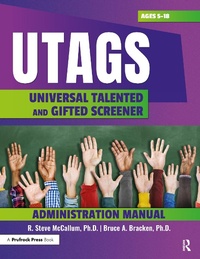
UTAGS Administration Manual
1st Edition
Published on 1. September 2018
Book
Paperback/Softback
106 pages
978-1-61821-834-6 (ISBN)
Description
This is the technical manual for the Universal Talented and Gifted Screener.
Universal Talented and Gifted Screener (UTAGS)
features up-to-date national norms,
is effective with twice-exceptional learners,
includes bias-free items, and
provides a fair assessment regardless of student demographic characteristics.
The UTAGS offers schools a time-saving screener for identifying gifted and advanced learners. Designed to be culturally and linguistically fair, the UTAGS is ideal for schools seeking a nationally normed, statistically sound identification screener. Additionally, the UTAGS includes specific considerations for identifying twice-exceptional learners.
UTAGS is designed to screen potentially gifted students in six important areas of school success:
cognition,
creativity,
leadership,
literacy,
math, and
science.
This theoretically sound instrument provides easily interpretable scores in the IQ metric (i.e., Mean = 100; SD = 15) and identifies student strengths/weaknesses in a quick, accurate, and cost-efficient format. UTAGS provides interpretation norms based on a standardization sample of 2,492 participants from 22 states; student demographics closely reflect the United States population.
The authors also provide a guide for local norming. Assessment fairness was a strong consideration during the UTAGS development, and teacher raters are requested to focus on effective examinee communication strategies rather than addressing the particular language/communication mode employed by the student. Consequently, examinees from other cultures, those who have speech limitations, or those who use nonstandard English are not unfairly penalized.
Ages 5 years 0 months-17 years 11 months
Universal Talented and Gifted Screener (UTAGS)
features up-to-date national norms,
is effective with twice-exceptional learners,
includes bias-free items, and
provides a fair assessment regardless of student demographic characteristics.
The UTAGS offers schools a time-saving screener for identifying gifted and advanced learners. Designed to be culturally and linguistically fair, the UTAGS is ideal for schools seeking a nationally normed, statistically sound identification screener. Additionally, the UTAGS includes specific considerations for identifying twice-exceptional learners.
UTAGS is designed to screen potentially gifted students in six important areas of school success:
cognition,
creativity,
leadership,
literacy,
math, and
science.
This theoretically sound instrument provides easily interpretable scores in the IQ metric (i.e., Mean = 100; SD = 15) and identifies student strengths/weaknesses in a quick, accurate, and cost-efficient format. UTAGS provides interpretation norms based on a standardization sample of 2,492 participants from 22 states; student demographics closely reflect the United States population.
The authors also provide a guide for local norming. Assessment fairness was a strong consideration during the UTAGS development, and teacher raters are requested to focus on effective examinee communication strategies rather than addressing the particular language/communication mode employed by the student. Consequently, examinees from other cultures, those who have speech limitations, or those who use nonstandard English are not unfairly penalized.
Ages 5 years 0 months-17 years 11 months
More details
Language
English
Place of publication
Oxford
United States
Publishing group
Taylor & Francis Inc
Target group
Professional and scholarly
Professional Practice & Development
Product notice
Paperback (trade)
Unsewn / adhesive bound
Dimensions
Height: 276 mm
Width: 219 mm
Weight
280 gr
ISBN-13
978-1-61821-834-6 (9781618218346)
Copyright in bibliographic data and cover images is held by Nielsen Book Services Limited or by the publishers or by their respective licensors: all rights reserved.
Schweitzer Classification
Other editions
Additional editions
M. Steve McCallum | Bruce Bracken
UTAGS Administration Manual
E-Book
05/2023
1st Edition
Routledge
€108.99
Available for download
M. Steve McCallum | Bruce Bracken
UTAGS Administration Manual
E-Book
05/2023
1st Edition
Routledge
€108.99
Available for download
Persons
R. Steve McCallum, Ph.D., professor at the University of Tennessee, has authored numerous books, book chapters, journal articles, tests, and national/international conference presentations. He is cofounder and consulting editor of the Journal of Psychoeducational Assessment, is a Fellow of the American Psychological Association, and has been the recipient of numerous awards, including the Distinguished Alumnus Award from the University of Georgia, and Chancellor's Research and Creative Achievement Award from the University of Tennessee, among others.
Bruce A. Bracken, Ph.D., professor at William & Mary, has authored numerous articles, books, tests, and related materials. A Fellow of the American Psychological Association and a Charter Fellow of the AERA, Bruce received a Senior Scientist award from the APA and Lifetime Achievement Award from the University of Georgia.
Bruce A. Bracken, Ph.D., professor at William & Mary, has authored numerous articles, books, tests, and related materials. A Fellow of the American Psychological Association and a Charter Fellow of the AERA, Bruce received a Senior Scientist award from the APA and Lifetime Achievement Award from the University of Georgia.
Content
Chapter 1: Introduction to the Universal Talented and Gifted Screener (UTAGS) Rationale for the UTAGS Description of the UTAGS Uses of the UTAGS Examinee Qualifications Examiner Qualifications Rater Qualifications Chapter 2: Administering, Scoring, and Interpreting the UTAGS Information to Consider Before Using the UTAGS Administering and Scoring the UTAGS Completing the Record Booklet Normative Scores and Their Interpretation Identifying Gifted and At-Risk Students Conducting Intratest Discrepancy Analyses Advocating for Screening and Identifying Twice-Exceptional Students Using the UTAGS Chapter 3: Normative Information Rationale for the Sample Sample Selection Demographic Characteristics of the Sample Stratification of Sample Chapter 4: UTAGS Reliability Internal Consistency Stability Scorer Consistency Conclusions Chapter 5: Validity of UTAGS Results Content-Description Validity Criterion-Prediction Validity Construct-Identification Validity Conclusions Chapter 6: Fairness Test Theory and Fairness Internal Test Characteristics Empirical Evidence of Fairness Considerations for Culturally/Linguistically Fair(er) Assessment Conclusions Chapter 7: Local Norming Two Models Establishing Percentile Ranks Estimating Local Exceptionality Incidence Rates Creating Cut Scores Applying Cut Scores Screening Accuracy Conclusions References Appendix A: Converting Subscale Raw Scores to Percentile Ranks Appendix B: Converting Subscale Raw Scores to Index Scores Appendix C: Converting Sums of Index Scores to General Aptitude Index and Percentile Rank Appendix D: Professional Diagnostic Report for Fictional Case Demarcus About the Authors