

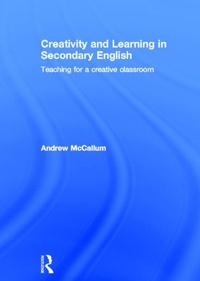
Creativity and Learning in Secondary English
Teaching for a creative classroom
1st Edition
Published on 19. March 2012
Book
Hardback
176 pages
978-0-415-62069-7 (ISBN)
Description
Creativity in secondary English lessons today is a democratically conceived quality that all pupils are expected to achieve and a resource on which all are entitled to draw. But what exactly is creativity? And how does it relate to English? Creativity and Learning in Secondary English answers these questions, and others, by arguing for a version of creativity that sees it as an ordinary, everyday part of successful classroom practice, central to processes of meaning-making, dialogic interaction and textual engagement. In this construction, creativity is not just linked to learning; it is the driving force behind learning itself, offering pupils the opportunity to transform their knowledge and understanding of the world around them.
This book borrows from a range of theories about creativity and about learning, while remaining largely practical in focus. It contains numerous examples for teachers of how to apply ideas about creativity in the classroom. In doing so, it attempts to maintain the subject's core identity while also keeping abreast of contemporary social, pedagogical and technological developments. The result is a refreshing challenge to some of the more mundane approaches to English teaching on offer in an age focussed excessively on standardisation and teaching to tests.
Practical applications of creativity include:
Using picture books and graphic novels to stimulate multimodal responses
Placing pupils in the role of the teacher
Devising marketing campaigns for class novels
Adopting experimental approaches to redrafting
Encouraging 'extreme' forms of re-creative writing
Focusing on how to 'listen' to texts
Creating sound-scapes for poems
Thought-provoking and provocative, this textbook draws on current best practice in English teaching and will equip trainee and practising teachers with a wide range of strategies that will lead to greater creativity in the classroom.
This book borrows from a range of theories about creativity and about learning, while remaining largely practical in focus. It contains numerous examples for teachers of how to apply ideas about creativity in the classroom. In doing so, it attempts to maintain the subject's core identity while also keeping abreast of contemporary social, pedagogical and technological developments. The result is a refreshing challenge to some of the more mundane approaches to English teaching on offer in an age focussed excessively on standardisation and teaching to tests.
Practical applications of creativity include:
Using picture books and graphic novels to stimulate multimodal responses
Placing pupils in the role of the teacher
Devising marketing campaigns for class novels
Adopting experimental approaches to redrafting
Encouraging 'extreme' forms of re-creative writing
Focusing on how to 'listen' to texts
Creating sound-scapes for poems
Thought-provoking and provocative, this textbook draws on current best practice in English teaching and will equip trainee and practising teachers with a wide range of strategies that will lead to greater creativity in the classroom.
More details
Language
English
Place of publication
London
United Kingdom
Publishing group
Taylor & Francis Ltd
Target group
College/higher education
Professional and scholarly
Postgraduate and Professional
Illustrations
8 s/w Photographien bzw. Rasterbilder
8 Halftones, black and white
Dimensions
Height: 246 mm
Width: 174 mm
Weight
380 gr
ISBN-13
978-0-415-62069-7 (9780415620697)
Copyright in bibliographic data and cover images is held by Nielsen Book Services Limited or by the publishers or by their respective licensors: all rights reserved.
Schweitzer Classification
Other editions
Additional editions
E-Book
05/2012
1st Edition
Routledge
€52.49
Available for download
E-Book
05/2012
1st Edition
Routledge
€52.49
Available for download
Book
03/2012
1st Edition
Routledge
€59.80
Shipment within 15-20 days
Person
Andrew McCallum is Senior Lecturer in Education and Course Leader for Secondary English with Media and Drama at London Metropolitan University.
Content
Introduction
Section One
1. English and creativity: a brief history
2. Theories of creativity, English and learning
Section Two
3. Creativity, English and modality
4. Creativity as re-creativity
5. Creativity and the class novel
6. Listening, reading and creativity
7. Speaking, writing and creativity
8. Critical-creativity
9. Creativity and culture
Conclusion
10. Creativity and not learning
References
Section One
1. English and creativity: a brief history
2. Theories of creativity, English and learning
Section Two
3. Creativity, English and modality
4. Creativity as re-creativity
5. Creativity and the class novel
6. Listening, reading and creativity
7. Speaking, writing and creativity
8. Critical-creativity
9. Creativity and culture
Conclusion
10. Creativity and not learning
References