

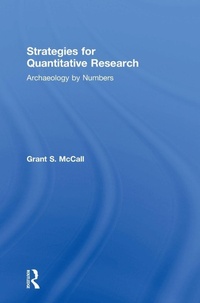
Strategies for Quantitative Research
Archaeology by Numbers
1st Edition
Published on 13. February 2018
Book
Hardback
224 pages
978-1-138-63253-0 (ISBN)
Description
It is little secret that most archaeologists are uneasy with statistics. Thankfully, in the modern world, quantitative analysis has been made immensely easier by statistical software packages. Software now does virtually all our statistical calculations, removing a great burden for researchers. At the same time, since most statistical analysis now takes place through the pushing of buttons in software packages, new problems and dangers have emerged. How does one know which statistical test to use? How can one tell if certain data violate the assumptions of a particular statistical analysis?
Rather than focusing on the mathematics of calculation, this concise handbook selects appropriate forms of analysis and explains the assumptions that underlie them. It deals with fundamental issues, such as what kinds of data are common in the field of archaeology and what are the goals of various forms of analysis.
This accessible textbook lends a refreshing playfulness to an often-humorless subject and will be enjoyed by students and professionals alike.
Rather than focusing on the mathematics of calculation, this concise handbook selects appropriate forms of analysis and explains the assumptions that underlie them. It deals with fundamental issues, such as what kinds of data are common in the field of archaeology and what are the goals of various forms of analysis.
This accessible textbook lends a refreshing playfulness to an often-humorless subject and will be enjoyed by students and professionals alike.
More details
Language
English
Place of publication
London
United Kingdom
Publishing group
Taylor & Francis Ltd
Target group
College/higher education
Professional and scholarly
Illustrations
1 s/w Photographie bzw. Rasterbild, 55 s/w Zeichnungen, 43 s/w Tabellen
43 Tables, black and white; 55 Line drawings, black and white; 1 Halftones, black and white
Dimensions
Height: 250 mm
Width: 175 mm
Thickness: 18 mm
Weight
610 gr
ISBN-13
978-1-138-63253-0 (9781138632530)
Copyright in bibliographic data and cover images is held by Nielsen Book Services Limited or by the publishers or by their respective licensors: all rights reserved.
Schweitzer Classification
Other editions
Additional editions
Book
02/2018
1st Edition
Routledge
€68.34
Shipment within 10-20 days
E-Book
02/2018
1st Edition
Routledge
€53.99
Available for download
E-Book
02/2018
Routledge
€53.99
Available for download
Person
Grant S. McCall is the Executive Director of the Center for Human-Environmental Research and Associate Professor of Anthropology at Tulane University. He is also the author of Before Modern Humans: New Perspectives on the African Stone Age and (with Karl Widerquist) Prehistoric Myths in Modern Political Philosophy.
Content
List of Figures
List of Tables
List of Boxes
List of Formula
Preface
Chapter 1: Introduction: How Does Quantitative Analysis Fit Into Archaeological Research?
Chapter 2: Basics: Knowing Your Data
Chapter 3: Preparing Your Data: Aggregation, Standardization, and Transformation
Chapter 4: Numerical and Graphical Approaches to Summarizing Your Data
Chapter 5: Basic Approaches for Statistical Hypothesis Testing Using Univariate Data
Chapter 6: Bivariate Analysis: Linear Regression and Correlation
Chapter 7: Multivariate Techniques for Data Reduction and Pattern Recognition
Chapter 8: Multivariate Approaches to Statistical Hypothesis Testing
Chapter 9: Clustering and Discrimination: Grouping Data According to Similarity
Chapter 10: Conclusion: Numerical Facts in the World of Archaeological Ambiguity
List of Tables
List of Boxes
List of Formula
Preface
Chapter 1: Introduction: How Does Quantitative Analysis Fit Into Archaeological Research?
Chapter 2: Basics: Knowing Your Data
Chapter 3: Preparing Your Data: Aggregation, Standardization, and Transformation
Chapter 4: Numerical and Graphical Approaches to Summarizing Your Data
Chapter 5: Basic Approaches for Statistical Hypothesis Testing Using Univariate Data
Chapter 6: Bivariate Analysis: Linear Regression and Correlation
Chapter 7: Multivariate Techniques for Data Reduction and Pattern Recognition
Chapter 8: Multivariate Approaches to Statistical Hypothesis Testing
Chapter 9: Clustering and Discrimination: Grouping Data According to Similarity
Chapter 10: Conclusion: Numerical Facts in the World of Archaeological Ambiguity