

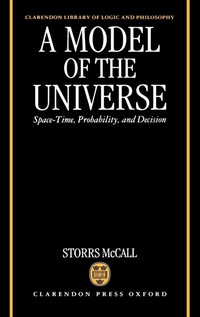
A Model of the Universe
Space-Time, Probability, and Decision
Published on 3. February 1994
Book
Hardback
338 pages
978-0-19-824053-2 (ISBN)
Description
Storrs McCall presents an original philosophical theory of the nature of the universe based on a striking new model of its space-time structure. He shows that this theory can illuminate a wide variety of hitherto unresolved philosophical problems. These include: the direction and flow of time; the nature of scientific laws; the interpretation of quantum mechanics; the definition of probability; counterfactual semantics; and the notions of identity, essential properties, deliberation, decision, and free will. A particular instance of the explanatory powers of the proposed space-time model is its account of quantum non-locality in the EPR and GHZ experiments.
Professor McCall argues that the fact that the model explains and throws light on such a broad range of problems constitutes strong evidence that the universe is as the model portrays it.
Professor McCall argues that the fact that the model explains and throws light on such a broad range of problems constitutes strong evidence that the universe is as the model portrays it.
Reviews / Votes
This wide-ranging book is McCall's most complete elaboration and defense of his long-held branching model of the universe, according to which the past and present of the universe at any time consists of a single space-time manifold (represented as the trunk of a tree) while the future at that time consists of a multiplicity of space-time manifolds (represented as the tree's branches) ... McCall's defense of his thesis is elegantly and concisely written, clear in its organization and development, and impressive in its scope * William Lane Craig, International Philosophical Quarterly * `McCall's candour and integrity as an arguer are not less impressive and engaging than his ingenuity and tenacity. His book abounds with fresh theories and perspectives ... McCall's novel treatment of free choice .. is scholarly and inventive.'Times Literary Supplement 'presents the most coherent and fully worked-out account of the universe that takes seriously indeterminism and the dynamic nature of time ... McCall's branching-tree model is the best altnerative version yet to be produced, and will occasion mcuh discussion and dispute in metaphysics and the philosophy of logic ... his discussion of quantum mechanics is well-informed and illuminating ... McCall has managed to put forward in a clear, well-argued and accessible form a vision of the world which accords with quantum mechanics and does justice to many of our deepest intuitions, and within that setting has acounted for many other fundamental concepts - cause, identity and choice, among others - in a stimulating and illuminating way. It is a must for every philosophical library, and any philosopher who is serious about metaphysics or interested in contemporary topics in philosophical logic.'
R. J.R. Lucas, International Studies in the Philosophy of Science, 8:3 His handling of the problems is invariably illuminating and exciting ... Of the many topics with which McCall deals, the most interesting is that of human decision. He delineates with exceptional clarity the way in which a free decision has to occupy a niche lying between rigid determinism on one hand and blind chance on the other ... McCall's arguments ... open our eyes to the very real cosmic role for humanity. * The Scientific and Medical Network *
More details
Series
Language
English
Place of publication
Oxford
United Kingdom
Publishing group
Oxford University Press
Target group
College/higher education
Professional and scholarly
Illustrations
line figures
Dimensions
Height: 240 mm
Width: 161 mm
Thickness: 23 mm
Weight
675 gr
ISBN-13
978-0-19-824053-2 (9780198240532)
Copyright in bibliographic data and cover images is held by Nielsen Book Services Limited or by the publishers or by their respective licensors: all rights reserved.
Schweitzer Classification
Other editions
Additional editions
Book
02/1996
Clarendon Press
€50.12
Shipment within 15-20 days
Person
Content
Part 1 The model; Part 2 The direction and flow of time: the direction of time; time flow - the mind-dependency theory; objective time flow; McTaggart's alleged proof of the inconsistency of the A-series; truth-conditions for temporal discourse; Cambridge change and real change. Part 3 Causation and laws of nature: the link between cause and effect; laws of nature; cosmology; scientific knowledge; three differing views - Armstrong, Dretske, and Tooley, Lewis and van Fraassen; branched laws. Part 4 An interpretation of quantum mechanics: quantum probabilities; quantum non-locality and the EPR experiment; the measurement problem; comparison with the many-worlds interpretation; indeterminism. Part 5 Probability: rival theories of probability; the "branched" definition of probability; a probability value for every event. Part 6 Conditionals: truth-values and probability values; "inferential", "degree of belief" and "possible world" analyses of counterfactuals; comparative similarity; two kinds of conditionals; semantics for type-A conditionals; type-B conditionals; summary on conditionals. Part 7 Individuals and identity: actualism and modal realism; individuals in the branched model; transtemporal identity; transworld identity; puzzle cases of identity. Part 8 Essential properties: the necessity of origin; naturals kinds. Part 9 Decision and free will: chance, deliberation and decision; deliberation-reasons and explanation-reasons; the causal theory of action; responsibility for decisions; indeterministic mechanisms which select their own future states; summing-up. Appendices: the topology of branched spaces; branched four-dimensional space-time; a branched picture of Mermin's EPR experiment; probabilities of conditionals defined as conditional probabilities.