

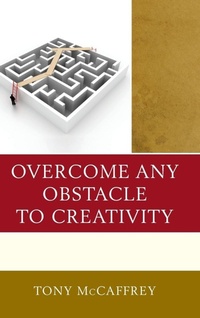
Overcome Any Obstacle to Creativity
Published on 19. March 2018
Book
Hardback
196 pages
978-1-4758-3463-5 (ISBN)
Description
The overall purpose of the book is to present (1) the best science on creativity and innovation in the most practical way possible and (2) a new way of teaching called the Nonsense Method, which relies on humans' incredible ability to create sense out of apparent nonsense and have fun while doing it. The central theory of the book, the Obscure Features Hypothesis for Innovation (OFH), is the first approach to innovation that yields effective counter techniques to all known cognitive obstacles to innovation. The OFH states that any creative solution is built upon at least one commonly overlooked (i.e., obscure) or new feature of the problem. Each chapter ends with puzzles that relate to the cognitive obstacle and counter technique discussed in the chapter. Two hints and a solution for each puzzle are given at the book's end. The Nonsense Method of Teaching focuses upon universal puzzles that can be adapted to any subject. These universal puzzles situate vocabulary words and ideas from any subject matter in situations that need to be connected and thus made sense of.
Reviews / Votes
McCaffrey has delivered a captivating exploration of the psychology of invention, a lively romp into the pleasures of puzzles, and a practical guidebook for overcoming the roadblocks to creativity. Don't miss it! -- Jamie Holmes, author of Nonsense: The Power of Not Knowing There are many books about creativity, but this one is unique in its focus on systematic methods that actually help us to think more creatively. It goes into detail about the different features that items can have, and how to use these to design improvements to the items in interesting and effective ways. Overcome Any Obstacle to Creativity is a vast advancement on previous works in that it actually delivers on what it promises, helping to break us out of our functional fixedness and other ways of rigid thinking that impede innovation. McCaffrey uses the latest developments in cognitive science and neuro-psychology to inspire his methods so that they cohere well with the way the brain actually operates. This book will challenge you and open your mind with powerful yet simple tools to generate novel ideas in almost any kind of endeavor. It is also fun to use and has many helpful examples that demonstrate various ways to use the valuable insights found within. Get ready for a lot of a-ha moments with this book. -- Daniel Veidlinger Ph.D, professor, Department of Comparative Religion and Humanities, California State University, Chico, author of From Indra's Net to Internet: Communication, Technology and the Evolution of Buddhist Ideas For more than half a century, researchers have been adding to our understanding of obstacles that block creativity. Only now are they getting around to understanding how to overcome all those creative obstacles. In engaging and surprisingly accessible language, Dr. McCaffrey's book builds on cutting-edge research to help readers not only understand but uncork their own creative potential. -- Garth Sundem, author of "Beyond IQ: Scientific Tools for Training Problem-Solving, Intuition, Emotional Intelligence, Creativity and More" Dr. Tony McCaffrey's marvelous new book, Overcome Any Obstacle to Creativity, explains that creativity involves picking out nonobvious features and relationships of a problem to use as building blocks of a solution. But Dr. McCaffrey doesn't just make this point in an abstract way. He shows concretely how this works for many different types of problems and gives practical, step-by-step recipes for making the nonobvious obvious. A clear, concise, and immensely helpful book for those who want to become creative problem solvers. -- John Kounios, coauthor of The Eureka Factor: Aha Moments, Creative Insight, and the Brain and professor of cognitive neuroscience, Drexel UniversityMore details
Language
English
Place of publication
United States
Publishing group
Bloomsbury Publishing Plc
Target group
Professional and scholarly
Illustrations
73 b/w illustrations; 5 tables
Dimensions
Height: 235 mm
Width: 157 mm
Thickness: 15 mm
Weight
445 gr
ISBN-13
978-1-4758-3463-5 (9781475834635)
Copyright in bibliographic data and cover images is held by Nielsen Book Services Limited or by the publishers or by their respective licensors: all rights reserved.
Schweitzer Classification
Other editions
Additional editions
Tony McCaffrey
Overcome Any Obstacle to Creativity
E-Book
03/2018
1st Edition
Rowman & Littlefield Publishers
€38.99
Available for download
Tony McCaffrey
Overcome Any Obstacle to Creativity
E-Book
03/2018
1st Edition
Rowman & Littlefield Publishers
€38.99
Available for download
Person
Dr. Tony McCaffrey has built a new approach to improving creativity that has led to an effective technique to overcome every known mental blind spot to creativity. He teaches at Eagle Hill School in Hardwick, MA, and helps lead the company, Innovation Accelerator, Inc., which uses his techniques to help companies solve problems.
Content
Preface
Introduction
Chapter 1: The Nonsense Method of Teaching
Chapter 2: More Nonsense in Teaching
Chapter 3: Functional Fixedness
Chapter 4: Design Fixation
Chapter 5: Brainswarming: Solving Problems Together
Chapter 6: Analogy Blindness
Chapter 7: Other Blind Spots around Goals and Assumptions
Chapter 8: Solving Like Animals
Chapter 9: Visual Blending
Chapter 10: Unconscious Creativity
Chapter 11: Evolution and Creativity
Chapter 12: Diagnosing Creative Weaknesses
Chapter 13: Contradictions
Chapter 14: Unlimited Features
Chapter 15: Back to the Childlike
Appendix A: Hints and Solutions
About the Author
Introduction
Chapter 1: The Nonsense Method of Teaching
Chapter 2: More Nonsense in Teaching
Chapter 3: Functional Fixedness
Chapter 4: Design Fixation
Chapter 5: Brainswarming: Solving Problems Together
Chapter 6: Analogy Blindness
Chapter 7: Other Blind Spots around Goals and Assumptions
Chapter 8: Solving Like Animals
Chapter 9: Visual Blending
Chapter 10: Unconscious Creativity
Chapter 11: Evolution and Creativity
Chapter 12: Diagnosing Creative Weaknesses
Chapter 13: Contradictions
Chapter 14: Unlimited Features
Chapter 15: Back to the Childlike
Appendix A: Hints and Solutions
About the Author