

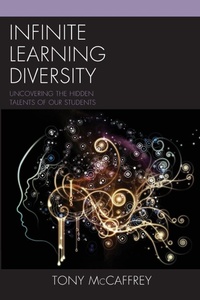
Infinite Learning Diversity
Uncovering the Hidden Talents of Our Students
Published on 12. January 2019
Book
Paperback/Softback
140 pages
978-1-4758-3461-1 (ISBN)
Description
Are schools smart enough to detect the cognitive diversity of students? In this book we will discuss a framework that will help teachers identify the talents of their students.
Reviews / Votes
Tony McCaffrey offers a whirlwind tour of the many ways people solve everyday problems: insightful and eye-opening while stressing each individual's special abilities. -- Frans de Waal, Emory University and author of Mama's Last Hug: Animal Emotions and What They Tell Us about Ourselves This book offers accessible, coherent and important insights into the remarkable, and complex, world of human cognition. Tony McCaffrey uses clear and effective examples to illustrate why, and how, human language matters in understanding our cognitive process. By illustrating the overlaps and differences between human and other primate neurobiologies McCaffrey weaves a robust narrative of how we think and why that matters. -- Agustin Fuentes, The Edmund P. Joyce C.S.C. Professor of Anthropology, University of Notre Dame; author of "The Creative Spark: How Imagination Made Humans Exceptional" (Dutton, 2017) Dr. McCaffrey uses research, practice, observations, experience, thought, wonder, and synthesis to explore the challenge of using contemporary cognitive neuroscience to develop a system to better detect many of the hidden talents in our youth. Through a fascinating prosaic journey, he elucidates the connections between language, cognition, perspective, and ultimately the need to examine these more deeply as we begin to use scientific advances to delve into the human brain to access the human mind and how we learn. Using increasingly complex puzzles to identify talents, Dr. McCaffrey's case studies demonstrate the power of puzzles to recognize diverse strengths we normally would miss. -- Gerald Fussell, Principal, Lake Trail Middle School, Comox Valley School District. This book revives a tradition of general theories of how the mind works. McCaffrey draws together attention, language, learning, memory, perception and puzzle-solving in stunningly integrative fashion, drawing on comparative psychology, neuroscience, human development, and even anthropology. His concept of "blend" goes well beyond simple association or Chomsky's "merge" to account for the diversity and creativity of human thought and action. -- Michael Corballis, author of "The Truth About Language: What It Is and Where It Came From" (University of Chicago Press, 2017) and "The Recursive Mind: The Origins of Human Language, Thought, and Civilization" (Princeton University Press, 2014)More details
Language
English
Place of publication
United States
Publishing group
Bloomsbury Publishing Plc
Target group
Professional and scholarly
Dimensions
Height: 229 mm
Width: 152 mm
Thickness: 8 mm
Weight
215 gr
ISBN-13
978-1-4758-3461-1 (9781475834611)
Copyright in bibliographic data and cover images is held by Nielsen Book Services Limited or by the publishers or by their respective licensors: all rights reserved.
Schweitzer Classification
Other editions
Additional editions
E-Book
01/2019
1st Edition
Rowman & Littlefield Publishers
€29.99
Available for download
E-Book
01/2019
1st Edition
Rowman & Littlefield Publishers
€29.99
Available for download
Person
Tony McCaffrey holds a doctorate in cognitive psychology and researches how to make people more creative. He teaches at Eagle Hill School in Hardwick, MA, and loves creating new ways to teach math and other subjects to his students with learning differences. Tony takes joy in discovering their hidden talents, which are often overlooked. In his spare time, he leads his own company which helps other companies solve their toughest problems. He and his wife Stephanie live in the small New England town of West Brookfield, MA.
Content
Dedication
Preface
1) Introduction
2) Problem: Few Categories and Missing Neuroscience
3) A Mammal Thought Experiment
4) More Non-Linguistic Experiences with Blending
5) The Neuroscience Behind Blending
6) Language's Relation to Other Cognitive Abilities
7) Transforming Language to Neural Activity
8) Students Baselines for Mental Simulations
9) Gestalt Principles Revitalized
10) From Non-Linguistic to Linguistic Puzzles
11) More Impressive Spatialists
12) Linguistic Math Puzzles
13) Conclusions and Next Steps
About the Author
Preface
1) Introduction
2) Problem: Few Categories and Missing Neuroscience
3) A Mammal Thought Experiment
4) More Non-Linguistic Experiences with Blending
5) The Neuroscience Behind Blending
6) Language's Relation to Other Cognitive Abilities
7) Transforming Language to Neural Activity
8) Students Baselines for Mental Simulations
9) Gestalt Principles Revitalized
10) From Non-Linguistic to Linguistic Puzzles
11) More Impressive Spatialists
12) Linguistic Math Puzzles
13) Conclusions and Next Steps
About the Author