

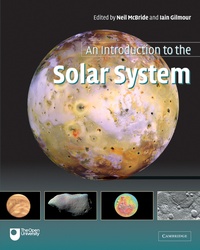
An Introduction to the Solar System
Published on 26. February 2004
Book
Paperback/Softback
418 pages
978-0-521-54620-1 (ISBN)
Description
Compiled by a team of experts, this textbook has been designed for introductory university courses in planetary science. It starts with a tour of the Solar System and an overview of its formation. The composition, internal structure, surface morphology and atmospheres of the terrestrial planets are then described. This leads naturally to a discussion of the giant planets and why they are compositionally different. Minor bodies are reviewed and the book concludes with a discussion of the origin of the Solar System and the evidence from meteorites. Written in an accessible style that avoids complex mathematics, and illustrated in colour throughout, this book is suitable for self-study and will appeal to amateur enthusiasts as well as undergraduate students. It contains numerous helpful learning features such as boxed summaries, student exercises with full solutions, and a glossary of terms. The book is also supported by a website hosting further teaching materials.
Reviews / Votes
'An Introduction to the Solar System is clearly written, accurate, up-to-date, well-produced and a pleasure to read. It is a first rate production by a team of professionals, clearly designed for teaching and up to the high standards of The Open University. The many questions that are posed throughout the text (with answers at the back) make it an ideal teaching text. As a beginning text at an undergraduate or advanced high school level, it is hard to fault this book and I suspect that it will be widely used in introductory courses.' Professor S. Ross Taylor, The Australian National University 'An Introduction to the Solar System stands out from the majority of introductory textbooks in this area due to its excellent coverage of the geological and geophysical aspects of planetary science. The glossary of terms provided in the back of the book will prove extremely helpful to students, as will the many questions and exercises interspersed throughout the text.' Professor Imke De Pater, University of California, Berkeley 'Of all the planetary-science textbooks on my shelf, this is my new favorite. It is up to date, lavishly illustrated, and engagingly written at a level that would challenge but not overwhelm the typical undergraduate ... excellent value.' Science Direct '... it is clearly written and a joy to turn over each page ... This book covers such a wide range of information that there is bound to be something for anyone who has ever had an interest in what is beyond our planet ... It represents, to my mind, excellent value for money with so much knowledge available for each penny spent!.' Open University Geological SurveyMore details
Language
English
Place of publication
Cambridge
United Kingdom
Target group
College/higher education
Professional and scholarly
Product notice
Paperback (trade)
Illustrations
Worked examples or Exercises; 38 Tables, unspecified; 261 Plates, color; 66 Halftones, unspecified
Dimensions
Height: 263 mm
Width: 211 mm
Thickness: 25 mm
Weight
1357 gr
ISBN-13
978-0-521-54620-1 (9780521546201)
Copyright in bibliographic data and cover images is held by Nielsen Book Services Limited or by the publishers or by their respective licensors: all rights reserved.
Schweitzer Classification
Other editions
New editions
David A. Rothery | Neil McBride | Iain Gilmour
An Introduction to the Solar System
Book
05/2011
2nd Edition
Cambridge University Press
€54.46
Article exhausted; check for reprint
Persons
Content
Introduction; 1. A tour of the Solar System; 2. The internal structure of the terrestrial planets; 3. Planetary volcanism - Ultima Thule?; 4. Planetary surface processes; 5. Atmospheres of terrestrial planets; 6. The giant planets; 7. Minor bodies of the Solar System; 8. The origin of the Solar System; 9. Meteorites: a record of formation; Answers and comments; Appendix A. Useful planetary data; Appendix B. Selected physical constants and unit conversions; Appendix C. The elements; Glossary; Acknowledgements; Index.