

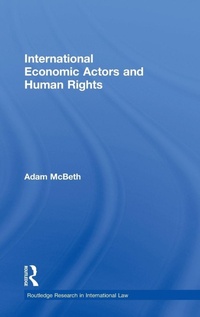
International Economic Actors and Human Rights
Global Rules for Global Players
1st Edition
Published on 21. September 2009
Book
Hardback
384 pages
978-0-415-48670-5 (ISBN)
Description
In noting that the actions of entities other than states in the economic arena can and often do have a profound effect on human rights, this book poses the question as to how international human rights law can and should address that situation. This book takes three very different categories of international actor - the World Trade Organization, the international financial institutions (World Bank and IMF) and multinational enterprises - and analyses the interaction of each category with human rights, in each case analysing the interaction of the different fields of law and seeking to identify a role for international human rights law.
Adam McBeth concludes that each of the selected international economic actors can and should be considered to operate within a holistic system of international law, including human rights obligations, but that changes in the operations and the accountability mechanisms for each actor are necessary for the practical implementation of that approach.
While written from a human rights perspective, the underlying theme of the book is one of engagement and harmonisation rather than condemnation. It provides valuable insight for those who approach this topic from a background of international trade law, commercial law or general international law, just as much as those who have a human rights background. International Economic Actors and Human Rights will be of great interest to those studying or working in any field of international economic law, as well as human rights scholars and practitioners.
Adam McBeth concludes that each of the selected international economic actors can and should be considered to operate within a holistic system of international law, including human rights obligations, but that changes in the operations and the accountability mechanisms for each actor are necessary for the practical implementation of that approach.
While written from a human rights perspective, the underlying theme of the book is one of engagement and harmonisation rather than condemnation. It provides valuable insight for those who approach this topic from a background of international trade law, commercial law or general international law, just as much as those who have a human rights background. International Economic Actors and Human Rights will be of great interest to those studying or working in any field of international economic law, as well as human rights scholars and practitioners.
More details
Series
Language
English
Place of publication
London
United Kingdom
Publishing group
Taylor & Francis Ltd
Target group
College/higher education
Professional and scholarly
Postgraduate and Undergraduate
Product notice
Paper over boards
Dimensions
Height: 240 mm
Width: 161 mm
Thickness: 25 mm
Weight
743 gr
ISBN-13
978-0-415-48670-5 (9780415486705)
Copyright in bibliographic data and cover images is held by Nielsen Book Services Limited or by the publishers or by their respective licensors: all rights reserved.
Schweitzer Classification
Other editions
Additional editions
Adam McBeth
International Economic Actors and Human Rights
Book
07/2011
1st Edition
Routledge
€72.20
Shipment within 15-20 days
Adam McBeth
International Economic Actors and Human Rights
E-Book
09/2009
1st Edition
Routledge
€64.49
Available for download
Adam McBeth
International Economic Actors and Human Rights
E-Book
09/2009
Routledge
€64.49
Available for download
Person
Adam McBeth is a senior lecturer in the Law Faculty at Monash University and is a Deputy Director of the Castan Centre for Human Rights Law at Monash.
Content
1. Introduction 2. Human Rights in International Law 3. The nature of Human Rights Obligations for Various International Actors 4. International Trade Law and the World Trade Organization 5. International Financial Institutions: The World Bank and the International Monetary Fund 6. Multinational Enterprises 7. Conclusion