

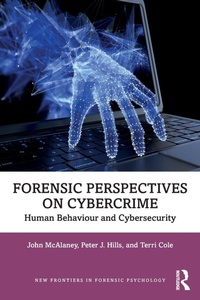
Forensic Perspectives on Cybercrime
Human Behaviour and Cybersecurity
1st Edition
Published on 11. March 2024
Book
Paperback/Softback
136 pages
978-1-032-29174-1 (ISBN)
Description
Forensic Perspectives on Cybercrime is the first book to combine the disciplines of cyberpsychology and forensic psychology, helping to define this emergent area. It explores the psychological factors that influence the behaviour of all those involved in cybersecurity, drawing upon the research literatures in relevant areas including forensic, social, and cyberpsychology.
Written by leading figures in the field, the book provides an introduction to the cybercrime ecosystem, before discussing the psychological manipulation of targets through social engineering techniques and highlighting the unique threats that this type of attack presents. The reasons why people become involved in hacking are explored, and the authors review research literature on risk factors of being a victim of cybercrime, along with the concept of resilience. Behaviour change and prevention strategies are also evaluated, as well as the role of emergent technologies such as artificial intelligence and what this may mean for the role of humans in cybersecurity. Case studies and real-world examples are woven throughout to illustrate key issues, opportunities, and challenges.
This unique text is a must-read for students undertaking any degree that relates to behaviour and cybersecurity, including psychology, computing, law, and business management. It is also highly relevant to researchers, practitioners, and policymakers who work in cybersecurity and/or have an interest in empowering people to be safe online.
Written by leading figures in the field, the book provides an introduction to the cybercrime ecosystem, before discussing the psychological manipulation of targets through social engineering techniques and highlighting the unique threats that this type of attack presents. The reasons why people become involved in hacking are explored, and the authors review research literature on risk factors of being a victim of cybercrime, along with the concept of resilience. Behaviour change and prevention strategies are also evaluated, as well as the role of emergent technologies such as artificial intelligence and what this may mean for the role of humans in cybersecurity. Case studies and real-world examples are woven throughout to illustrate key issues, opportunities, and challenges.
This unique text is a must-read for students undertaking any degree that relates to behaviour and cybersecurity, including psychology, computing, law, and business management. It is also highly relevant to researchers, practitioners, and policymakers who work in cybersecurity and/or have an interest in empowering people to be safe online.
More details
Series
Language
English
Place of publication
London
United Kingdom
Publishing group
Taylor & Francis Ltd
Target group
College/higher education
Professional and scholarly
Postgraduate and Professional
Dimensions
Height: 234 mm
Width: 156 mm
Thickness: 8 mm
Weight
240 gr
ISBN-13
978-1-032-29174-1 (9781032291741)
Copyright in bibliographic data and cover images is held by Nielsen Book Services Limited or by the publishers or by their respective licensors: all rights reserved.
Schweitzer Classification
Other editions
Additional editions
John McAlaney | Peter J. Hills | Terri Cole
Forensic Perspectives on Cybercrime
Human Behaviour and Cybersecurity
E-Book
03/2024
1st Edition
Taylor & Francis
€49.99
Available for download
John McAlaney | Peter J. Hills | Terri Cole
Forensic Perspectives on Cybercrime
Human Behaviour and Cybersecurity
E-Book
03/2024
1st Edition
Taylor & Francis
€49.99
Available for download

John McAlaney | Peter J. Hills | Terri Cole
Forensic Perspectives on Cybercrime
Human Behaviour and Cybersecurity
Book
03/2024
1st Edition
Routledge
€195.60
Shipment within 10-20 days
Persons
John McAlaney is a Chartered Psychologist and Chartered Scientist at Bournemouth University. His research looks at psychological determinants of risk behaviours including online gambling, digital addiction, and cybersecurity. He engages with charities, businesses, and policymakers to help them empower individuals to protect themselves and others from online harms.
Peter J. Hills is a Cognitive Psychologist by training who has published over 60 peer-reviewed research articles using various experimental and non-experimental methods to research aspects of psychology relevant to the forensic domain including face recognition, sexual violence reduction, and online/offline misogyny and sexism.
Terri Cole worked for the National Crime Agency providing behavioural investigative advice to serious crime investigations for many years. She currently works at Bournemouth University lecturing and researching how psychological knowledge can be applied to crime investigations. She has previously authored two books including a BPS textbook of the year.
Peter J. Hills is a Cognitive Psychologist by training who has published over 60 peer-reviewed research articles using various experimental and non-experimental methods to research aspects of psychology relevant to the forensic domain including face recognition, sexual violence reduction, and online/offline misogyny and sexism.
Terri Cole worked for the National Crime Agency providing behavioural investigative advice to serious crime investigations for many years. She currently works at Bournemouth University lecturing and researching how psychological knowledge can be applied to crime investigations. She has previously authored two books including a BPS textbook of the year.
Content
1. Introduction to cybercrime 2. Social engineering 3. Attackers 4. Victimology and resilience 5. Culture 6. Behaviour change and prevention 7. Emergent technologies and future directions 8. Conclusions and recommendations