

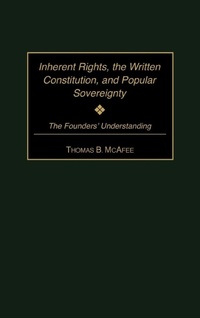
Inherent Rights, the Written Constitution, and Popular Sovereignty
The Founders' Understanding
Published on 30. July 2000
Book
Hardback
200 pages
978-0-313-31507-7 (ISBN)
Description
In recent decades the Ninth Amendment, a provision designed to clarify that the federal government was to be one of enumerated and limited powers, has been turned into an unenumerated rights clause that effectively grants unlimited power to the judiciary. Was this the intent of the framers of the Constitution? McAffee argues that the founders had a rather different set of priorities than ours, and that the goal of enforcing fundamental human rights was not why they drafted any of the first ten amendments. They did not intend to grant to the courts the power to generate fundamental rights, whether by reference to custom or history, reason or natural law, or societal values or consensus.
It has become increasingly popular to identify our constitutional order as an experiment in the protection of fundamental human rights and to forget that it is also an experiment in self-government. As fundamental as the founding generation believed basic rights to be, they saw popular authority to make decisions about government as being even more central to the project in which they were engaged. They supported natural law and rights, but they felt strongly that those rights did not bind the people or their government unless they were inserted in the written Constitution. They did not contemplate that there would be unwritten limitations on the powers granted to government.
It has become increasingly popular to identify our constitutional order as an experiment in the protection of fundamental human rights and to forget that it is also an experiment in self-government. As fundamental as the founding generation believed basic rights to be, they saw popular authority to make decisions about government as being even more central to the project in which they were engaged. They supported natural law and rights, but they felt strongly that those rights did not bind the people or their government unless they were inserted in the written Constitution. They did not contemplate that there would be unwritten limitations on the powers granted to government.
More details
Language
English
Place of publication
United States
Publishing group
Bloomsbury Publishing Plc
Target group
College/higher education
Professional and scholarly
Dimensions
Height: 235 mm
Width: 157 mm
Thickness: 15 mm
Weight
448 gr
ISBN-13
978-0-313-31507-7 (9780313315077)
Copyright in bibliographic data and cover images is held by Nielsen Book Services Limited or by the publishers or by their respective licensors: all rights reserved.
Schweitzer Classification
Other editions
Additional editions
Thomas B. McAffee
Inherent Rights, the Written Constitution, and Popular Sovereignty
The Founders' Understanding
E-Book
07/2000
1st Edition
Praeger Publishers Inc
€82.49
Available for download
Person
THOMAS B. MCAFFEE is Professor of Law at the University of Nevada, Las Vegas./e He has also taught at the Southern Illinois University Law School and at the University of Utah College of Law. He has published widely on topics related to American constitutional law, theory, and history.
Content
The Modern Debate Over Inherent Constitutional Rights: What is at Stake? State Constitutions in the Early American Republic: The Experiment With Republican Government Constitutional Practice in the Confederation Period: The Search for Effective Limits on Legislative Power The Decision at the Philadelphia Convention: The Federal System as Bill of Rights The Ratification-Era Debate Over the Omission of a Bill of Rights: The Constitution as Fundamental Positive Law The Ninth Amendment and Modern Constitutional Theory