

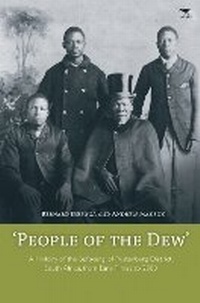
People of the dew
A history of the Bafokeng of Rustenburg District of SA, from early times to 2000
Published on 11. October 2011
Book
256 pages
978-1-77009-825-1 (ISBN)
Description
The Bafokeng tribe has become an established and well-known community in South Africa with a reputation that can be attributed to their considerable wealth derived from platinum mining and direct investment in mining ventures. Employing written, oral, and archaeological sources, this detailed history traces the emergence of the Bafokeng, their settlement in the western Highveld, and their consolidation under various capable leaders during the period of white rule from the 1830s to the early 20th century.
It explores, among other topics, the Bafokeng's history with missionaries, their land acquisition, and their disputes with the powerful white minority. One of the first books to document the Bafokeng people, this record provides insight into one of the remaining South African monarchies.
It explores, among other topics, the Bafokeng's history with missionaries, their land acquisition, and their disputes with the powerful white minority. One of the first books to document the Bafokeng people, this record provides insight into one of the remaining South African monarchies.
More details
Language
English
Place of publication
Johannesburg
South Africa
Publishing group
Jacana Media (Pty) Ltd
Dimensions
Height: 235 mm
Width: 155 mm
Thickness: 15 mm
Weight
500 gr
ISBN-13
978-1-77009-825-1 (9781770098251)
Copyright in bibliographic data and cover images is held by Nielsen Book Services Limited or by the publishers or by their respective licensors: all rights reserved.
Schweitzer Classification
Persons
Professor Bernard K. Mbenga has been lecturing in History at North-West University, Mafikeng Campus, South Africa, since September 1987. He has a Secondary Teachers' Diploma and a B.A.Ed. in History and English from the University of Zambia, an MA in African History from the University of York, England, and a History doctorate on the Pilanesberg from the University of South Africa obtained in 1997. His research interests and publications include the role of black societies in the South African War of 1899-1902; the acquisition of land by black communities in the then Western Transvaal in the 19th and early 20th centuries; missionaries, chiefly authorities and black societies in the Transvaal. He has delivered papers at international conferences in South Africa, the US, England and Australia. Apart from journal articles and chapters in books, he is co-editor and co-author (with Hermann Giliomee) of the highly acclaimed New History of South Africa, published by Tafelberg, Cape Town, in December 2007. He is also co-editor and co-author (with Carolyn Hamilton and Robert Ross) of The Cambridge History of South Africa, Vol.1, From Early Times to 1886 AD published by Cambridge University Press early in 2010. Andrew Manson was awarded his Masters Degree in History from Natal University, and specialised initially in the field of Natal and Zulu History. His thesis was published as part of a publication entitled The Hlubi Chiefdom in Natal/Zululand, with J. Wright. He worked at the Killie Campbell Library and Archive as an Oral Historian, before taking up the position of Archivist at the South African Institute of Race Relations in 1981. In 1984 he moved to what is now North-West University. In 1994 he was promoted to Associate Professor, and in 1996, to full Professor in History and Head of Department. In 1998, he became Dean of the Faculty Of Human and Social Sciences. Professor Manson retired in 2003, but is currently actively writing and researching whilst attached to the Universities of South Africa and the Witwatersrand. He has researched widely in the field of Batswana history, specifically on the Bahurutshe in the Marico District, the formation of the Bechuanaland Frontier, western Transvaal rural history, and in aspects of the Bophuthatswana homeland. Much of this has been published in the Journal of Southern African Studies, the International Journal of Historical Studies, and the Canadian Journal of African Studies.