

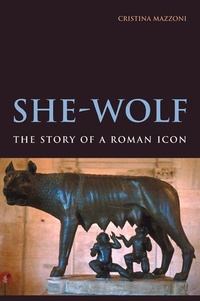
She-Wolf
The Story of a Roman Icon
Published on 29. March 2010
Book
Paperback/Softback
304 pages
978-0-521-14566-4 (ISBN)
Description
Since antiquity, the she-wolf has served as the potent symbol of Rome. For more than two thousand years, the legendary animal that rescued Romulus and Remus has been the subject of historical and political accounts, literary treatments in poetry and prose, and visual representations in every medium. In She-Wolf: The Story of a Roman Icon, Cristina Mazzoni examines the evolution of the she-wolf as a symbol in western history, art, and literature, from antiquity to contemporary times. Used, for example, as an icon of Roman imperial power, papal authority, and the distance between the present and the past, the she-wolf has also served as an allegory for greed, good politics, excessive female sexuality, and, most recently, modern, multi-cultural Rome. Mazzoni engagingly analyzes the various role guises of the she-wolf over time in the first comprehensive study in any language on this subject.
More details
Language
English
Place of publication
Cambridge
United Kingdom
Target group
Professional and scholarly
College/higher education
Product notice
Paperback (trade)
Illustrations
19 Halftones, unspecified
Dimensions
Height: 229 mm
Width: 152 mm
Thickness: 16 mm
Weight
435 gr
ISBN-13
978-0-521-14566-4 (9780521145664)
Copyright in bibliographic data and cover images is held by Nielsen Book Services Limited or by the publishers or by their respective licensors: all rights reserved.
Schweitzer Classification
Other editions
Person
Cristina Mazzoni is Professor of Romance Languages at the University of Vermont. In addition to numerous articles in scholarly journals, she is the author of Saint Hysteria, Maternal Impressions, The Voices of Gemma Galgani (with Rudolph Bell), and The Women in God's Kitchen.
Content
Introduction; Part I. The Capitoline She-Wolf: 1. Antiquity; 2. Middle Ages and Renaissance; 3. Modern and contemporary times; Part II. Writing about the She-Wolf: 4. Antiquity; 5. Middle Ages and Renaissance; 6. Modern and contemporary times; Part III. The She-Wolf in Art: 7. Antiquity; 8. Middle Ages and Renaissance; 9. Modern and contemporary times; Conclusion: the live wolves of Rome.