

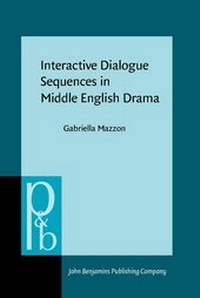
Interactive Dialogue Sequences in Middle English Drama
Published on 15. April 2009
Book
Hardback
228 pages
978-90-272-5430-6 (ISBN)
Description
This book looks at mediaeval English drama using the theoretical frameworks of historical sociopragmatics and dialogue analysis. It focuses on the collection of cycle plays known as the N.Town Plays, preserved in a manuscript from the fifteenth century. The book examines various linguistic markers that are important for the expression of social relations and pragmatic stance: pronouns and terms of address, modal markers, performatives, and sequential structures such as question-answer, imperative-compliance, etc. These elements are examined separately and then brought together to arrive at a more integrated analysis of dramatic dialogue and of the dynamics of interaction it portrays. A separate chapter is devoted to tracing the same mechanisms on a different communication level, i.e. in 'dialogue' with the audience, which is particularly relevant to the instructional purposes of the plays. The book will be useful to students and scholars of pragmatics, historical linguistics, dialogue studies and drama studies.
More details
Series
Language
English
Place of publication
Amsterdam
Netherlands
Target group
Professional and scholarly
Illustrations
+ index
Dimensions
Height: 245 mm
Width: 164 mm
Weight
575 gr
ISBN-13
978-90-272-5430-6 (9789027254306)
Copyright in bibliographic data and cover images is held by Nielsen Book Services Limited or by the publishers or by their respective licensors: all rights reserved.
Schweitzer Classification
Other editions
Additional editions
Gabriella Mazzon
Interactive Dialogue Sequences in Middle English Drama
E-Book
04/2009
1st Edition
John Benjamins Publishing Company
€118.99
Available for download
Person
Content
1. Acknowledgements; 2. Abbreviations; 3. Chapter 1. Introduction; 4. Chapter 2. Address between characters; 5. Chapter 3. Modality; 6. Chapter 4. Performatives and verba dicendi; 7. Chapter 5. Pair structures; 8. Chapter 6. Addressing and directing the audience; 9. Chapter 7. Conclusions; 10. References; 11. Index; 12. Index of names