

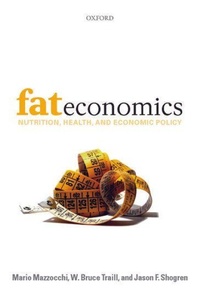
Fat Economics
Nutrition, Health, and Economic Policy
Published on 26. March 2009
Book
Paperback/Softback
198 pages
978-0-19-921386-3 (ISBN)
Description
The obesity epidemic and the growing debate about what, if any, public health policy should be adopted is the subject of endless debates within the media and in governments around the world. Whilst much has been written on the subject, this book takes a unique approach by looking at the obesity epidemic from an economic perspective. Written in a language accessible to non-specialists, the authors provide a timely discussion of evolving nutrition policies in both the developing and developed world, discuss the factors influencing supply and demand of food supply, and review the evidence for various factors which may explain recent trends in diets, weight, and health.
The traditional economic model assumes people choose to be overweight as part of a utility maximisation process that involves choices about what to eat and drink, how much time to spend on leisure, food preparation, and exercise, and choices about appearance and health. Market and behavioural failures, however, such as time available to a person, education, costs imposed on the health system and economic productivity provide the economic rationale for government intervention. The authors explore various policy measures designed to deal with the epidemic and examine their effectiveness within a cost-benefit analysis framework. While providing a sound economic basis for analysing policy decisions, the book also aims to show the underlying limits of the economic framework in quantifying changes in public well-being.
The traditional economic model assumes people choose to be overweight as part of a utility maximisation process that involves choices about what to eat and drink, how much time to spend on leisure, food preparation, and exercise, and choices about appearance and health. Market and behavioural failures, however, such as time available to a person, education, costs imposed on the health system and economic productivity provide the economic rationale for government intervention. The authors explore various policy measures designed to deal with the epidemic and examine their effectiveness within a cost-benefit analysis framework. While providing a sound economic basis for analysing policy decisions, the book also aims to show the underlying limits of the economic framework in quantifying changes in public well-being.
Reviews / Votes
...rich in information...important. * Asia Pacific Journal Clinical Nutrition *More details
Language
English
Place of publication
Oxford
United Kingdom
Target group
College/higher education
Professional and scholarly
Product notice
Paperback (trade)
Unsewn / adhesive bound
Dimensions
Height: 231 mm
Width: 155 mm
Thickness: 13 mm
Weight
326 gr
ISBN-13
978-0-19-921386-3 (9780199213863)
Copyright in bibliographic data and cover images is held by Nielsen Book Services Limited or by the publishers or by their respective licensors: all rights reserved.
Schweitzer Classification
Other editions
Additional editions
Mario Mazzocchi | W. Bruce Traill | Jason F. Shogren
Fat Economics
Nutrition, Health, and Economic Policy
E-Book
03/2009
1st Edition
OUP eBook
€41.99
Available for download
Mario Mazzocchi | W. Bruce Traill | Jason F. Shogren
Fat Economics
Nutrition, Health, and Economic Policy
Book
03/2009
Oxford University Press
€157.85
Shipment within 15-20 days
Persons
Mario Mazzocchi is currently a lecturer in Economic Policy at the University of Bologna. From 2002 to 2005 he taught consumer behaviour and marketing research methods at the University of Reading. He holds a degree in statistics (University of Bologna) and a PhD in Food Economics and Policy (University of Siena). His research focuses on applied economics and consumer behaviour. He has been a consultant to FAO on the economics and policy of the diet-health relationship.
W. Bruce Traill has been Professor of Agricultural and Food Economics at the University of Reading since 1990 and was Head of Department from 1999 to 2005. He has previous lecturing experience at the University of Manchester and has worked for the European Commission and FAO. He has published widely on issues concerning multinational enterprises, international trade and competitiveness and innovation as well as food safety and nutrition and consumer food choice.
Jason F. Shogren is Stroock Professor of Natural Resource Conservation & Management at the University of Wyoming. He is a world leading researcher on the environment, nutrition and health economics. He has already published two books with OUP and has a long record of publications in top international reviews such as the American Economic Review and the Journal of Political Economy.
W. Bruce Traill has been Professor of Agricultural and Food Economics at the University of Reading since 1990 and was Head of Department from 1999 to 2005. He has previous lecturing experience at the University of Manchester and has worked for the European Commission and FAO. He has published widely on issues concerning multinational enterprises, international trade and competitiveness and innovation as well as food safety and nutrition and consumer food choice.
Jason F. Shogren is Stroock Professor of Natural Resource Conservation & Management at the University of Wyoming. He is a world leading researcher on the environment, nutrition and health economics. He has already published two books with OUP and has a long record of publications in top international reviews such as the American Economic Review and the Journal of Political Economy.
Content
1. The Obesity Epidemic ; The "Epidemic" in Context ; Why are People Eating More? The Need to Understand Behavior as well as Biology ; What Does This Have to Do With Governments? ; Conclusions ; 2. Why Obesity? An Economic Perspective ; Is Obesity a Failure of the Market Economy? ; Consumer Decision Making ; Market Exchange: Information ; Obesity in Developing Countries ; Children and Families ; Conclusion: The Economics of Obesity ; 3. Economic Evaluation Tools for Evidence-based Policy Making ; Measures of the Direct and Indirect Costs to Society of Obesity ; Evidence-based Interventions and their Costs ; Conclusion: The Economic Burden of Obesity ; 4. Policy Intervention ; Information Measures ; Market Measures ; Conclusions ; 6. Concluding Fat Economics ; Glossary