

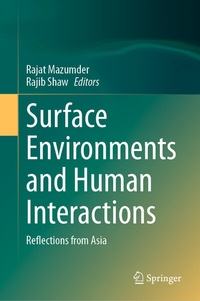
Surface Environments and Human Interactions
Description
This book describes the complex interplay between Earth's surface processes (erosion and sedimentation) and human interactions. Intensive as well as extensive research has been undertaken to infer modern sedimentation processes and to infer the mode of stratigraphic sequence building. However, the effort to understand the influence of sedimentation processes on society and the human impact on sedimentation is long overdue. This is a new upcoming multidisciplinary research field that is beyond the scope of leading traditional Earth and Environmental Science journals. To fill in the prodigious gap in the knowledge base, this book includes in-depth reviews and new data-based case studies from Asia, involving multidisciplinary research. It covers case studies of risk management of various hazards and risk management systems at regional, national, and local levels. The book proposes a comprehensive approach to reducing future risks by collaborating with various stakeholders and preparingfor the most effective responses towards complicated hazards, minimizing social damage. This publication will help researchers in the field of Environment and Earth surface processes, disaster risk reduction, and geoscientists to have a better idea of the current trend of research in the field and will provide updated synthesis on this important topic.
More details
Other editions
Additional editions
Persons
Dr. Rajib Shaw is a professor in the Graduate School of Media and Governance at Keio University, Japan. He co-founded a Delhi (India) social entrepreneur startup Resilience Innovation Knowledge Academy (RIKA), and RIKA Institute. He is the Co-chair of the United Nations Asia Pacific Science Technology Advisory Group (AP-STAG) and was CLA for IPCC's 6th Assessment Report. Professor Shaw is the recipient of the prestigious "Pravasi Bharatiya Samman Award (PBSA)" in 2021 for his contribution to the education sector. He also received the United Nations Sasakawa Award in 2022 for his lifetime contributions to disaster risk reduction. He is the editor-in-chief of Progress in Disaster Science, a high-impact factor Elsevier journal. He published 66 books and over 450 research papers. More about his work can be found at: www.rajibshaw.org
Content
Chapter 1. A study of the temporal variation in the bars, bedforms and riparian population in the downstream stretch of Tista River, Eastern Himalaya: impact of the upstream river regulation.- Chapter 2. Evolution of modern sedimentation patterns in the Himalayan Ganges River Alluvial Flood Plain.- Chapter 3. Interplay between Sediment Transport and Urbanization in Wadi Environments.- Chapter 4. Geological characteristics, and landslide risk reduction.- Chapter 5. Landslide, Land Cover, and Land use Changes and its implications in disaster risks in Nepal.- Chapter 6. Paleo-sediments deposits, and implications to tsunami risk.- Chapter 7. Sedimentary evidence of past tsunami deposits in Aceh, Indonesia.- Chapter 8. Landslide susceptibility modelling in Malaysia: insights from sedimentology.- Chapter 9. Landslide susceptibility in western part of China.- Chapter 10. Sundarbans estuarine system of India: sedimentation, morphodynamics, and human interactions.- Chapter 11. Microbially induced sedimentary processes in the intertidal regions, Sundarbans, India.