

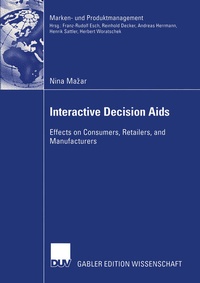
Interactive Decision Aids
Effects on Consumers, Retailers, and Manufacturers
Published on 12. December 2003
Book
Paperback/Softback
XVIII, 138 pages
978-3-8244-8020-3 (ISBN)
Description
In a time where the Internet and online retailing play a proliferating role in the world-wide economy, it is of major concern to understand e-commerce's advantages and pitfalls. Only then retailers and manufacturers can act effectively in this extremely competitive market. In this context interactive decision aids, or so called smart agents, are becoming more and more important. While it is known that their key advantage lies in offering various levels of interac tivity with which information can be tailored to each consumer's idiosyncratic needs, little is known about its particular advantages for consumers, retailers, or manufacturer when com pared to the alternative of offline shopping. Nina Maiar's work targets exactly this shortcoming. To be more precise, she deals with one of the currently most feasible interactive decision aids in order to show its usefulness for dif ferent product categories and effects on all actors in the market. Based on profound findings from research on constructive consumer preferences and economics of information, Nina Maiar analyses the consequences in an experimental simulation and demonstrates the deci sion aid's effectiveness and boundaries.
More details
Series
Thesis
Doctoral thesis
Edition
Softcover reprint of the original 1st ed. 2003
Language
English
Place of publication
Wiesbaden
Germany
Target group
Professional and scholarly
Research
Illustrations
16 s/w Abbildungen
XVIII, 138 p. 16 illus.
Dimensions
Height: 210 mm
Width: 148 mm
Thickness: 9 mm
Weight
216 gr
ISBN-13
978-3-8244-8020-3 (9783824480203)
DOI
10.1007/978-3-322-81679-5
Schweitzer Classification
Person
Dr. Nina Mazar promovierte bei Prof. Dr. Andreas Herrmann am Lehrstuhl für allgemeine Betriebswirtschaftslehre und Marketing I der Universität Mainz. Sie ist Post-Doktorandin und Lehrbeauftragte für Marketing, insbesondere Marketing Management, Consumer Behavior, Decision Making, Behavioral Economics und eCommerce an der MIT Sloan School of Management sowie Teil der eRationality Group im MIT Medialab in Cambridge, USA.
Content
1 Introduction.- 2 Conceptual Framework.- 2.1 The Adaptive Decision Maker.- 2.2 Interactive Decision Aids.- 2.3 Overview of Existing Research.- 3 Hypotheses.- 3.1 Attribute Importance Weights.- 3.2 Consumer Welfare.- 3.3 Objective Differences in Product Choice.- 3.4 Perceived Purchase Risk and Applied Processing Method.- 4 Experiment.- 4.1 Method.- 4.2 Results.- 5 Integrated Discussion of Results.- 5.1 Summary of Results.- 5.2 Managerial Implications.- 6 Conclusions and Future Research.- Appendix 107.- References 113.