

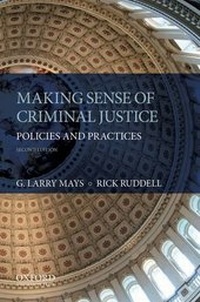
Making Sense of Criminal Justice
Policies and Practices
2nd Edition
Published on 9. January 2014
Book
Paperback/Softback
384 pages
978-0-19-931413-3 (ISBN)
Description
Addressing topics such as gun control, prison overcrowding, and the death penalty, this book encourages students to think critically about criminal justice policy. Each chapter confronts a timely and contentious issue in the field. The text maintains an awareness of the effect of race and gender on interactions with the criminal justice system, and includes chapters that discuss race and gender directly. In each chapter, the authors consider the ways in which the
examined issue impacts the criminal justice system, politics, and policymaking. The authors have organized the book around the three main elements of the criminal justice system (police, courts, and corrections), and the issues they feature are relevant to both informed citizens and future criminal
justice professionals.
examined issue impacts the criminal justice system, politics, and policymaking. The authors have organized the book around the three main elements of the criminal justice system (police, courts, and corrections), and the issues they feature are relevant to both informed citizens and future criminal
justice professionals.
Reviews / Votes
"Making Sense of Criminal Justice digs below the surface where most competing textbooks reside by not only examining what works, what doesn't, and possible explanations for each, but by also examining the means through which theory is filtered through structure and function to become policy, and how policy affects society."--J. Keith Akins, University of Houston-Victoria"The approach of this book is refreshing. Rather than fitting the cookie-cutter mold, Making Sense of Criminal Justice focuses on using policy issues as a way of structuring the information. The authors have chosen some 'slam-bang' topics that students are most likely to be interested in."--Susan J. Siggelakis, University of New Hampshire
"Making Sense of Criminal Justice allows students and professors to engage in fruitful discussions of the topics without too many of the writer's values jumping from the pages. It is an all-around good book."--Jennifer Kellman-Fritz, Eastern Michigan University
More details
Edition
2nd Revised edition
Language
English
Place of publication
New York
United States
Target group
Professional and scholarly
Edition type
Revised edition
Illustrations
25 illustrations
Dimensions
Height: 236 mm
Width: 157 mm
Thickness: 17 mm
Weight
544 gr
ISBN-13
978-0-19-931413-3 (9780199314133)
Copyright in bibliographic data and cover images is held by Nielsen Book Services Limited or by the publishers or by their respective licensors: all rights reserved.
Schweitzer Classification
Persons
G. Larry Mays is Regents Professor Emeritus of Criminal Justice at New Mexico State University. He served as a police officer in Knoxville, Tennessee for five years in the early 1970s, and he holds a Ph.D. in political science from the University of Tennessee. Dr. Mays taught at East Tennessee State University and Appalachian State University prior to coming to New Mexico State University in 1981. He has over 100 publications in referred journals, practitioner
publications, encyclopedia entries, and book chapters. This book is his twenty-first, including American Courts and the Judicial Process (Oxford University Press). He is also coauthor with L. Thomas Winfree, Jr. of Essentials of Corrections, fifth edition (Wiley Blackwell) and Juvenile Justice, third
edition (Wolters Kluwer Publishing Co.). Additionally, he and Rick Ruddell are the coauthors of Do the Time, Do the Crime (Praeger Publishing Co.)
Rick Ruddell served as Director of Operational Research with the Correctional Service of Canada and held faculty positions at Eastern Kentucky University and the California State University, Chico. A graduate of the Ph.D. program in Criminology and Criminal Justice at the University of Missouri - St. Louis, Dr. Ruddell's research has focused upon policing, juvenile justice, and corrections. His research has been disseminated in eight books and over 75 peer-reviewed articles, technical reports,
book chapters, and articles for professional journals. Dr. Ruddell has also worked with the Saskatchewan Ministry of Justice (Corrections and Policing Division) and during his tenure with the province held a number of front-line, supervisory and managerial positions.
publications, encyclopedia entries, and book chapters. This book is his twenty-first, including American Courts and the Judicial Process (Oxford University Press). He is also coauthor with L. Thomas Winfree, Jr. of Essentials of Corrections, fifth edition (Wiley Blackwell) and Juvenile Justice, third
edition (Wolters Kluwer Publishing Co.). Additionally, he and Rick Ruddell are the coauthors of Do the Time, Do the Crime (Praeger Publishing Co.)
Rick Ruddell served as Director of Operational Research with the Correctional Service of Canada and held faculty positions at Eastern Kentucky University and the California State University, Chico. A graduate of the Ph.D. program in Criminology and Criminal Justice at the University of Missouri - St. Louis, Dr. Ruddell's research has focused upon policing, juvenile justice, and corrections. His research has been disseminated in eight books and over 75 peer-reviewed articles, technical reports,
book chapters, and articles for professional journals. Dr. Ruddell has also worked with the Saskatchewan Ministry of Justice (Corrections and Policing Division) and during his tenure with the province held a number of front-line, supervisory and managerial positions.
Author
Regents Professor of Criminal JusticeRegents Professor of Criminal Justice, New Mexico State University
Law Foundation of Saskatchewan Chair in Police Studies, Department of Justice StudiesLaw Foundation of Saskatchewan Chair in Police Studies, Department of Justice Studies, University of Regina
Content
Table of Contents ; Preface ; About the Authors ; Introduction ; Section I ; Criminal Justice Policy ; Chapter 1 ; The Politics and Policy Dichotomy ; Introduction ; The Role of Politics in the Administration of Justice ; Sources of Law and Policy ; Politics and Legislative Processes and Functions ; Policymaking and Criminal Justice ; Conclusions ; Key Terms ; Critical Review Questions ; Writing Assignments ; Recommended Readings ; Chapter 2 ; Crime Control Versus Due Process ; Introduction ; The Crime Control Model ; The Due Process Model ; The Practical Difference Between the Models ; Crime Control Model Policies ; Due Process Model Policies ; Conclusions ; Key Terms ; Critical Review Questions ; Writing Assignments ; Recommended Readings ; Section II ; Law Enforcement Issues ; Chapter 3 ; The Search for a Guiding Philosophy of Policing ; Introduction ; Variation in the Police ; Stages of Police Development ; The Political Era (1820s-1940s) ; Reform Transition (Late 1800s-Early 1900s) ; The Professional Era (1940-1970) ; Days of Protest - Another Transition (Mid-1960s-Mid-1970s) ; The Community Policing Era (1970-2010) ; Community Policing ; Search for a New Guiding Philosophy for Policing (2010 to Present) ; Conclusions ; Key Terms ; Critical Review Questions ; Writing Assignments ; Recommended Readings ; Chapter 4 ; Police and the Use of Force ; Introduction ; Defining the Terms ; Police and Citizen Interactions ; Influences on the Use of Force ; Laws ; Policies ; Training ; Departmental Practice or Police Culture ; The Characteristics of Individual Officers ; High-Speed Pursuits As Deadly Force ; Less Than Lethal Force ; Police Officer Deaths ; Police Shootings of Civilians ; Remedies for Unauthorized Use of Force ; Conclusions ; Key Terms ; Critical Review Questions ; Writing Assignments ; Recommended Readings ; Chapter 5 ; Gun Control ; Introduction ; Firearms Mortality ; Violent Crime ; Firearms Legislation ; Regulating the Types of Firearms ; Legislating Access to Firearms ; Controlling Firearms Use ; Effectiveness of Gun Control Legislation ; Police Interventions to Reduce Illegal Gun Use ; Conclusions ; Key Terms ; Critical Review Questions ; Writing Assignments ; Recommended Readings ; Section III ; Justice for All, or Just for Some? ; Chapter 6 ; Sentencing ; Introduction ; Getting Tough ; Indeterminate to Determinate Sentencing ; Sentencing Guidelines ; Mandatory Minimum Sentences ; Three-Strikes Legislation ; Truth-in-Sentencing (NOTE: NO HYPHENS IN PREVIOUS EDITION, TITLE OR TEXT.) ; Conclusions ; Key Terms ; Critical Review Questions ; Writing Assignments ; Recommended Readings ; Chapter 7 ; Race, Ethnicity, and Justice ; Introduction ; Decision Making in the Criminal Justice System ; Arrest ; Juvenile Detention and Incarceration ; Prosecution ; Adjudication ; Sentencing ; Punishment ; Conclusions ; Key Terms ; Critical Review Questions ; Writing Assignments ; Recommended Readings ; Chapter 8 ; Gender and Justice ; Introduction ; Women As Offenders in the Criminal Justice System ; Arrests ; Detention ; Prosecution and Adjudication ; Criminal Sanctions ; Treatment and Rehabilitation Resources ; Women As Crime Victims ; Women Working in the Criminal Justice System ; Conclusions ; Key Terms ; Critical Review Questions ; Writing Assignments ; Recommended Readings ; Chapter 9 ; Wrongful Convictions ; Introduction ; Scope of the Problem ; Eyewitness Misidentification ; False Confessions and Incriminating Statements ; Informants ; Unvalidated or Improper Forensic Science ; Misconduct ; Ineffective Assistance of Counsel ; Conclusions ; Key Terms ; Critical Review Questions ; Writing Assignments ; Recommended Readings ; Section IV ; The Challenges of Correcting Law-Violating Behavior ; Chapter 10 ; What Are the Alternatives? ; Introduction ; Specialized Courts ; Drug Diversion Programs ; Intermediate Sanctions ; Community-Based Jail Programs ; Parole ; Conclusions ; Key Terms ; Critical Review Questions ; Writing Assignments ; Recommended Readings ; Chapter 11 ; Putting the Brakes on Correctional Populations ; Introduction ; Imprisonment and Crime Control ; The Rising Cost of Corrections ; Indirect Costs of Incarceration ; Rehabilitating Prisoners ; Privatization ; Conclusions ; Key Terms ; Critical Review Questions ; Writing Assignments ; Recommended Readings ; Chapter 12 ; The Death Penalty ; Introduction ; Capital Punishment in America - Evolving Conditions and Practices ; Support for the Death Penalty ; The Death Penalty Today ; Capital Punishment Policy ; The Future of the Death Penalty ; Conclusions ; Key Terms ; Critical Review Questions ; Writing Assignments ; Recommended Readings ; Chapter 13 ; Juvenile Crime and Violence ; Introduction ; Juvenile Crime Trends ; Explaining Changes in Juvenile Crime ; Cycles of Juvenile Justice ; Models for Controlling Juvenile Crime ; Noninterventionist Model ; Rehabilitation Model ; Crime Control Model ; Evidence Based Practice ; Conclusions ; Key Terms ; Critical Review Questions ; Writing Assignments ; Recommended Readings ; Section V ; Public Safety and the Future ; Chapter 14 ; Living in a Post-9/11 World ; Introduction ; Federal Legislation ; The Foreign Intelligence Surveillance Act ; The Antiterrorism and Effective Death Penalty Act ; The USA PATRIOT Act ; Homeland Security ; Security Versus Liberty ; The Changing Legal Environment ; Video Surveillance ; Fusion Centers ; Conclusions ; Key Terms ; Critical Review Questions ; Writing Assignments ; Recommended Readings ; Chapter 15 ; Making Sense of Criminal Justice ; Introduction ; Understanding Criminal Justice Policy ; Research and Criminal Justice Policy ; Criminal Justice in the Twenty-First Century ; Conclusions ; Key Terms ; Critical Review Questions ; Writing Assignments ; Recommended Readings ; Case Index ; Author Index ; Subject Index