

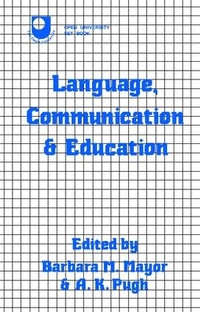
Language, Communication and Education
1st Edition
Published on 13. November 2017
Book
Hardback
476 pages
978-1-138-46828-3 (ISBN)
Description
Examines communication in the classroom within the larger context of the development of standard English and its social implications.
More details
Language
English
Place of publication
London
United Kingdom
Publishing group
Taylor & Francis Ltd
Target group
College/higher education
Dimensions
Height: 216 mm
Width: 138 mm
Weight
1040 gr
ISBN-13
978-1-138-46828-3 (9781138468283)
Copyright in bibliographic data and cover images is held by Nielsen Book Services Limited or by the publishers or by their respective licensors: all rights reserved.
Schweitzer Classification
Other editions
Additional editions
Barbara Mayor | A. K. Pugh
Language, Communication and Education
E-Book
08/2005
1st Edition
Routledge
€41.99
Available for download
Barbara Mayor | A. K. Pugh
Language, Communication and Education
E-Book
08/2005
1st Edition
Routledge
€41.99
Available for download
Barbara Mayor | A. K. Pugh
Language, Communication and Education
Book
11/1986
Routledge
€49.00
Article not available for order
Persons
Barbara M. Mayor, A.K. Pugh Open University
Content
Section 1: Language and Other Communication Systems 1.1 Primate Communication 1.2 British Sign Language 1.3 The President's Speech 1.4 The Berber House Section 2: Standardisation and Diversity in Language 2.1 Standardisation in English 2.2 Our Reactions to Accent 2.3 Social Network and Language Maintenance 2.4 White Adolescent Creole Users and the Politics of Friendship 2.5 Women in Their Speech Communities 2.6 Welsh and English in Wales Section 3: Language, Power and Control 3.1 The Vocabulary of Power, Rank and Status 3.2 Bias in Language: the Case of Sexism 3.3 Sociolinguistic Rules of Address 3.4 Problems and Problems: Power Relationships in a Medical Encounter 3.5 "Women's Language" or "Powerless Language"? 3.6 Patterns of Power and Authority in Classroom Talk Section 4: Learning Communication Skills 4.1 From Communicating to Talking 4.2 What No Bedtime Story Means: Narrative Skills at Home and School 4.3 Language-learner Language 4.4 The Description of Bilingualism 4.5 Some New Developments in Social Skills Training 4.6 A Case Study of a T-group Section 5: Language in Classroom Learning 5.1 Teaching and Learning as the Creation of Meanings 5.2 Ground-rules for Mutual Understanding: a Social Psychological Approach to Classroom Knowledge 5.3 Beyond Lip-service: Discourse Development After the Age of Nine Section 6: Literacy 3 6.1 On Being Literate in an Age of Information 6.2 Illiteracy in Context 6.3 Functional Literacy: Fond Illusions and False Economies 6.4 The Comprehension Revolution: a Twenty-year History of Process Related to Reading Comprehension