

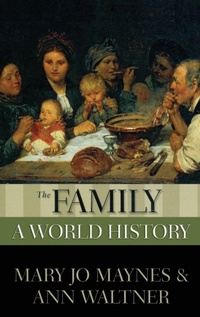
The Family
A World History
Published on 26. July 2012
Book
Hardback
168 pages
978-0-19-530476-3 (ISBN)
Description
This book addresses the question of what world history looks like when the family is at the center of the story. People have always lived in families, but what that means has varied dramatically over time and across cultures. The family is not a "natural" phenomenon--it has a history. And family life is not limited to the realm of the private or the strictly personal; the family is a force of history. Gender and generational differences affect how individual family members relate to each other and how the family operates in changing historical times. For example, youth rebellion against repressive elders fed into choices about conversion to Christianity in colonial Kenya in the early twentieth century and also into the May Fourth rebellion against traditional rule in China in 1919.These are the sorts of examples that drive the narrative of The Family: A World History.
Maynes and Waltner begin their story more than 10,000 years ago with various projects of domestication around the globe - different ways of inventing human settlement and explaining and attempting to control the natural world. The authors then examine how family systems and family practices help to account for the historical fate of different world regions in the era of growing world trade, colonization, and religious warfare and conversions between 1450 and 1750. They make connections between economic, political, and cultural modernity and the transformation of family and gender relationships between 1750 and 1920. Finally, they demonstrate that the struggle over family relations was central to fascist and colonial regimes, Cold War era ideological and economic confrontations, and post-World-War II antagonisms between 'developed' and 'underdeveloped' nations, and, more recently, between the global North and the global South. The narrative concludes with such contemporary realities as transcontinental family life, state programs of genocide, and innovative reproductive technologies.
Taking a long and broad view of the family as a force of history brings to light processes of human development and patterns of social life that are missed by narrower investigations. This book on the family is thus also engaged in a larger conversation about what it means to be human, and how a very expansive temporal and geographic frame of history brings new insights into the human past and present. Maynes and Waltner draw on a wide range of historical sources including legal codes, census records, memoirs, art, and oral history.
Maynes and Waltner begin their story more than 10,000 years ago with various projects of domestication around the globe - different ways of inventing human settlement and explaining and attempting to control the natural world. The authors then examine how family systems and family practices help to account for the historical fate of different world regions in the era of growing world trade, colonization, and religious warfare and conversions between 1450 and 1750. They make connections between economic, political, and cultural modernity and the transformation of family and gender relationships between 1750 and 1920. Finally, they demonstrate that the struggle over family relations was central to fascist and colonial regimes, Cold War era ideological and economic confrontations, and post-World-War II antagonisms between 'developed' and 'underdeveloped' nations, and, more recently, between the global North and the global South. The narrative concludes with such contemporary realities as transcontinental family life, state programs of genocide, and innovative reproductive technologies.
Taking a long and broad view of the family as a force of history brings to light processes of human development and patterns of social life that are missed by narrower investigations. This book on the family is thus also engaged in a larger conversation about what it means to be human, and how a very expansive temporal and geographic frame of history brings new insights into the human past and present. Maynes and Waltner draw on a wide range of historical sources including legal codes, census records, memoirs, art, and oral history.
Reviews / Votes
A thoughtful work that is part of an exciting series, the New Oxford World History. This is very much an American series and reflects the energy of that historical community. Pledged to offer a comprehensive world history that looks over a long timespan, this series provides the basis for an account of the family that begins in 10,000 BCE ... the scholarship is up to date, the judgments pertinent and the writing good. An impressive volume. * Jeremy Black, The Historian * This welcome addition to the New Oxford World History series examines both the history of the family as a social institution from Paleolithic times to the present, and the ways in which the family has been an agent of historical change ... excellent * Merry Wiesner-Hanks, Journal of Social History *More details
Series
Language
English
Place of publication
New York
United States
Target group
College/higher education
Illustrations
20 b/w halftones, 3 maps, 1 chart
Dimensions
Height: 240 mm
Width: 161 mm
Thickness: 14 mm
Weight
417 gr
ISBN-13
978-0-19-530476-3 (9780195304763)
Copyright in bibliographic data and cover images is held by Nielsen Book Services Limited or by the publishers or by their respective licensors: all rights reserved.
Schweitzer Classification
Other editions
Additional editions
Book
07/2012
1st Edition
Oxford University Press Inc
€41.20
Shipment within 15-20 days
E-Book
06/2012
1st Edition
OUP eBook
€18.49
Available for download
E-Book
06/2012
1st Edition
OUP eBook
€18.49
Available for download
Persons
Mary Jo Maynes is professor of history at the University of Minnesota. Her recent books include Telling Stories: The Use of Personal Narratives in the Social Sciences and History (2008) and Secret Gardens, Satanic Mills: Placing Girls in European History (2004).
Ann Waltner is professor of history and director of the Institute for Advanced Study at the University of Minnesota. She is a former editor of the Journal of Asian Studies and author of Getting an Heir: Adoption and the Construction of Kinship in Late Imperial China.
Ann Waltner is professor of history and director of the Institute for Advanced Study at the University of Minnesota. She is a former editor of the Journal of Asian Studies and author of Getting an Heir: Adoption and the Construction of Kinship in Late Imperial China.
Content
Editors' Preface ; Introduction ; Chapter 1: Domestic Life and Human Origins ; Chapter 2: The Birth of the Gods: Family in the Emergence of Religions and Cosmologies ; Chapter 3: Ruling Families: Kinship at the Dawn of Politics (3000 BCE to 1450 CE) ; Chapter 4: Family Dynamics in a Global Frame (1400-1750) ; Chapter 5: Families in Global Markets (1600-1850) ; Chapter 6: Families in Revolutionary Times (1750-1920) ; Chapter 7: Powers of Life and Death: Families in the Era of State Population Management (1880 to the Present) ; Epilogue: The Future of the Family ; Chronology ; Notes ; Further Reading ; Websites ; Index