

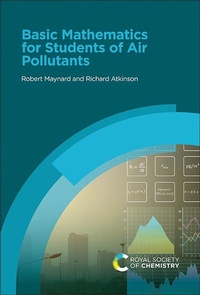
Basic Mathematics for Students of Air Pollutants
Published on 27. March 2024
Book
Hardback
206 pages
978-1-83767-278-3 (ISBN)
Description
Air pollution is recognised as a major threat to global public health. The study of air pollution requires an understanding of various mathematical concepts that some students may not have encountered. For students struggling with the necessary maths this book provides a brilliant basic resource to get them up to speed.
The two authors use their long experience in the air pollution field to provide a selection of the basic mathematical techniques required for the study of air pollution. These include introductions to statistical distributions, regression analysis, the elementary physics of airborne particles and gases and epidemiological techniques. Aimed at students of air pollution with a limited background in mathematics, this book is a useful addition to any air pollution course.
The two authors use their long experience in the air pollution field to provide a selection of the basic mathematical techniques required for the study of air pollution. These include introductions to statistical distributions, regression analysis, the elementary physics of airborne particles and gases and epidemiological techniques. Aimed at students of air pollution with a limited background in mathematics, this book is a useful addition to any air pollution course.
More details
Language
English
Place of publication
Cambridge
United Kingdom
Target group
College/higher education
Product notice
Unsewn / adhesive bound
Dimensions
Height: 234 mm
Width: 156 mm
Thickness: 11 mm
Weight
467 gr
ISBN-13
978-1-83767-278-3 (9781837672783)
Copyright in bibliographic data and cover images is held by Nielsen Book Services Limited or by the publishers or by their respective licensors: all rights reserved.
Schweitzer Classification
Other editions
Additional editions
Robert Maynard | Richard Atkinson
Basic Mathematics for Students of Air Pollutants
E-Book
03/2024
1st Edition
Royal Society of Chemistry
€66.99
Available for download
Persons
Professor Maynard retired from the UK's Health Protection Agency (now Public Health England) in 2011, having led the Department of Health's and, subsequently, the Health Protection Agency's work on the effects of air pollution on health since 1990. He was appointed CBE in 2000. He is an Honorary Professor at the Institute of Public Health, Birmingham University and Honorary Principal Fellow in the Department of Occupational and Environmental Medicine, National Heart and Lung Institute, London.
Professor Atkinson has worked in air pollution epidemiology for over 20 years. He has studied both the long- and short-term effects of air pollution on health in the UK and collaborated extensively with research colleagues in Europe, the US and elsewhere. He has published several systematic reviews in the field, undertaking work for the UK Government, the European Commission, WHO and the US Health Effects Agency. He was a member of the UK advisory committee on the health effects of air pollutants (COMEAP) from 2009 to 2019. He has many years of experience teaching statistics and research methods to medical students and scientists.
Professor Atkinson has worked in air pollution epidemiology for over 20 years. He has studied both the long- and short-term effects of air pollution on health in the UK and collaborated extensively with research colleagues in Europe, the US and elsewhere. He has published several systematic reviews in the field, undertaking work for the UK Government, the European Commission, WHO and the US Health Effects Agency. He was a member of the UK advisory committee on the health effects of air pollutants (COMEAP) from 2009 to 2019. He has many years of experience teaching statistics and research methods to medical students and scientists.
Content
Introduction;Logarithms;Exponential Decay and Semi-logarithmic Graph Paper;Other Curvilinear Relationships;Preliminary Examination of a Set of Measurements;The Normal Distribution Curve;Does the Normal Distribution Curve Fit the Data?;Distribution of the Diameters of Particles in a Typical Aerosol;The Statistical Distribution of Mass and Surface Area of Particles Comprising an Aerosol;Deposition of Particles in the Respiratory Tract;Gases, Liquids and Droplets;Elementary Considerations of Line Fitting Techniques: Derivation of Concentration-Response Relationships;Air Pollution and Health;Causality;Quantification of the Effects of Air Pollutants on Health