

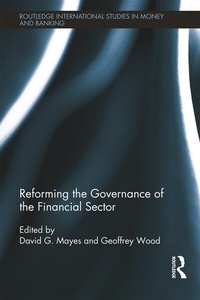
Reforming the Governance of the Financial Sector
1st Edition
Published on 6. September 2012
Book
Hardback
302 pages
978-0-415-68684-6 (ISBN)
Description
Many financial institutions have in recent years failed - failed either completely, and gone into bankruptcy, or failed in the sense that they have not achieved what their owners or their customers expected them to deliver. This has had significant and adverse effects on customers, taxpayers, shareholders, and sometimes management. There has been much discussion of what should be done about this, and some action has been taken. But has it been the right kind of action?
Crises of the sort being experienced are low probability but high impact events. This volume, from an international group of scholars, deals with two main issues: firstly, how can the governance of the financial sector by the authorities be improved and secondly, how can the governance of firms and institutions within the sector be improved to render the probability and cost of future crises lower?
Poor governance has been one of the major contributors to the global financial crisis. With better governance of and in the financial sector the financial crisis might well have been avoided altogether and certainly could have been much milder in its impact. This is not simply a case of being wise after the event. These problems were widely discussed before the event, but little action was taken. This book explores not only what the contribution of poor governance was to the crisis and to its depth, but also why it is often difficult to improve governance. The volume offers a positive critique of the measures that are being put in place in the light of the experience of the crisis and suggests how they might plausibly be improved.
This book will be of particular interest to students and researchers of economics and international finance, but will also prove profitable reading for practitioners and the interested public.
Crises of the sort being experienced are low probability but high impact events. This volume, from an international group of scholars, deals with two main issues: firstly, how can the governance of the financial sector by the authorities be improved and secondly, how can the governance of firms and institutions within the sector be improved to render the probability and cost of future crises lower?
Poor governance has been one of the major contributors to the global financial crisis. With better governance of and in the financial sector the financial crisis might well have been avoided altogether and certainly could have been much milder in its impact. This is not simply a case of being wise after the event. These problems were widely discussed before the event, but little action was taken. This book explores not only what the contribution of poor governance was to the crisis and to its depth, but also why it is often difficult to improve governance. The volume offers a positive critique of the measures that are being put in place in the light of the experience of the crisis and suggests how they might plausibly be improved.
This book will be of particular interest to students and researchers of economics and international finance, but will also prove profitable reading for practitioners and the interested public.
More details
Series
Language
English
Place of publication
London
United Kingdom
Publishing group
Taylor & Francis Ltd
Target group
College/higher education
Illustrations
6 s/w Abbildungen, 6 s/w Zeichnungen, 17 s/w Tabellen
17 Tables, black and white; 6 Line drawings, black and white; 6 Illustrations, black and white
Dimensions
Height: 234 mm
Width: 156 mm
Weight
750 gr
ISBN-13
978-0-415-68684-6 (9780415686846)
Copyright in bibliographic data and cover images is held by Nielsen Book Services Limited or by the publishers or by their respective licensors: all rights reserved.
Schweitzer Classification
Other editions
Additional editions
David Mayes | Geoffrey Wood
Reforming the Governance of the Financial Sector
Book
05/2014
1st Edition
Routledge
€89.32
Shipment within 10-20 days
David Mayes | Geoffrey Wood
Reforming the Governance of the Financial Sector
E-Book
12/2012
1st Edition
Routledge
€77.99
Available for download
David Mayes | Geoffrey Wood
Reforming the Governance of the Financial Sector
E-Book
12/2012
1st Edition
Routledge
€77.99
Available for download
Persons
David G. Mayes is BNZ Professor of Finance and Director of the New Zealand Governance Centre and the Europe Institute at the University of Auckland, New Zealand.
Geoffrey Wood is Professor Emeritus of Economics at Cass Business School, City University, UK and Professor Emeritus of Monetary Economics at the University of Buckingham, UK.
Geoffrey Wood is Professor Emeritus of Economics at Cass Business School, City University, UK and Professor Emeritus of Monetary Economics at the University of Buckingham, UK.
Content
1. Introduction David G. Mayes and Geoffrey Wood 2. Fundamental Problems with the Governance of the Financial Sector Bruce Sheppard 3. The Poor Performance of Compulsory Saving in Australia: Superannuation and Corporate Governance Christine Brown and Deborah Ralston 4. Best Practice Corporate Governance? The Failure of Bridgecorp Finance Ltd. William Wilson, Laurence Rose and John Pinfold 5. Bank Governance: What Do We Know, and What Should We Do? Kevin Davis 6. Moral Hazard, Bank Governance and the Protection of Depositors David G Mayes, with comments by Geof Mortlock 7. Efficiency, Stability, and Integrity in the Financial Sector: The Role of Governance and Regulation Geoffrey Wood 8. The Impact of the Global Financial Crisis on Financial Policy Grant Spencer 9. Creating Policy Stigmas in Financial Governance: The International Monetary Fund and Capital Controls Jeffrey M. Chwieroth 10. Missing the Red Flag Gillian G.H. Garcia 11. Time for a Paradigm Shift in Thinking Jane Diplock 12. Cultural Considerations for Prudential Supervisors Charles Littrell 13. Firm Stability and System Stability: The Regulatory Delusion Geoffrey Wood 14. Surviving the Next Financial Crisis David G. Mayes