

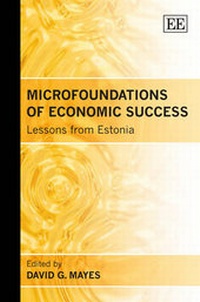
Microfoundations of Economic Success
Lessons from Estonia
Published on 30. April 2009
Book
Hardback
328 pages
978-1-84720-929-0 (ISBN)
Description
This book explores the nature of the flexibility of Estonia's rapid growth, that enables it to swiftly seize opportunities and weather crises without undue cost.The distinguished cast of contributors draws upon detailed data on individual firms and households to explore the basis for Estonia's record as the most successful of all the EU accession countries over the last decade. They conclude that much of this accomplishment can be attributed to the greater flexibility of the Estonian economy, both in price setting in employment and wages, and in consumption. The book also reveals that Estonia is able to adjust to shocks more rapidly and with less real impact than other countries. Coupled with a favourable macroeconomic policy and a good institutional structure and legal framework, this indicates that Estonia will be an excellent example to other countries despite the recent downturn.
This unique book will be of great interest to researchers and students of the economics of transition, and will prove invaluable to policy-makers and their advisors in both transition countries and the rest of the EU, as well as graduate students studying microeconomics and monetary policy.
This unique book will be of great interest to researchers and students of the economics of transition, and will prove invaluable to policy-makers and their advisors in both transition countries and the rest of the EU, as well as graduate students studying microeconomics and monetary policy.
More details
Language
English
Place of publication
Cheltenham
United Kingdom
Target group
Professional and scholarly
Dimensions
Height: 234 mm
Width: 156 mm
ISBN-13
978-1-84720-929-0 (9781847209290)
Copyright in bibliographic data and cover images is held by Nielsen Book Services Limited or by the publishers or by their respective licensors: all rights reserved.
Schweitzer Classification
Person
Edited by the late David G. Mayes, formerly Professor of Banking and Financial Institutions, Director, Europe Institute and Director, NZ Governance Centre, University of Auckland, New Zealand
Content
Contents:
Foreword
1. The Path of Transition in Estonia
David G. Mayes and Martti Randveer
2. Comparison of Pricing Behaviour of Firms in the Euro Area and Estonia
Aurelijus Dabusinskas and Martti Randveer
3. The Principles of Wage Formation in Estonian Companies
Tairi Room and Lenno Uuskuela
4. Productivity in Estonian Enterprises: The Role of Innovation and Competition
Priit Vahter
5. Liquidity and Productivity Shocks: A Look at Sectoral Firm Creation
Lenno Uuskuela
6. A Microeconometric Analysis of Household Saving in Estonia: Income, Wealth and Financial Exposure
Dmitry Kulikov, Annika Paabut and Karsten Staehr
7. Estimates of Employment and Welfare Effects of Personal Labour Income Taxation in a Flat-Tax Country
Karsten Staehr
8. Outlook
David G. Mayes and Martti Randveer
Index
Foreword
1. The Path of Transition in Estonia
David G. Mayes and Martti Randveer
2. Comparison of Pricing Behaviour of Firms in the Euro Area and Estonia
Aurelijus Dabusinskas and Martti Randveer
3. The Principles of Wage Formation in Estonian Companies
Tairi Room and Lenno Uuskuela
4. Productivity in Estonian Enterprises: The Role of Innovation and Competition
Priit Vahter
5. Liquidity and Productivity Shocks: A Look at Sectoral Firm Creation
Lenno Uuskuela
6. A Microeconometric Analysis of Household Saving in Estonia: Income, Wealth and Financial Exposure
Dmitry Kulikov, Annika Paabut and Karsten Staehr
7. Estimates of Employment and Welfare Effects of Personal Labour Income Taxation in a Flat-Tax Country
Karsten Staehr
8. Outlook
David G. Mayes and Martti Randveer
Index