

Making and Unmaking Disability
The Three-Body Approach
Published on 17. September 2019
Book
Hardback
264 pages
978-1-5381-2772-8 (ISBN)
Description
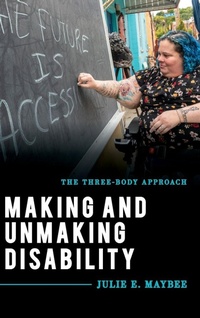
If the future is accessible, as Alisa Grishman-one of 55 million Americans categorized as having a disability-writes in this book's cover image, then we must stop making or constructing people as disabled and impaired.
In this brave new theoretical approach to human physicality, Julie E. Maybee traces societal constructions of disability and impairment through Western history along three dimensions of embodiment: the personal body, the interpersonal body, and the institutional body. Each dimension has played a part in defining people as disabled and impaired in terms of employment, healthcare, education, and social and political roles.
Because impairment and disability have been constructed along all three of these bodies, unmaking disability and making the future accessible will require restructuring Western institutions, including capitalism, changing how social roles are assigned, and transforming our deepest beliefs about impairment and disability to reconstruct people as capable. Ultimately, Maybee suggests, unmaking disability will require remaking our world.
In this brave new theoretical approach to human physicality, Julie E. Maybee traces societal constructions of disability and impairment through Western history along three dimensions of embodiment: the personal body, the interpersonal body, and the institutional body. Each dimension has played a part in defining people as disabled and impaired in terms of employment, healthcare, education, and social and political roles.
Because impairment and disability have been constructed along all three of these bodies, unmaking disability and making the future accessible will require restructuring Western institutions, including capitalism, changing how social roles are assigned, and transforming our deepest beliefs about impairment and disability to reconstruct people as capable. Ultimately, Maybee suggests, unmaking disability will require remaking our world.
Reviews / Votes
Drawing from a knowledge base encompassing such diverse disciplines as anthropology, philosophy, feminist theory, and disability theory and history, Maybee (philosophy, Lehman College, CUNY) develops a powerful discussion of the way prevailing societal beliefs shape every facet of how people organize and make sense of the world around them. Maybee's three-pronged strategy is based on embodiment-institutional, interpersonal, and individual-and she uses it in analyzing how persistent values are created and reflected in the language used to define disability, in effect "making" a construct of a person's worth in the community. Maybee explores the interactive sociocultural and economic factors that keep people who have disabilities from fully engaging with their milieus. She suggests, rightly, that to achieve equality for people with disabilities, change must be institutional and structural to be effective and "unmake" disability. Maybee is a skilled writer and lays out logical arguments to facilitate change. She has extensive experience as a mother of a child who became disabled because of a brain aneurysm. The narrative is easy to follow, and Maybee provides succinct outlines reinforcing her points.Summing Up: Recommended. All readers. * Choice Reviews * Making and Unmaking Disability: The Three-Body Approach dissects disability and its social construction through the three dimensions of embodiment: the personal, interpersonal, and institutional body.... Those interested in teaching special education-from elementary education to higher education-would find this informative. * Communication Booknotes Quarterly * Informed by anthropology, philosophy, feminist theory, disability theory, and history, Julie E. Maybee provides a sweeping overview of many barriers to equity and community participation faced by people with disabilities in American society. This book is a great primer on different ways to look at disability. -- Jennifer C. Sarrett, lecturer, Emory University A fresh and insightful approach to analyzing the complex routes through which the phenomenon of disability is generated. Maybee's theoretically and empirically wide-ranging account moves the discussion of disability and embodiment to a new level. -- Jackie Leach Scully, director, Disability Innovation Institute, University of New South Wales An important contribution to the growing literature on philosophy and disability. Moving fluently between philosophy, the social sciences, and history, it makes a powerful case that our judgments, perceptions, and even experiences of disability have been pervasively shaped by political, economic, social, and cultural forces. -- David Wasserman, Clinical Center Department of Bioethics, National Institutes of Health
More details
Series
Language
English
Place of publication
United States
Publishing group
Bloomsbury Publishing Plc
Target group
College/higher education
US School Grade: From College Freshman to College Graduate Student
Illustrations
1 b/w illustration; 1 table; 44 textboxes
Dimensions
Height: 235 mm
Width: 157 mm
Thickness: 20 mm
Weight
581 gr
ISBN-13
978-1-5381-2772-8 (9781538127728)
Copyright in bibliographic data and cover images is held by Nielsen Book Services Limited or by the publishers or by their respective licensors: all rights reserved.
Schweitzer Classification
Other editions
Additional editions
E-Book
09/2019
1st Edition
Rowman & Littlefield Publishers
€35.49
Available for download
E-Book
09/2019
1st Edition
Bloomsbury eBooks US
€35.49
Available for download
Person
JULIE E. MAYBEE is professor and chair of the Department of Philosophy as well as the director of the interdisciplinary Disability Studies Minor at Lehman College, City University of New York (CUNY). She also teaches in the Disability Studies Master's Program for CUNY's School of Professional Studies. For many years, her research areas were nineteenth-century Continental philosophy, particularly the work of G. W. F. Hegel, Africana philosophy, and race and philosophy. After her daughter had a brain aneurysm and came to be what our society would call "disabled" in 2002, Maybee became interested in the analysis of disability as a social category.
Content
Series Editor Foreword
Preface and Acknowledgements
Introduction and Theoretical Overview
Chapter 1: Disability and Capitalism
Chapter 2: A New Structure of Attitudes: Normalcy, Eugenics, the Ugly Laws and Segregation
Chapter 3: The Experience of the Socially Defined Body
Chapter 4: The Socially Defined Body in Society
Chapter 5: The Socially Constructed Body in Biology
Chapter 6: Beyond Individual Accommodation
Chapter 7: Diversifying Access, Remaking Worlds
Conclusion
Preface and Acknowledgements
Introduction and Theoretical Overview
Chapter 1: Disability and Capitalism
Chapter 2: A New Structure of Attitudes: Normalcy, Eugenics, the Ugly Laws and Segregation
Chapter 3: The Experience of the Socially Defined Body
Chapter 4: The Socially Defined Body in Society
Chapter 5: The Socially Constructed Body in Biology
Chapter 6: Beyond Individual Accommodation
Chapter 7: Diversifying Access, Remaking Worlds
Conclusion