

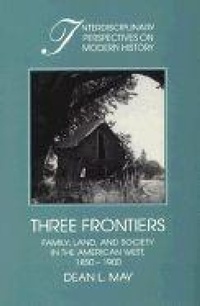
Three Frontiers
Family, Land, and Society in the American West, 1850-1900
Published on 26. August 1994
Book
Hardback
324 pages
978-0-521-43499-7 (ISBN)
Description
This book explores the values and aspirations of early settlers in the American Far West. It compares those who settled in the Willamette Valley in the 1840s, the Utah Valley in the 1850s, and the Boise Valley in the 1860s. The Oregon and Utah settlers tried with differing degrees of success to resist the modernizing trends represented by Idaho, but ultimately adopted their individualistic, commercial, and acquisitive values. How did Americans move away from a culture centering on family and kin and from attitudes that valued and protected the land, not for its commercial worth, but as the base of support for future generations? What led to the present tendency to pursue individual pleasure and material well-being at the expense of communal and broader societal well-being? These two questions are central to this comparative study of the three groups who pioneered the Western frontier.
Reviews / Votes
"This is an exciting study, intellectually stimulating and provocative, skillful in its interweaving of people and places and scholastic disciplinary skills....written in a clear and graceful style." American Historical Review "Three Fontiers is a complex, ambitious social history..." The Journal of American History "Creatively using census and economic data, Dean May has produced a well-researched, provocative study of three towns in the U.S. West--Sublimity, Oregon; Alpine, Utah; and Middleton, Idaho--thus crafting a comparative analysis of people in places." The Historian "The treatment is fair and even handed..." Western Historical Quarterly "...the most important contribution of this research is that it offers a perspective that is neither an outright rejection nor acceptance of the Turnerian or Hartzian views. The truth lies somewhere between both deterministic models, and Dean May has managed to capture the essence of this truth in a very fine book." Utah Historical Quarterly "Imaginative in using his sources to yield insight into the dreams and hopes of his settlers as well as their material existence, unafraid to speculate, sensitive to the nuances of non-quantitative sources, May has written an excellent and insightful book." Journal of Social History "May does an impressive job of gracefully integrating his observations into each chapter. This book will be most useful, and welcome, to specialists in the field." S.L. Recken, Choice "...May's project required the assembly of comparable data from the disarray of three widely separated communities in Oregon, Utah, and Idaho. What's more important, he has come up with provocative and significant results....this is an important comparative history of American communities and an essential study for historians of the American West. John Faragher, Pacific Northwest Quarterly "Creatively using census and economic data, Dean May has produced a well-researched, provocative study of three towns in the U.S. West -- Sublimity, Oregon; Alpine, Utah; and Middleton, Idaho -- thus crafting a comparative analysis of people in places." Gordon Bakken, The Historian "Three Frontiers is a masterful social history of community in the American West....richly detailed chapters..." David A. Johnson, Oregon Historical SocietyMore details
Series
Language
English
Place of publication
Cambridge
United Kingdom
Target group
Professional and scholarly
Illustrations
3 Tables, unspecified; 4 Maps; 16 Halftones, unspecified; 264 Line drawings, unspecified
Dimensions
Height: 235 mm
Width: 157 mm
Thickness: 22 mm
Weight
630 gr
ISBN-13
978-0-521-43499-7 (9780521434997)
Copyright in bibliographic data and cover images is held by Nielsen Book Services Limited or by the publishers or by their respective licensors: all rights reserved.
Schweitzer Classification
Person
Content
Preface; 1. A long, tedious journey; 2. His own customs are the best; 3. These savage desert regions; 4. The heirs of my body; 5. The soil to our posterity; 6. The place where we lived; 7. Our paths diverged; Coda; Note on sources; Appendix.