

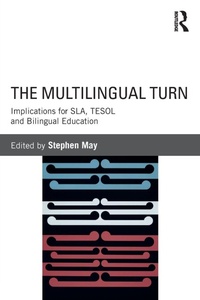
The Multilingual Turn
Implications for SLA, TESOL, and Bilingual Education
1st Edition
Published on 30. July 2013
Book
Paperback/Softback
240 pages
978-0-415-53432-1 (ISBN)
Description
Drawing on the latest developments in bilingual and multilingual research, The Multilingual Turn offers a critique of, and alternative to, still-dominant monolingual theories, pedagogies and practices in SLA, TESOL, and bilingual education. Critics of the 'monolingual bias' argue that notions such as the idealized native speaker, and related concepts of interlanguage, language competence, and fossilization, have framed these fields inextricably in relation to monolingual speaker norms. In contrast, these critics advocate an approach that emphasizes the multiple competencies of bi/multilingual learners as the basis for successful language teaching and learning.
This volume takes a big step forward in re-situating the issue of multilingualism more centrally in applied linguistics and, in so doing, making more permeable its key sub-disciplinary boundaries - particularly, those between SLA, TESOL, and bilingual education. It addresses this issue head on, bringing together key international scholars in SLA, TESOL, and bilingual education to explore from cutting-edge interdisciplinary perspectives what a more critical multilingual perspective might mean for theory, pedagogy, and practice in each of these fields.
This volume takes a big step forward in re-situating the issue of multilingualism more centrally in applied linguistics and, in so doing, making more permeable its key sub-disciplinary boundaries - particularly, those between SLA, TESOL, and bilingual education. It addresses this issue head on, bringing together key international scholars in SLA, TESOL, and bilingual education to explore from cutting-edge interdisciplinary perspectives what a more critical multilingual perspective might mean for theory, pedagogy, and practice in each of these fields.
Reviews / Votes
"This important contribution to educational linguistics... adds a much-needed social perspective to the theory of SLA, English language teaching, and bilingual education. It takes a useful and needed step in moving beyond the monolingual and psycholinguistic biases of researchers in SLA and TESOL."Bernard Spolsky, Bar-Ilan University, Israel
"Boundary-breaking, with wonderful width as well as originality, this book is at the cutting edge. The star-studded list of chapter authors are THE experts in their fields of study."
Colin Baker, Bangor University, UK
"The critical approach to SLA, TESOL, bi- and multilingual education raises much needed questions about the usefulness of subject-bounded approaches to second language teaching. The case for multidisciplinary frameworks is well-made."
Naz Rassool, The University of Reading, UK
More details
Language
English
Place of publication
London
United Kingdom
Publishing group
Taylor & Francis Ltd
Target group
College/higher education
Illustrations
1 s/w Tabelle
1 Tables, black and white
Dimensions
Height: 229 mm
Width: 152 mm
Thickness: 13 mm
Weight
354 gr
ISBN-13
978-0-415-53432-1 (9780415534321)
Copyright in bibliographic data and cover images is held by Nielsen Book Services Limited or by the publishers or by their respective licensors: all rights reserved.
Schweitzer Classification
Other editions
Additional editions
Book
12/2013
1st Edition
Routledge
€231.70
Shipment within 15-20 days
E-Book
07/2013
1st Edition
Routledge
€69.99
Available for download
E-Book
07/2013
1st Edition
Routledge
€69.99
Available for download
Person
Stephen May is Professor of Education in Te Puna Wananga, and Deputy Dean Research in the Faculty of Education, University of Auckland, New Zealand. He is editor of the interdisciplinary journal, Ethnicities and Associate Editor of the journal Language Policy.
Content
Introducing the "Multilingual Turn" Ch. 1. Disciplinary Divides, Knowledge Construction, and the Multilingual Turn Ch. 2. Ways Forward for a Bi/multilingual Turn in SLA Ch. 3. Moving beyond "lingualism": Multilingual embodiment and multimodality in SLA Ch. 4. Theorizing a Competence for Translingual Practice at the Contact Zone Ch. 5. Identity, Literacy and the Multilingual Classroo Ch. 6. Communication and Participatory Involvement in Linguistically Diverse Classrooms Ch. 7. Multilingualism and Common Core State Standards in the US Ch. 8. Who's teaching whom? Co-learning in multilingual classrooms Ch. 9. Beyond Multilingualism: Heteroglossia in Practice