

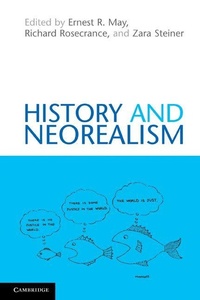
History and Neorealism
Published on 9. September 2010
Book
Paperback/Softback
406 pages
978-0-521-13224-4 (ISBN)
Description
Neorealists argue that all states aim to acquire power and that state cooperation can therefore only be temporary, based on a common opposition to a third country. This view condemns the world to endless conflict for the indefinite future. Based upon careful attention to actual historical outcomes, this book contends that, while some countries and leaders have demonstrated excessive power drives, others have essentially underplayed their power and sought less position and influence than their comparative strength might have justified. Featuring case studies from across the globe, History and Neorealism examines how states have actually acted. The authors conclude that leadership, domestic politics, and the domain (of gain or loss) in which they reside play an important role along with international factors in raising the possibility of a world in which conflict does not remain constant and, though not eliminated, can be progressively reduced.
Reviews / Votes
'This book by three eminent scholars is audacious in its hope: since history shows that nations do not always obey the rules of pure power politics, a world of consent and cooperation is possible - and ever more likely. They buttress their case with a wealth of data from the American, European and Asian experience, presenting an original synthesis of history and theory that has become far too rare in the field of international relations.' Josef Joffe, Senior Fellow, Freeman-Spogli Institute for International Studies, Stanford University 'Richard Rosecrance, Zara Steiner, and the late Ernest May, along with other notable contributors from the field of international relations, have assembled a stunning and provocative attack on what they believe to be the reductionist hegemony of neorealist theory. It will unleash a terrific debate and deserves a place on every reading list in international politics.' Charles S. Maier, Leverett Saltonstall Professor of History, Harvard University 'A first rate team of scholars convincingly and overwhelming demonstrates that there is more - vastly more - to international relations that has been dreamt of in 'realist' philosophies.' John Mueller, Ohio State UniversityMore details
Language
English
Place of publication
Cambridge
United Kingdom
Target group
Professional and scholarly
Product notice
Paperback (trade)
Illustrations
6 Tables, black and white
Dimensions
Height: 229 mm
Width: 152 mm
Thickness: 22 mm
Weight
589 gr
ISBN-13
978-0-521-13224-4 (9780521132244)
Copyright in bibliographic data and cover images is held by Nielsen Book Services Limited or by the publishers or by their respective licensors: all rights reserved.
Schweitzer Classification
Other editions
Additional editions
Ernest R. May | Richard Rosecrance | Zara Steiner
History and Neorealism
E-Book
11/2010
1st Edition
Cambridge University Press
€29.49
Available for download
Ernest R. May | Richard Rosecrance | Zara Steiner
History and Neorealism
Book
09/2010
Cambridge University Press
€92.40
Shipment within 15-20 days
Persons
Ernest R. May was Charles Warren Professor of History at Harvard University and a renowned historian of international relations and foreign policy. Richard Rosecrance is Adjunct Professor in the Kennedy School of Government and Director of the Project on US-Chinese Relations at the Belfer Center, Harvard University. He is also Research Professor in the Department of Political Science, UCLA. Zara Steiner is Senior Fellow of the British Academy and Emeritus Fellow of Murray Edwards College, University of Cambridge.
Content
1. Theory and international history Ernest R. May, Richard Rosecrance and Zara Steiner; 2. Transformations in power Richard Rosecrance; 3. Domestically driven deviations: internal regimes, leaders, and realism's power line John M. Owen IV; 4. How international institutions affect outcomes Robert O. Keohane and Lisa Martin; 5. Not even for the seventeenth and eighteenth centuries: power and order in the early modern era Paul W. Schroeder; 6. Austria-Hungary and the coming of the First World War Samuel R. Williamson Jr; 7. British decisions for peace and war 1938-1939: the rise and fall of realism Zara Steiner; 8. Realism and risk in 1938: German foreign policy and the Munich crisis Niall Ferguson; 9. Domestic politics, interservice impasse, and Japan's decisions for war Michael Barnhart; 10. Military audacity: Mao Zedong, Liu Shaoqi, and China's adventure in Korea Andrew Kennedy; 11. The United States' underuse of military power Ernest R. May; 12. The overuse of American power Robert S. Litwak; 13. Redrawing the Soviet power line: Gorbachev and the end of the Cold War Deborah Welch Larson and Alexei Shevchenko; 14. Shared sovereignty in the European Union: Germany's economic governance Sherrill Brown Wells and Samuel F. Wells Jr; 15. John Mearsheimer's 'elementary geometry of power': Euclidean moment or an intellectual blind alley? Jonathan Haslam; 16. History and neorealism reconsidered Richard Rosecrance and Zara Steiner.