

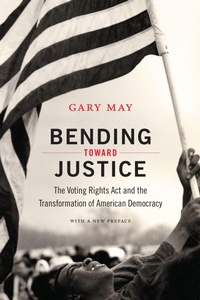
Bending Toward Justice
The Voting Rights Act and the Transformation of American Democracy
Published on 26. December 2014
Book
Paperback/Softback
344 pages
978-0-8223-5927-2 (ISBN)
Description
A vivid and fast-paced history, Gary May's Bending toward Justice offers a dramatic account of the birth and precarious life of the 1965 Voting Rights Act. It is an extraordinary story of the intimidation and murder of courageous activists who struggled to ensure that all Americans would be able to exercise their right to vote. May outlines the divisions within the Civil Rights Movement, describes the relationship between President Johnson and Martin Luther King Jr., and captures the congressional politics of the 1960s. Bending toward Justice is especially timely, given that the Supreme Court's decision in Shelby County v. Holder in 2013 invalidated a key section of the Voting Rights Act. As May shows, the fight for voting rights is by no means over.
Reviews / Votes
"Gary May's compelling book about the Voting Rights Act of 1965 is both timely and deeply historical. . . . The second half of the book examines in fascinating detail the passage of the law itself and its aftermath. May is careful to include and address critiques of the act from political and legal perspectives." - Margaret M. Russell (California Lawyer) "Bending Toward Justice is a book of the classical phase [of the Civil Rights Movement], a lively and unabashedly partisan account of Selma and the Voting Rights Act. . . . May tells the story in his own way, and he is able to add many details." - Louis Menand (The New Yorker) "An illuminating history of a law that remains all too relevant." (Booklist) "Have we-at long last-overcome? Not yet, University of Delaware historian Gary May makes clear in his exemplary account of the landmark law." - Kevin Boyle (Washington Post) "Compelling. . . . This lucid investigation of the [Voting Rights Act's] history relates its critical importance to American democracy." (Library Journal) "May accomplishes what he set out to do, rendering 'a dramatic account of the struggle that finally won African Americans the ballot.' It's a story that is chilling in many ways and inspiring in others. . . . May explores the testy relationship between the Rev. Dr. Martin Luther King Jr. and President Lyndon B. Johnson with nuance and detail. . . . And May's account of Johnson facing down Alabama Gov. George Wallace over Wallace's refusal to force county registrars to register black voters is one of the best descriptions anywhere of the fabled 'LBJ Treatment.'" - Paul Jablow (Philadelphia Inquirer) "Anyone interested in understanding the extent of the damage, actual and symbolic, to the voting rights of racial and ethnic minorities caused by this monumental decision [Shelby County v. Holder] would do well to read May's book. . . . Once the reader has finished the book, she will have a good grasp of the long, hard, often dangerous battle Blacks and their allies have fought since the end of Reconstruction to achieve equal voting rights, the terrible sacrifices champions of voting rights-particularly southern Blacks-have made in behalf of this goal, and the importance the VRA has had in partially achieving the goal." - Chandler Davidson (African American Review) "May's book is a great introduction to voting rights at a moment when the subject is drawing more attention than any time since 1965." - Ari Berman (The Nation) "May's lively and cogent history of the Voting Rights Act is indispensable reading for anyone concerned about the erosion of voting rights that has accompanied the election of Barack Obama, America's first black president, especially as the issue is still up for debate. . . . May has constructed a vivid, fast-paced morality tale. . . . By focusing on Selma, May pays tribute to the courage of otherwise ordinary people and makes a case for the continued relevance of this legislation." (Publishers Weekly)More details
Language
English
Place of publication
North Carolina
United States
Target group
Professional and scholarly
Product notice
Paperback (trade)
Illustrations
18 illustrations
Dimensions
Height: 231 mm
Width: 152 mm
Thickness: 18 mm
Weight
458 gr
ISBN-13
978-0-8223-5927-2 (9780822359272)
Copyright in bibliographic data and cover images is held by Nielsen Book Services Limited or by the publishers or by their respective licensors: all rights reserved.
Schweitzer Classification
Person
Gary May is Professor of History at the University of Delaware. He is the author of The Informant: The FBI, the Ku Klux Klan and the Murder of Viola Liuzzo.
Content
Prologue: The Most Powerful Instrument ix
Preface to the Paperback Edition xxiii
1. Planting the Seed 1
2. An Ideal Place 25
3. "Give Us the Ballot!" 53
4. Nothing Can Stop Us 85
5. To the Promised Land 125
6. The Die is Cast 149
7. Breaking Down Injustice 171
8. Where the Votes Are 203
9. The Struggle of a Lifetime 237
Acknowledgments 255
Notes 257
Index 303
Preface to the Paperback Edition xxiii
1. Planting the Seed 1
2. An Ideal Place 25
3. "Give Us the Ballot!" 53
4. Nothing Can Stop Us 85
5. To the Promised Land 125
6. The Die is Cast 149
7. Breaking Down Injustice 171
8. Where the Votes Are 203
9. The Struggle of a Lifetime 237
Acknowledgments 255
Notes 257
Index 303