

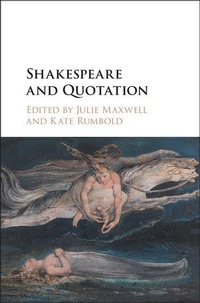
Shakespeare and Quotation
Published on 26. April 2018
Book
Hardback
322 pages
978-1-107-13424-9 (ISBN)
Description
Shakespeare is the most frequently quoted English author of all time. Quotations appear everywhere, from the epigraphs of novels to the mottoes on coffee cups. But Shakespeare was also a frequent quoter himself - of classical and contemporary literature, of the Bible, of snatches of popular songs and proverbs. This volume brings together an international team of scholars to trace the rich history of quotation from Shakespeare's own lifetime to the present day. Exploring a wide range of media, including Romantic poetry, theatre criticism, novels by Jane Austen, Thomas Hardy and Ian McEwan, political oratory, propaganda, advertising, drama, film and digital technology, the chapters draw fresh connections between Shakespeare's own practices of creative reworking and the quotation of his work in new and traditional forms. Richly illustrated and featuring an Afterword by Margreta de Grazia, the collection tells a new story of the making and remaking of Shakespeare's plays and poems.
More details
Language
English
Place of publication
Cambridge
United Kingdom
Target group
Professional and scholarly
College/higher education
Dimensions
Height: 235 mm
Width: 157 mm
Thickness: 24 mm
Weight
681 gr
ISBN-13
978-1-107-13424-9 (9781107134249)
Copyright in bibliographic data and cover images is held by Nielsen Book Services Limited or by the publishers or by their respective licensors: all rights reserved.
Schweitzer Classification
Other editions
Additional editions
Julie Maxwell | Kate Rumbold
Shakespeare and Quotation
E-Book
06/2018
Cambridge University Press
€88.99
Available for download
Julie Maxwell
Shakespeare and Quotation
E-Book
04/2018
Cambridge University Press
€73.99
Available for download
Persons
Julie Maxwell is an independent scholar and was formerly a Fellow and Lecturer in English at Lucy Cavendish College, University of Cambridge and Exeter College, University of Oxford. She is the author of two novels which quote Shakespeare: You Can Live Forever (2007; winner of a Betty Trask Award; TLS Books of the Year), and These Are our Children (2013; Observer Books of the Year). Kate Rumbold is Senior Lecturer in English Literature at the University of Birmingham. She is the author of Shakespeare and the Eighteenth-Century Novel: Cultures of Quotation from Samuel Richardson to Jane Austen (Cambridge, 2016), and the co-author, with Kate McLuskie, of Cultural Value in the Twenty-First Century: the Case of Shakespeare (2014).
Content
List of illustrations; Acknowledgements; General introduction; Part I. Shakespeare and Early Modern Quotation: Introduction; 1. Shakespeare and the early modern culture of quotation James P. Bednarz; 2. Shakespeare and Sententiae: the use of quotation in Lucrece Kevin Petersen; 3. 'The ears of profiting': listening to Falstaff's biblical quotations Beatrice Groves; 4. Quoting Hamlet Douglas Bruster; Part II. Quoting Shakespeare, 1700-2000: Introduction; 5. 'Shakespeare says ...': the anthology and the eighteenth-century novel Kate Rumbold; 6. Pope's Shakespeare and poetic quotation in the early eighteenth century Brean Hammond; 7. Shakespeare quotation in the Romantic Age Fiona Ritchie and R. S. White; 8. Quoting Shakespeare in the British novel from Dickens to Wodehouse Daniel Pollack-Pelzner; 9. Pedagogy and propaganda: the uses of quotation, 1750-1945 Frans De Bruyn, Gail Marshall and Ton Hoenselaars; 10. The impossibility of quotation: twentieth-century literature Craig Raine; 11. Quoting Shakespeare in twentieth-century film Toby Malone; Part III. Quoting Shakespeare Now: Introduction; 12. Creative writing: quoting Shakespeare in theory and in practice Julie Maxwell; 13. Quoting Shakespeare in contemporary poetry and prose Christy Desmet; 14. Mis/quotation in constrained writing Peter Kirwan; 15. 'Beauty too rich for use?': Shakespeare and advertising Graham Holderness; 16. Digital technology and the future of reception history Stephen O'Neill, Balz Engler and Regula Trillini Hohl; Afterword Margreta de Grazia.