

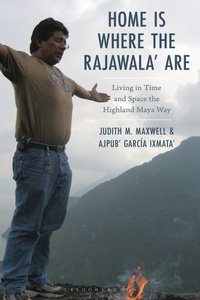
Home Is Where the Rajawala' Are
Living in Time and Space the Highland Maya Way
Will be published approx. on 1. October 2026
Book
Hardback
264 pages
978-1-6669-3392-5 (ISBN)
Description
The Mayan peoples of highland Guatemala live within an animate world, where the physical environment, ancestors, and surrounding people, plants, and animals are infused with spirit and presence.
At the heart of this daily engagement are the ajq'ija', Mayan spiritual guides who serve as mediators between human communities and the rajawala'-the vital, living energies of the world. This book offers insight into the foundational knowledge ajq'ija' use to communicate with the rajawala', revealing how the sacred becomes visible through time and space, shaping and protecting the landscapes where Maya communities live. Each community is surrounded by its own constellation of guardian energies and sacred altars. The authors also confront the modern threats facing these sacred spaces: restricted access by private landowners, the loss of traditional roles, vandalism, religious opposition, environmental degradation, and violence against spiritual practitioners. Structured like a ritual itself, the book embodies the ongoing creation of sacred space and the deep dialogue with spiritual forces that sustain it. Through this work, the authors aim to share Mayan perspectives and practices for living within a sacred, interconnected world.
At the heart of this daily engagement are the ajq'ija', Mayan spiritual guides who serve as mediators between human communities and the rajawala'-the vital, living energies of the world. This book offers insight into the foundational knowledge ajq'ija' use to communicate with the rajawala', revealing how the sacred becomes visible through time and space, shaping and protecting the landscapes where Maya communities live. Each community is surrounded by its own constellation of guardian energies and sacred altars. The authors also confront the modern threats facing these sacred spaces: restricted access by private landowners, the loss of traditional roles, vandalism, religious opposition, environmental degradation, and violence against spiritual practitioners. Structured like a ritual itself, the book embodies the ongoing creation of sacred space and the deep dialogue with spiritual forces that sustain it. Through this work, the authors aim to share Mayan perspectives and practices for living within a sacred, interconnected world.
Reviews / Votes
Much has been written about Mayas' spiritual practices, but nothing measures up to Maxwell and Garcia Ixmata''s splendid, Home is Where the Rajawala' Are. This ethnographically and linguistically rich book is both a primer on how Mayas communicate with their ancestral, spiritual, and cosmological world and a detailed description of the sacred geography in which their practices take place. Moreover, throughout their book, they include historical and political context and deeply personal anecdotes from decades of experience. * Walter E. Little, University at Albany, SUNY * Home Is Where the Rajawala' Are is an invaluable contribution and belongs on the bookshelves of anyone interested in highland Maya ceremonialism and spirituality. I will return to its pages again and again in my own work. Judith Maxwell is a gifted linguist and anthropologist who has advanced the field of Maya studies for more years than either of us would likely care to say. She has established herself as the pre-eminent scholar of Kaqchikel Maya language, literature, and ritual practices outside the traditional Indigenous community itself. Her eighteen-year friendship and collaboration with Ajpub' Garcia Ixmata', himself a dedicated researcher as well as an ajq'ij (daykeeper), gives the reader a rare opportunity to look over the shoulders of living Maya caretakers of a spiritual worldview that has survived centuries of repression and persecution. This book is not only a masterwork of scholarship, but a token of deep respect for one of the world's great cultural traditions. -- Allen Christenson, Brigham Young University, USA. In this beautifully illustrated book the reader finds an authoritative and comprehensive understanding and explication of early twenty-first century Guatemalan Mayan cosmovision, shown to be based on enduring shared principles but also to be a work in progress. It describes the institutionalized practices that have developed since peace accords at the end of the twentieth century offered protection from interference by Christian zealots or by the Guatemalan state and since the indigenous people, with the help of linguists and epigraphers, gained access to the sixteenth century chronicles left by their direct ancestors and to Classic Maya carved and painted texts. The book combines a deep and rich description of the calendrical system and of the altars and practices that attune the human community to the energies that animate the universe. While this ethnographic description is at the center of the book the authors are aware of the complexity of the process of constructing a revitalized Mayan religion and of its internal conflicts and contradictions, for example in the uneasy but often productive relationship between Mayan tradition and new age spirituality, or the conflicts between efforts of regional councils to standardize practices and resistance by individual practitioners working in local traditions and guided by their own dreams and inspirations. It provides a very welcome, authoritative, sophisticated, thoroughly contextualized and important updating of existing scholarship on an Indigenous religion emerging from centuries of repression and finding its way in a globalized and commodified world. There is authenticity, accuracy, wisdom and something for everybody in this brilliant account. -- Garrett W. Cook, Baylor University, USA Home is Where the Rajawala' Are beautifully evokes a Maya world that is vibrantly alive. In this deeply collaborative work, Maya spirituality emerges on its own terms, situating humans within living, relational ecological and cosmological systems. Mountains and rivers, plants and animals, ancestors and winds all possess vital energy, and wellbeing depends on sustaining balance among these forces through reciprocity, respect, and dialogue. At a moment when global challenges increasingly strain the conceptual boundaries of Western thought, such ways of understanding the world and our place within it have much to teach us--and are urgently needed. -- Edward F. Fischer, Vanderbilt University, USA As the authors and Maya colleagues re-encounter and re-consecrate Maya sacred spaces, I am transported to Alta Verapaz and similar invitations to these sublime, otherworldly, sensorially powerful places. Their descriptions, layered with their combined decades of research and detailed syntheses, deepen my understanding of these cherished experiences and the Maya practitioners. -- Abigail E. Adams, Professor Emerita, Central Connecticut State University, USA. The authors bring long experience and deep knowledge to this study of Kaqchikel and Tz'utujiil Maya altars in the Lake Atitlan region of highland Guatemala. They document over the last half century how altars sacralize places and precepts through Maya calendrics, cosmology, geopolitics, and cultural revindication, affirming not some timeless Maya culture but a continual recovery and reconstitution of Maya knowledge across centuries of social and political violence. Invoking as Maya do spirituality instead of religion, the authors also remind us that spirituality at base involves a mindfulness to the world of signs in which we all as symbol using beings live. How Maya altarists read and respond to the signs they perceive makes clear their spirituality seeks sense in what they can neither will nor forestall but must abide: their faith that they can, if only conditionally, presumes an immanent, Durkheimian sociality of mutual place and purpose that reading this book could remind secular modernists well to recall. -- John M. Watanabe, Professor Emeritus, Dartmouth College, USA Maxwell and Garcia Ixmata' not only document the basic tenents of modern Maya spiritual practice, but they do so from a Mayan epistemological and ontological approach. Collaborating and gathering data in Kaqchikel and Tz'utujil Maya for two decades, the authors shepherd Maya ideologies into English. The collaborative methodology alone is a rare gem to which many academic authors only ever aspire. The volume presents readers with a stunning and unprecedented account of modern Maya spiritual practice, its challenges, and its intersections with daily life, ongoing clashes, and economic development. -- Joyce N. Bennett, Bates College, USA As they explore how ancient Maya histories and contemporary community relations inform town altars and the ceremonies ajq'ija (daykeepers) perform at them, Maxwell and Garcia Ixmata demonstrate how Maya spirituality is animated by both the past and present. Their study also reveals community tensions where, for example, evangelical leaders discourage the use of sacred Maya altars and forbid ceremonies that the rajawala' (spirit guardians), ajq'ija, and local Mayas refuse to concede. With adventures that compel them to take harrowing paths down ravines and up mountains, confront shotgun-wielding landowners, and even collaborate with ajq'ija to rescue a kidnapped girl, the authors' recounting of the research is as thrilling as their findings are enlightening. -- David Carey Jr., Loyola University Maryland, USAMore details
Language
English
Place of publication
United States
Publishing group
Bloomsbury Publishing Plc
Target group
Professional and scholarly
Product notice
sewn/stitched
Cloth over boards
With dust jacket
Illustrations
19 bw figures, 3 tables
Dimensions
Height: 229 mm
Width: 152 mm
Thickness: 28 mm
Weight
503 gr
ISBN-13
978-1-6669-3392-5 (9781666933925)
Copyright in bibliographic data and cover images is held by Nielsen Book Services Limited or by the publishers or by their respective licensors: all rights reserved.
Schweitzer Classification
Other editions
Additional editions
Judith M. Maxwell | Ajpub' Garcia Ixmata'
Home Is Where the Rajawala' Are
Living in Time and Space the Highland Maya Way
E-Book
approx. 09/2026
Bloomsbury Academic
€90.99
Available for download
Judith M. Maxwell | Ajpub' Garcia Ixmata'
Home Is Where the Rajawala' Are
Living in Time and Space the Highland Maya Way
E-Book
approx. 09/2026
Bloomsbury Academic
€90.99
Available for download
Persons
Judith M. Maxwell is Professor of Anthropology at Tulane University.
Ajpub' Garcia Ixmata' teaches at Universidad Rafael Landivar.
Ajpub' Garcia Ixmata' teaches at Universidad Rafael Landivar.
Content
Table of Contents
Foreword
Chapter One: Rajawala' in an Animate Universe
Chapter Two: Mayan Time
Chapter Three: Space
Chapter Four: The Spatial Distribution of the Avatars of Time
Chapter Five: Town Guardian Altars: a sample located in time and space
Chapter Six: The Responsibilities of the Caretakers of the Sacred Spaces
Chapter Seven: Threats to Public Altars
Chapter Eight: Founding New Towns and Seating their Altars
Chapter Nine: Home Altars
Chapter Ten: Regional and International Altars
Chapter Eleven: Regulation
Chapter Twelve: Health and Spiritual Practice
Chapter Thirteen: Creating and Re-creating Safe, Protected and Protective Mayan Spaces
Bibliography
Index
About the Authors
Foreword
Chapter One: Rajawala' in an Animate Universe
Chapter Two: Mayan Time
Chapter Three: Space
Chapter Four: The Spatial Distribution of the Avatars of Time
Chapter Five: Town Guardian Altars: a sample located in time and space
Chapter Six: The Responsibilities of the Caretakers of the Sacred Spaces
Chapter Seven: Threats to Public Altars
Chapter Eight: Founding New Towns and Seating their Altars
Chapter Nine: Home Altars
Chapter Ten: Regional and International Altars
Chapter Eleven: Regulation
Chapter Twelve: Health and Spiritual Practice
Chapter Thirteen: Creating and Re-creating Safe, Protected and Protective Mayan Spaces
Bibliography
Index
About the Authors