

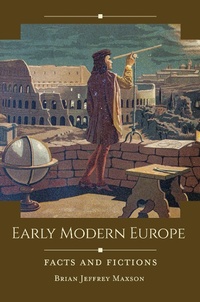
Early Modern Europe
Facts and Fictions
Published on 15. June 2023
Book
Hardback
272 pages
978-1-4408-6745-3 (ISBN)
Description
Through the exploration of nine common myths about the history and culture of early modern Europe, roughly 1350-1700, this book uses common assumptions to introduce newcomers to the period and its key figures, developments, and events.
Many myths about early modern Europe originated in the 19th and 20th centuries and continue to appear today across popular media. In recent years, such popular documentaries and television shows as Game of Thrones have tended to reinforce what we think we know about the world during the early modern period.
Early modern Europe birthed the modern world-just not in the way we think it did. This installment in the Facts and Fictions series utilizes primary sources to interrogate popular beliefs about early modern Europe and reveal the true story behind such movements and events as the Scientific Revolution, the Crusades, and the European witch hunts. Focusing on how perceptions of these events have shifted and evolved through history, this book is an excellent resource for students of this period as well as general readers interested in understanding what really happened during this time.
Many myths about early modern Europe originated in the 19th and 20th centuries and continue to appear today across popular media. In recent years, such popular documentaries and television shows as Game of Thrones have tended to reinforce what we think we know about the world during the early modern period.
Early modern Europe birthed the modern world-just not in the way we think it did. This installment in the Facts and Fictions series utilizes primary sources to interrogate popular beliefs about early modern Europe and reveal the true story behind such movements and events as the Scientific Revolution, the Crusades, and the European witch hunts. Focusing on how perceptions of these events have shifted and evolved through history, this book is an excellent resource for students of this period as well as general readers interested in understanding what really happened during this time.
More details
Series
Language
English
Place of publication
London
United Kingdom
Publishing group
Bloomsbury Publishing PLC
Target group
College/higher education
Primary & secondary/elementary & high school
Product notice
sewn/stitched
Cloth over boards
With dust jacket
Illustrations
9 bw illus
Dimensions
Height: 236 mm
Width: 156 mm
Thickness: 20 mm
Weight
454 gr
ISBN-13
978-1-4408-6745-3 (9781440867453)
Copyright in bibliographic data and cover images is held by Nielsen Book Services Limited or by the publishers or by their respective licensors: all rights reserved.
Schweitzer Classification
Other editions
Additional editions
E-Book
06/2023
1st Edition
Bloomsbury Academic USA
€108.99
Available for download
E-Book
06/2023
Bloomsbury Academic USA
€24.99
Available for download
Person
Brian Jeffrey Maxson is Professor of History at East Tennessee State University, USA
Content
Preface
Acknowledgments
Introduction
1. The Italian Renaissance Ended the Dark Ages and Ushered in the Modern World
2. Christopher Columbus Proved that the Earth Was Round
3. Early Modern Women Were Uneducated and Uninfluential
4. Humanists Introduced Secularism to Early Modern Europe
5. The Pope Was an All-Powerful Ruler in Early Modern Europe
6. The Moral Failures of the Catholic Church Made the Reformation Inevitable
7. Torture and Superstition Drove the Witch Hunts
8. A Few Geniuses Sparked the Scientific Revolution
9. The Crusades Ended in the Middle Ages
Bibliography
Index
Acknowledgments
Introduction
1. The Italian Renaissance Ended the Dark Ages and Ushered in the Modern World
2. Christopher Columbus Proved that the Earth Was Round
3. Early Modern Women Were Uneducated and Uninfluential
4. Humanists Introduced Secularism to Early Modern Europe
5. The Pope Was an All-Powerful Ruler in Early Modern Europe
6. The Moral Failures of the Catholic Church Made the Reformation Inevitable
7. Torture and Superstition Drove the Witch Hunts
8. A Few Geniuses Sparked the Scientific Revolution
9. The Crusades Ended in the Middle Ages
Bibliography
Index