

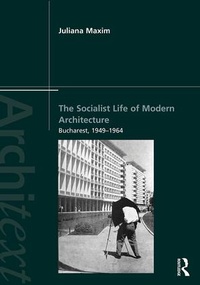
The Socialist Life of Modern Architecture
Bucharest, 1949-1964
1st Edition
Published on 29. November 2018
Book
Paperback/Softback
200 pages
978-1-138-82035-7 (ISBN)
Description
The Socialist Life of Modern Architecture is the first systematic architectural history of Romania under socialism written in English. It examines the mechanisms through which modern architecture was invested with political meaning and, in reverse, how specific architectural solutions came to define the socialist experience.
Each of the book's three parts traces the historical development of one key aspect of Romania's architectural culture between the years 1949-1964:
the planning and construction of housing districts in Bucharest;
the role of typification of design and standardization of construction in a project of cultural transformation;
the production and management of a folk architectural tradition.
Going beyond buildings and architects to consider the use of photography, painting, and novels, as well as narrations of history and the formation of an ethnographic architectural heritage, the author explores how buildings came to participate in the cultural imagination of socialism-and became, in fact, a privileged medium of socialism.
Part of the growing interest in the significance of Soviet Bloc architecture, this is an important contribution to the fields of architectural history, cultural history, and visual culture.
Each of the book's three parts traces the historical development of one key aspect of Romania's architectural culture between the years 1949-1964:
the planning and construction of housing districts in Bucharest;
the role of typification of design and standardization of construction in a project of cultural transformation;
the production and management of a folk architectural tradition.
Going beyond buildings and architects to consider the use of photography, painting, and novels, as well as narrations of history and the formation of an ethnographic architectural heritage, the author explores how buildings came to participate in the cultural imagination of socialism-and became, in fact, a privileged medium of socialism.
Part of the growing interest in the significance of Soviet Bloc architecture, this is an important contribution to the fields of architectural history, cultural history, and visual culture.
More details
Series
Language
English
Place of publication
London
United Kingdom
Publishing group
Taylor & Francis Ltd
Target group
College/higher education
Illustrations
86 s/w Abbildungen, 53 s/w Photographien bzw. Rasterbilder, 33 s/w Zeichnungen
33 Line drawings, black and white; 53 Halftones, black and white; 86 Illustrations, black and white
Dimensions
Height: 246 mm
Width: 174 mm
Weight
450 gr
ISBN-13
978-1-138-82035-7 (9781138820357)
Copyright in bibliographic data and cover images is held by Nielsen Book Services Limited or by the publishers or by their respective licensors: all rights reserved.
Schweitzer Classification
Other editions
Additional editions
E-Book
12/2018
1st Edition
Routledge
€61.99
Available for download
E-Book
12/2018
1st Edition
Routledge
€61.99
Available for download
Book
11/2018
1st Edition
Routledge
€230.65
Shipment within 10-20 days
Person
Juliana Maxim is Associate Professor of Architectural History at the University of San Diego, USA.
Content
Introduction Part 1: The Rise of the Socialist City Part 2: Type and Typification Part 3: Peasant Houses and Workers' Apartments Index