

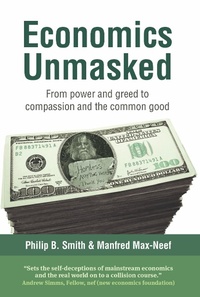
Economics Unmasked
From power and greed to compassion and the common good
Will be published approx. on 10. February 2011
Book
Paperback/Softback
200 pages
978-1-900322-70-6 (ISBN)
Description
An inspiring outline of a new economics system, where justice, human dignity, compassion and reverence for life are the guiding values.
The economic system under which we live not only forces the great majority of humankind to live their lives in indignity and poverty but also threatens all forms of life on Earth. Economics Unmasked presents a cogent critique of the dominant economic system, showing that the theoretical constructions of mainstream economics work mainly to bring about injustice.
The merciless onslaught on the global ecosystem of recent decades, brought about by the massive increase in the production of goods and the consequent depletion of nature's reserves, is not a chance property of the economic system. It is a direct result of neoliberal economic thinking, which recognizes value only in material things. The growth obsession is not a mistaken conception that mainstream economists can unlearn, it is inherent in their view of life. But a socio-economic system based on the growth obsession can never be sustainable.
This book outlines the foundations of a new economics, where we are not ruled by greed and injustice. Contrary to the absurd assumption of mainstream economists that economics is a value-free science, a new economics must make its values explicit.
The economic system under which we live not only forces the great majority of humankind to live their lives in indignity and poverty but also threatens all forms of life on Earth. Economics Unmasked presents a cogent critique of the dominant economic system, showing that the theoretical constructions of mainstream economics work mainly to bring about injustice.
The merciless onslaught on the global ecosystem of recent decades, brought about by the massive increase in the production of goods and the consequent depletion of nature's reserves, is not a chance property of the economic system. It is a direct result of neoliberal economic thinking, which recognizes value only in material things. The growth obsession is not a mistaken conception that mainstream economists can unlearn, it is inherent in their view of life. But a socio-economic system based on the growth obsession can never be sustainable.
This book outlines the foundations of a new economics, where we are not ruled by greed and injustice. Contrary to the absurd assumption of mainstream economists that economics is a value-free science, a new economics must make its values explicit.
Reviews / Votes
The world urgently needs original and creative thinking about economics - the sort of thinking that Manfred Max-Neef has been offering for several decades. His latest book (written jointly with Philip B. Smith) is an inspiring statement that there is an alternative to the hollow dream of globalisation. * Molly Scott Cato, Reader in Green Economics at Cardiff School of Management * Philip B. Smith and Manfred Max Neef have done something remarkable and necessary - they have set the self-deceptions of mainstream economics and the real world onto a collision course. * Andrew Simms, Fellow New Economics Foundation * Much of the language of the book is passionate and emotive. * Feasta * One good way for honest economics professors to fight back is to recommend this book to their students. * Herman Daly, Professor at University of Maryland * Presents a cogent critique of the dominant economics system in order to help transform our society into one in which all forms of life will be protected. * Postive News *More details
Language
English
Place of publication
United Kingdom
Publishing group
Bloomsbury Publishing PLC
Product notice
Paperback (trade)
Illustrations
Graphs and charts.
Dimensions
Height: 232 mm
Width: 157 mm
Thickness: 15 mm
Weight
384 gr
ISBN-13
978-1-900322-70-6 (9781900322706)
Copyright in bibliographic data and cover images is held by Nielsen Book Services Limited or by the publishers or by their respective licensors: all rights reserved.
Schweitzer Classification
Other editions
Additional editions
Manfred Max-Neef | Philip B. Smith
Economics Unmasked
From Power and Greed to Compassion and the Common Good
E-Book
08/2011
1st Edition
Green Books
€16.49
Available for download
Manfred Max-Neef | Philip B. Smith
Economics Unmasked
From Power and Greed to Compassion and the Common Good
E-Book
08/2011
1st Edition
Green Books
€16.49
Available for download
Persons
Philip Bartlett Smith was an American-Dutch experimental physicist and writer who after his retirement devoted himself to studying economic theories, environment and energy, and world poverty. He was co-author of The World at the Crossroads and the editor of Dimensions of Sustainability.
Manfred Max-Neef is a Chilean-German economist and environmentalist. He is Professor of Ecological Economics in the Southern University of Chile, and Director of the Economics Institute. His book Human Scale Development has been recognised by Cambridge University as one of the fifty most important texts in sustainability.
Manfred Max-Neef is a Chilean-German economist and environmentalist. He is Professor of Ecological Economics in the Southern University of Chile, and Director of the Economics Institute. His book Human Scale Development has been recognised by Cambridge University as one of the fifty most important texts in sustainability.
Content
Preface
Introduction: the case for a new economics
From knowledge to understanding
The function of economics in society
Keynesianism: its rise and fall
Honesty and value premises
Imitation of the exact sciences: reductionism, mathematical models and Pareto
Economic growth
Globalization
Compassion
The world on a collision course and the need for a new economics
A humane economics for the twenty-first century
The United States: an underdeveloping nation
A non-toxic teaching of economics
Implementation: from the village to a global order
References and notes
Index
Introduction: the case for a new economics
From knowledge to understanding
The function of economics in society
Keynesianism: its rise and fall
Honesty and value premises
Imitation of the exact sciences: reductionism, mathematical models and Pareto
Economic growth
Globalization
Compassion
The world on a collision course and the need for a new economics
A humane economics for the twenty-first century
The United States: an underdeveloping nation
A non-toxic teaching of economics
Implementation: from the village to a global order
References and notes
Index