

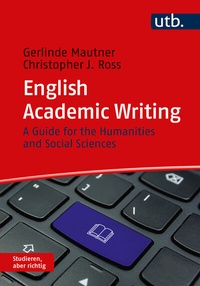
English Academic Writing
A Guide for the Humanities and Social Sciences
1st Edition
Published on 19. June 2023
Book
Paperback/Softback
238 pages
978-3-8252-6028-6 (ISBN)
Description
Das Buch richtet sich an all jene, die in Studium oder Beruf wissenschaftliche Texte auf Englisch verfassen wollen und dafür praxisorientierte Hilfe suchen. Es enthält eine Vielzahl von sprachlichen Tipps, authentischen Beispielen, Zusammenfassungen und eine Phrasensammlung.
More details
Other editions
Additional editions
Gerlinde Mautner | Christopher J. Ross
English Academic Writing
A Guide for the Humanities and Social Sciences
E-Book
06/2023
1st Edition
UTB
€31.99
Available for download
Gerlinde Mautner | Christopher J. Ross
English Academic Writing
A Guide for the Humanities and Social Sciences
E-Book
06/2023
1st Edition
UTB
€31.99
Available for download
Persons
Content
Acknowledgments
Explanatory notes for readers
Introduction: Seven pillars of academic writing
1 Creativity and constraints: Planning research texts
1.1 Research genres
1.1.1 Genres, structures and hierarchies
1.1.2 Hierarchical organisation in research texts
1.2 The research story and its parts
1.2.1 The abstract
1.2.2 The beginning: Setting the scene
1.2.3 The middle: Developing the plot
1.2.4 The ending: Rounding it all off
1.3 Text appeal
2 One step at a time: Designing paragraphs
2.1 The essence of English paragraphs
2.2 The components of a paragraph
2.2.1 The topic sentence
2.2.2 The 'meaty' middle
2.2.3 The final sentence
2.3 Paragraph appeal
3 Focus and flow: Constructing sentences
3.1 Sentence types
3.1.1 The simple sentence
3.1.2 The complex sentence
3.1.3 Subordinate clauses
3.2 Principles of sentence construction
3.2.1 The 'given-new' principle
3.2.2 End focus
3.3 Passive sentences
3.4 Sentence appeal
3.4.1 Getting the verb-noun balance right
3.4.2 Varying sentence structure
4 Breath marks: Punctuation
4.1 Why punctuation matters
4.2 What punctuation marks signal
4.2.1 Suggesting 'stops'
4.2.2 Suggesting 'detours'
4.2.3 Suggesting 'pauses'
4.3 Commas: sometimes a question of style
4.3.1 Where style plays little part
4.3.2 Where style comes in
5 Only connect: Cohesion
5.1 General principles of cohesion and coherence
5.2 Cohesion within paragraphs
5.2.1 Semantic chains
5.2.2 Pronouns
5.2.3 Linkers
5.2.4 Structural devices
5.3 Cohesion beyond the paragraph
6 Your words, not mine: Citations
6.1 What to cite and how much
6.2 Types of citations
6.2.1 Direct versus indirect citations
6.2.2 Integral versus non-integral citations
6.3 Weaving citations into the text
6.4 Inadvertent plagiarism and how to avoid it
7 Follow me: Guiding and persuading the reader
7.1 Showing the reader the way: Metacomments
7.2 Getting the reader on your side
7.2.1 Reasoning
7.2.2 Emphasising
7.2.3 Evaluating
7.2.4 Rapport-building
Appendix 1 Conference presentations
A1.1 The audience, or 'pity the listener'
A1.2 The purposes
A1.3 Language considerations
A1.4 Text slides
Appendix 2 Grant proposals
Appendix 3 Phrasebank for academic writing
List of references
Index