

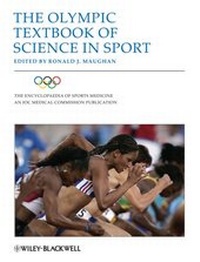
The Olympic Textbook of Science in Sport
Published on 27. November 2008
Book
Hardback
440 pages
978-1-4051-5638-7 (ISBN)
Description
This new book provides an up-to-date, state of the art presentation of the scientific aspects of conditioning, injury prevention, and competition. The content is presented in a clear style and format and provides invaluable guidance for all medical doctors and other health personnel who serve athletes and sports teams.
The book covers key topics in eleven sections:
* Physiology
* Biochemistry
* Nutrition
* Anthropometry
* Immunology
* Cell Biology
* Biomechanics, Engineering, and Ergonomics
* Psychology
* Limitation to Performance
* Special Populations
* Exercise and Health
More details
Series
Edition
1. Auflage
Language
English
Place of publication
Chicester
United Kingdom
Publishing group
John Wiley and Sons Ltd
Target group
College/higher education
Dimensions
Height: 25.5 cm
Width: 19.6 cm
Thickness: 2.7 cm
Weight
1282 gr
ISBN-13
978-1-4051-5638-7 (9781405156387)
Schweitzer Classification
Person
Professor Ronald J. Maughan, PhD - Univeristy of Loughborough, England.
Dr. Ronald J. Maughan is currently a visiting professor at the School of Sport and Exercise Science, Loughgorough University, England. He obtained his bachelor of science degree in physiology and his doctoral from the University of Aberdeen. He held a lecturing position in Liverpool before returning to Aberdeen, where he was based for over 20 years before moving to Loughborough in 2003.
His research interests are in the physiology, biochemistry, and nutrition of exercise performance, with an interest in both the basic science of exercise and the applied aspects that relate to health and to performance in sport. He has published extensively in the scientific literature and is on the editorial board of several international journals.
Dr. Maughan is a fellow of the American College of Sports Medicine and is a member of many scientific organizations, including the Physiological Society, the Nutrition Society, the Biochemical Society, the Medical Research Society, and the New York Academy of Sciences.
He chaired the Human Exercise Physiology group of the Physiological Society and the Nutrition Steering Group of the British Olympic Association for more than 10 years and now chairs the nutrition working group of the Medical Commission of the International Olympic Committee. He also acts as an adviser to UK Athletics, the Irish Sports Council and to various other sporting bodies.
Content
Introduction.
1. Sport, science and sports science.
2. The evolution of sports science.
Section 1 Physiology.
3. Muscles: producing force and movement.
4. Physiological demands of sprinting and multiple sprint sports.
5. Physiological demands of endurance exercise.
6. Adaptations to training.
Section 2 Biochemistry.
7. Metabolic responses to high intensity exercise.
8. Metabolic responses to endurance exercise.
9. Metabolic adaptations to training.
Section 3 Nutrition.
10. Nutrition needs of athletes.
11. Nutrition goals and eating strategies.
12. Hydration.
Section 4 Anthropometry.
13. Body composition and sports performance.
Section 5 Immunology.
14. Exercise immunology.
15. Exercise, inflammation and metabolism.
Section 6 Cell biology.
16. Genetic determinants of sports performance.
17. Molecular mechanisms of adaptations to training.
Section 7 Biomechanics, engineering and ergonomics.
18. Biomechanics of human movement.
19. Sports equipment: bioengineering.
20. Sports ergonomics.
Section 8 Psychology.
21. Effects of exercise participation on mood and behaviour.
22. Psychological strategies for optimum performance.
Section 9 Pharmacology.
23. Performance enhancing drugs.
Section 10 Limitations to performance.
24. Cardiorespiratory limitations to performance.
25. Metabolic limitations to performance.
26. The brain and fatigue.
Section 10 Special populations.
27. The child and adolescent athlete.
28. The female athlete.
29. The special needs athlete.
Section 11 Exercise and health.
30. Health benefits of exercise