

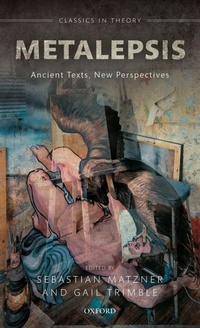
Metalepsis
Ancient Texts, New Perspectives
Published on 27. August 2020
Book
Hardback
336 pages
978-0-19-884698-7 (ISBN)
Description
'Metalepsis' is a term from classical rhetoric, but in the twentieth century, it was re-framed more broadly as a crossing of the boundaries that separate distinct narrative worlds. This modern notion of metalepsis, introduced by Gerard Genette, has so far largely been theorized on the basis of examples from post-modern novels and films. Yet metalepsis has a much greater potential to address all sorts of transgressions between 'worlds' or 'levels', not only in post-modern but also pre-modern literature.
This volume explores metalepsis in classical antiquity, considering questions such as: if metalepsis consists fundamentally in the breaking down of barriers, what sort of barriers and what sort of transgressions can the concept be fruitfully applied to? Can it be used within approaches other than narratology? Does metalepsis require recognisable levels of reality and fictionality, and if so, what role might be played by other planes, such as the past, the mythical or the divine? What form does metalepsis take in less obviously 'narrative' genres, such as lyric poetry? And how should it be understood in visual media? Reflecting on these questions sheds new light on important dynamics in ancient texts, and advances literary theory by probing how explorations of ancient metalepsis might change, refine, or extend our understanding of the concept itself.
This volume explores metalepsis in classical antiquity, considering questions such as: if metalepsis consists fundamentally in the breaking down of barriers, what sort of barriers and what sort of transgressions can the concept be fruitfully applied to? Can it be used within approaches other than narratology? Does metalepsis require recognisable levels of reality and fictionality, and if so, what role might be played by other planes, such as the past, the mythical or the divine? What form does metalepsis take in less obviously 'narrative' genres, such as lyric poetry? And how should it be understood in visual media? Reflecting on these questions sheds new light on important dynamics in ancient texts, and advances literary theory by probing how explorations of ancient metalepsis might change, refine, or extend our understanding of the concept itself.
More details
Series
Language
English
Place of publication
Oxford
United Kingdom
Target group
Professional and scholarly
Illustrations
13 black-and-white illustrations
Dimensions
Height: 222 mm
Width: 145 mm
Thickness: 22 mm
Weight
555 gr
ISBN-13
978-0-19-884698-7 (9780198846987)
Copyright in bibliographic data and cover images is held by Nielsen Book Services Limited or by the publishers or by their respective licensors: all rights reserved.
Schweitzer Classification
Other editions
Additional editions
E-Book
08/2020
1st Edition
OUP eBook
€68.99
Available for download
E-Book
08/2020
1st Edition
OUP eBook
€68.99
Available for download
Persons
Sebastian Matzner is Senior Lecturer in Comparative Literature at King's College London. His research focuses on interactions between ancient and modern literature and thought, especially in the fields of poetics and rhetoric, literary and critical theory, history of sexualities, LGBTQ studies, and traditions of classicism.
Gail Trimble is Associate Professor in Classical Languages and Literature at the University of Oxford and Brown Fellow and Tutor in Classics at Trinity College. Her research interests focus on Latin poetry and literary form, and she has published book chapters on Catullus, Virgil, and Ovid as well as work interrogating the history of scholarship as reception.
Gail Trimble is Associate Professor in Classical Languages and Literature at the University of Oxford and Brown Fellow and Tutor in Classics at Trinity College. Her research interests focus on Latin poetry and literary form, and she has published book chapters on Catullus, Virgil, and Ovid as well as work interrogating the history of scholarship as reception.
Content
1: Sebastian Matzner: By Way of Introduction: Back to the Future? Problems and Potential of Metalepsis avant Genette
2: Jonas Grethlein: Representation Delimited and Historicized: Metalepsis in Ancient Literature and Vase-Painting
3: Felix Budelmann: Metalepsis and Readerly Investment in Fictional Characters: Reflections on Apostrophic Reading
4: Irene J. F. de Jong: Metalepsis and the Apostrophe of Heroes in Pindar
5: Peter Bing: Anachronism as a Form of Metalepsis in Ancient Greek Literature
6: Gail Trimble: Narrative and Lyric Levels in Catullus
7: Laurel Fulkerson: Close Encounters: Divine Epiphanies on the Fringes of Latin Love Elegy
8: Helen Lovatt: Metalepsis, Grief, and Narrative in Aeneid 2
9: Talitha Kearey: Secondary Metalepsis? Talking to Virgil in Fulgentius' Expositio Virgilianae Continentiae
10: Duncan Kennedy: Metalepsis and Metaphysics
11: Sebastian Matzner and Gail Trimble: Epilogue: Metaleptically Ever After
2: Jonas Grethlein: Representation Delimited and Historicized: Metalepsis in Ancient Literature and Vase-Painting
3: Felix Budelmann: Metalepsis and Readerly Investment in Fictional Characters: Reflections on Apostrophic Reading
4: Irene J. F. de Jong: Metalepsis and the Apostrophe of Heroes in Pindar
5: Peter Bing: Anachronism as a Form of Metalepsis in Ancient Greek Literature
6: Gail Trimble: Narrative and Lyric Levels in Catullus
7: Laurel Fulkerson: Close Encounters: Divine Epiphanies on the Fringes of Latin Love Elegy
8: Helen Lovatt: Metalepsis, Grief, and Narrative in Aeneid 2
9: Talitha Kearey: Secondary Metalepsis? Talking to Virgil in Fulgentius' Expositio Virgilianae Continentiae
10: Duncan Kennedy: Metalepsis and Metaphysics
11: Sebastian Matzner and Gail Trimble: Epilogue: Metaleptically Ever After