

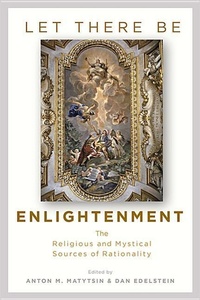
Let There Be Enlightenment
The Religious and Mystical Sources of Rationality
Will be published approx. on 9. November 2018
Book
Hardback
312 pages
978-1-4214-2601-3 (ISBN)
Description
Challenging the triumphalist narrative of Enlightenment secularism.
According to most scholars, the Enlightenment was a rational awakening, a radical break from a past dominated by religion and superstition. But in Let There Be Enlightenment, Anton M. Matytsin, Dan Edelstein, and the contributors they have assembled deftly undermine this simplistic narrative. Emphasizing the ways in which religious beliefs and motivations shaped philosophical perspectives, essays in this book highlight figures and topics often overlooked in standard genealogies of the Enlightenment. The volume underscores the prominent role that religious discourses continued to play in major aspects of seventeenth- and eighteenth-century thought.
The essays probe a wide range of subjects, from reformer Jan Amos Comenius's quest for universal enlightenment to the changing meanings of the light metaphor, Quaker influences on Baruch Spinoza's theology, and the unexpected persistence of Aristotle in the Enlightenment. Exploring the emergence of historical consciousness among Enlightenment thinkers while examining their repeated insistence on living in an enlightened age, the collection also investigates the origins and the long-term dynamics of the relationship between faith and reason.
Providing an overview of the rich spectrum of eighteenth-century culture, the authors demonstrate that religion was central to Enlightenment thought. The term "enlightenment" itself had a deeply religious connotation. Rather than revisiting the celebrated breaks between the eighteenth century and the period that preceded it, Let There Be Enlightenment reveals the unacknowledged continuities that connect the Enlightenment to its various antecedents.
Contributors: Philippe Buc, William J. Bulman, Jeffrey D. Burson, Charly Coleman, Dan Edelstein, Matthew T. Gaetano, Howard Hotson, Anton M. Matytsin, Darrin M. McMahon, James Schmidt, Celine Spector, Jo Van Cauter
According to most scholars, the Enlightenment was a rational awakening, a radical break from a past dominated by religion and superstition. But in Let There Be Enlightenment, Anton M. Matytsin, Dan Edelstein, and the contributors they have assembled deftly undermine this simplistic narrative. Emphasizing the ways in which religious beliefs and motivations shaped philosophical perspectives, essays in this book highlight figures and topics often overlooked in standard genealogies of the Enlightenment. The volume underscores the prominent role that religious discourses continued to play in major aspects of seventeenth- and eighteenth-century thought.
The essays probe a wide range of subjects, from reformer Jan Amos Comenius's quest for universal enlightenment to the changing meanings of the light metaphor, Quaker influences on Baruch Spinoza's theology, and the unexpected persistence of Aristotle in the Enlightenment. Exploring the emergence of historical consciousness among Enlightenment thinkers while examining their repeated insistence on living in an enlightened age, the collection also investigates the origins and the long-term dynamics of the relationship between faith and reason.
Providing an overview of the rich spectrum of eighteenth-century culture, the authors demonstrate that religion was central to Enlightenment thought. The term "enlightenment" itself had a deeply religious connotation. Rather than revisiting the celebrated breaks between the eighteenth century and the period that preceded it, Let There Be Enlightenment reveals the unacknowledged continuities that connect the Enlightenment to its various antecedents.
Contributors: Philippe Buc, William J. Bulman, Jeffrey D. Burson, Charly Coleman, Dan Edelstein, Matthew T. Gaetano, Howard Hotson, Anton M. Matytsin, Darrin M. McMahon, James Schmidt, Celine Spector, Jo Van Cauter
Reviews / Votes
This book has many merits. All of its chapters are very original and even groundbreaking in several respects. By employing interdisciplinary approaches that pay due attention to both texts and contexts, the contributors to this volume rediscover and revalue several intellectual currents and figures traditionally neglected by historiography . . . [Let There Be Enlightenment] provides excellent food for thought for both specialists in the field and educated lay readers willing to acquire a deeper insight into this fascinating and complex period of human history.-Diego Lucci, American University in Bulgaria, Journal of Jesuit Studies I am delighted to have this collection in my library . . . [Let There Be Enlightenment] asserts stronger and more complex continuities between medieval thought and the Enlightenment, making it worth noting for not only specialists in early modern history, but more broadly scholars of religion and ideas in pre-nineteenth-century Europe.
-Chad Denton, H-France Review
More details
Language
English
Place of publication
Baltimore, MD
United States
Target group
Professional and scholarly
College/higher education
Product notice
sewn/stitched
Cloth over boards
Illustrations
15 s/w Photographien bzw. Rasterbilder, 1 s/w Zeichnung
1 Line drawings, black and white; 15 Halftones, black and white
Dimensions
Height: 226 mm
Width: 160 mm
Thickness: 23 mm
Weight
576 gr
ISBN-13
978-1-4214-2601-3 (9781421426013)
DOI
10.1353/book.61241
Copyright in bibliographic data and cover images is held by Nielsen Book Services Limited or by the publishers or by their respective licensors: all rights reserved.
Schweitzer Classification
Other editions
Additional editions
Anton M. Matytsin | Dan Edelstein
Let There Be Enlightenment
The Religious and Mystical Sources of Rationality
E-Book
11/2018
Johns Hopkins University Press
€41.49
Available for download
Persons
Anton M. Matytsin is an assistant professor of history at Kenyon College. He is the author of The Specter of Skepticism in the Age of Enlightenment. Dan Edelstein is the William H. Bonsall Professor of French and a professor of history (by courtesy) at Stanford University. He is the author of The Terror of Natural Right: Republicanism, the Cult of Nature, and the French Revolution and The Enlightenment: A Genealogy.
Content
Acknowledgments
Introduction
Part I. Lux
Chapter 1. Via Lucis in tenebras: Comenius as Prophet of the Age of Light
Chapter 2. Whose Light Is It Anyway? The Struggle for Light in the French Enlightenment
Chapter 3. The "Lights" before the Enlightenment: The Tribunal of Reason and Public Opinion
Chapter 4. Writing the History of Illumination in the Siecle des Lumieres: Enlightenment Narratives of Light
Part II. Veritas
Chapter 5. Another Dialogue in the Tractatus: Spinoza on "Christ's Disciples" and the Religious Society of Friends (Quakers)
Chapter 6. A Backward Glance: Light and Darkness in the Medieval Theology of Power
Chapter 7. Lumen unitivum: The Light of Reason and the Aristotelian Sect in Early-Modern Scholasticism
Chapter 8. The Aristotelian Enlightenment
Part III: Tenebrae
Chapter 9. Secular Sacerdotalism in the Anglican Enlightenment, 1660-1740
Chapter 10. Refracting the Century of Lights: Alternate Genealogies of Enlightenment in Eighteenth-Century Culture
Chapter 11. Enlightenment in the Shadows: Mysticism, Materialism, and the Dream State in Eighteenth-Century France
Chapter 12. Light, Truth, and the Counter-Enlightenment's Enlightenment
Contributors
Index
Introduction
Part I. Lux
Chapter 1. Via Lucis in tenebras: Comenius as Prophet of the Age of Light
Chapter 2. Whose Light Is It Anyway? The Struggle for Light in the French Enlightenment
Chapter 3. The "Lights" before the Enlightenment: The Tribunal of Reason and Public Opinion
Chapter 4. Writing the History of Illumination in the Siecle des Lumieres: Enlightenment Narratives of Light
Part II. Veritas
Chapter 5. Another Dialogue in the Tractatus: Spinoza on "Christ's Disciples" and the Religious Society of Friends (Quakers)
Chapter 6. A Backward Glance: Light and Darkness in the Medieval Theology of Power
Chapter 7. Lumen unitivum: The Light of Reason and the Aristotelian Sect in Early-Modern Scholasticism
Chapter 8. The Aristotelian Enlightenment
Part III: Tenebrae
Chapter 9. Secular Sacerdotalism in the Anglican Enlightenment, 1660-1740
Chapter 10. Refracting the Century of Lights: Alternate Genealogies of Enlightenment in Eighteenth-Century Culture
Chapter 11. Enlightenment in the Shadows: Mysticism, Materialism, and the Dream State in Eighteenth-Century France
Chapter 12. Light, Truth, and the Counter-Enlightenment's Enlightenment
Contributors
Index