

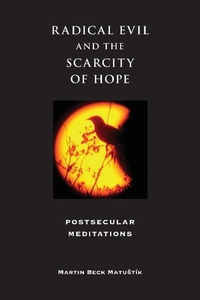
Radical Evil and the Scarcity of Hope
Postsecular Meditations
Published on 16. April 2008
Book
Paperback/Softback
312 pages
978-0-253-21968-8 (ISBN)
Description
No one will deny that we live in a world where evil exists. But how are we to come to grips with human atrocity and its diabolical intensity? Martin Beck Matustik considers evil to be even more radically evil than previously thought and to have become all too familiar in everyday life. While we can name various moral wrongs and specific cruelties, Matustik maintains that radical evil understood as a religious phenomenon requires a religious response where the language of hope, forgiveness, redemption, and love can take us beyond unspeakable harm and irreparable violence. Drawing upon the work of Kant, Schelling, Kierkegaard, Levinas, Derrida, and Marion, this work is written as a series of meditations. Matustik presents a bold new way of dealing with one of humanity's most intractable problems.
Reviews / Votes
"In a world filled with war, torture, and cruelty, where millions of people die of diseases related to malnutrition or inadequate health care each year, Martin Beck Matustik's book is an important and innovative inquiry into an age-old problem."-Rabbi Michael Lerner, Tikkun"This book deserves a large and thoughtful readership. . . . the insights are worth the effort.May 13, 2009 (online)"-Robert L. Perkins, Stetson University
More details
Series
Language
English
Place of publication
Bloomington, IN
United States
Target group
Professional and scholarly
Product notice
Paperback (trade)
Dimensions
Height: 234 mm
Width: 156 mm
Thickness: 18 mm
Weight
505 gr
ISBN-13
978-0-253-21968-8 (9780253219688)
Copyright in bibliographic data and cover images is held by Nielsen Book Services Limited or by the publishers or by their respective licensors: all rights reserved.
Schweitzer Classification
Person
Martin Beck Matustik is Lincoln Professor of Ethics and Religion at Arizona State University. He is author of Juergen Habermas: Philosophical-Political Profile and Specters of Liberation. He has edited (with Merold Westphal) Kierkegaard in Post/Modernity (IUP, 1995).
Content
Acknowledgments
Part 1. Impossible Hope
1. Job at Auschwitz
2. Redemptive Critical Theory
3. Between Hope and Terror
Part 2. The Negatively Saturated Phenomenon
4. Job Questions Kant
5. Redemption in an Antiredemptory Age
6. Radical Evil as a Saturated Phenomenon
Part 3. The Uncanny
7. The Unforgivable
8. Tragic Beauty
9. The Unspeakable
10. Without a Why
Epilogue: Job Questions the Grand Inquisitor
Notes
Works Cited
Index
Part 1. Impossible Hope
1. Job at Auschwitz
2. Redemptive Critical Theory
3. Between Hope and Terror
Part 2. The Negatively Saturated Phenomenon
4. Job Questions Kant
5. Redemption in an Antiredemptory Age
6. Radical Evil as a Saturated Phenomenon
Part 3. The Uncanny
7. The Unforgivable
8. Tragic Beauty
9. The Unspeakable
10. Without a Why
Epilogue: Job Questions the Grand Inquisitor
Notes
Works Cited
Index