

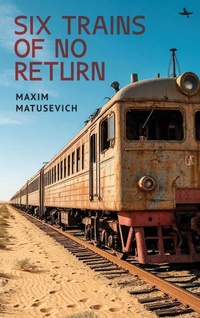
Six Trains of No Return
Will be published approx. on 12. March 2026
Book
Hardback
228 pages
979-8-89783-078-7 (ISBN)
Description
Six Trains of No Return collects twelve short stories and novellas that examine immigrant sagas and dislocations that are both uniquely personal and universal. These are the stories of past lives and loves, memories both fragile and unreliable, and our shared ties to larger historical narratives. They also evoke the Soviet Jewish experience during what was thought to be "The End of History" of the waning days of the USSR. A French-Cambodian woman embarks on a series of mysterious trips to the "killing fields" of her youth, an encounter in a Nigerian jail forces the narrator to face an impossible moral dilemma, a tender friendship grows between three young soldiers drafted into the Soviet army, a story of a young man's chance romantic encounter with a childhood friend and how it triggers memories of long-forgotten schoolyard cruelties, a pair of soldiers in the waning days of the Soviet Union watching the movie Jaws for the first time at a semi-underground video salon. Emotionally resonant yet edged with quiet humor, these stories explore themes of displacement, belonging, and memory-speaking across cultures and backgrounds.
More details
Language
English
Place of publication
Brighton
United States
Product notice
Laminated cover
Illustrations
Illustrations
Dimensions
Height: 235 mm
Width: 157 mm
Thickness: 17 mm
Weight
487 gr
ISBN-13
979-8-89783-078-7 (9798897830787)
Copyright in bibliographic data and cover images is held by Nielsen Book Services Limited or by the publishers or by their respective licensors: all rights reserved.
Schweitzer Classification
Person
Author Maxim Matusevich, a professor of history at Seton Hall University and a native of Leningrad (now St. Petersburg), drew upon his professional expertise and experience as an emigre to the United States in 1991 on the eve of the Soviet Union's dissolution for these stories and novellas. Matusevich's characters come from diverse walks of life, yet they remain unmistakably human-flawed, eccentric, and deeply relatable to anyone who has experienced historical upheaval, immigration, or the slow fading of stability.