

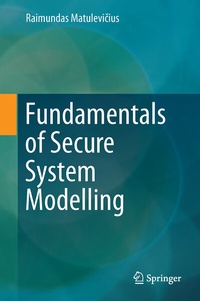
Fundamentals of Secure System Modelling
Published on 5. September 2017
Book
Hardback
XX, 218 pages
978-3-319-61716-9 (ISBN)
Description
This book provides a coherent overview of the most important modelling-related security techniques available today, and demonstrates how to combine them. Further, it describes an integrated set of systematic practices that can be used to achieve increased security for software from the outset, and combines practical ways of working with practical ways of distilling, managing, and making security knowledge operational.
The book addresses three main topics: (1) security requirements engineering, including security risk management, major activities, asset identification, security risk analysis and defining security requirements; (2) secure software system modelling, including modelling of context and protected assets, security risks, and decisions regarding security risk treatment using various modelling languages; and (3) secure system development, including effective approaches, pattern-driven development, and model-driven security.
The primary target audience of this book is graduate students studying cyber security, software engineering and system security engineering. The book will also benefit practitioners interested in learning about the need to consider the decisions behind secure software systems. Overall it offers the ideal basis for educating future generations of security experts.
The book addresses three main topics: (1) security requirements engineering, including security risk management, major activities, asset identification, security risk analysis and defining security requirements; (2) secure software system modelling, including modelling of context and protected assets, security risks, and decisions regarding security risk treatment using various modelling languages; and (3) secure system development, including effective approaches, pattern-driven development, and model-driven security.
The primary target audience of this book is graduate students studying cyber security, software engineering and system security engineering. The book will also benefit practitioners interested in learning about the need to consider the decisions behind secure software systems. Overall it offers the ideal basis for educating future generations of security experts.
Reviews / Votes
"Dr. Matulevicius' book gives a coherent account of the most important modeling-related security techniques today, and is well suited for educating the next generations of security experts." (Prof. Andreas Lothe Opdahl, University of Bergen, Norway)"Dr. Matulevicius introduces a fundamental set of knowledge for the advanced management of risk and security. Going from the conceptual aspects to practical tools, this book provides a broad coverage of the field." (Nicolas Mayer, Ph.D., Luxembourg Institute of Science and Technology)
More details
Edition
1st ed. 2017
Language
English
Place of publication
Cham
Switzerland
Publishing group
Springer International Publishing
Target group
Primary & secondary/elementary & high school
Illustrations
50 s/w Abbildungen, 62 farbige Abbildungen
XX, 218 p. 112 illus., 62 illus. in color.
Dimensions
Height: 241 mm
Width: 160 mm
Thickness: 19 mm
Weight
530 gr
ISBN-13
978-3-319-61716-9 (9783319617169)
DOI
10.1007/978-3-319-61717-6
Schweitzer Classification
Other editions
Additional editions
Raimundas Matulevicius
Fundamentals of Secure System Modelling
Book
08/2018
Springer
€74.89
Shipment within 10-15 days
Raimundas Matulevicius
Fundamentals of Secure System Modelling
E-Book
08/2017
Springer
€74.89
Available for download
Person
Raimundas Matulevicius
is Associate Professor of Software Systems at the University of Tartu, Estonia. He has spent over 15 years teaching and conducting research in the fields of security requirements engineering, secure software design and information systems security in Norway, Belgium and Estonia. He is co-coordinator of the Cyber Security Masters curriculum delivered by Tallinn University of Technology and University of Tartu.
Content
1 Introduction.- 2 Domain Model for Information Systems Security Risk Management.- 3 Security Risk.- 4 Security Requirements.- 5 Security Risk-Oriented BPMN.- 6 Security Risk-Aware Secure Tropos.- 7 Security Risk-Oriented Misuse Cases.- 8 Mal-activities for Security Risk Management.- 9 Transformations Between Security Risk-Oriented Modelling Languages.- 10 Role-Based Access Control.- 11 Secure System Development Using Patterns.- 12 Secure System Development.- 13 References.