

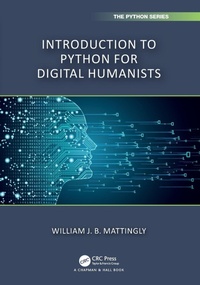
Introduction to Python for Humanists
1st Edition
Published on 26. July 2023
Book
Paperback/Softback
340 pages
978-1-032-37837-4 (ISBN)
Description
This book will introduce digital humanists at all levels of education to Python. It provides background and guidance on learning the Python computer programming language, and as it presumes no knowledge on the part of the reader about computers or coding concepts allows the reader to gradually learn the more complex tasks that are currently popular in the field of digital humanities. This book will be aimed at undergraduates, graduates, and faculty who are interested in learning how to use Python as a tool within their workflow. An Introduction to Python for Digital Humanists will act as a primer for students who wish to use Python, allowing them to engage with more advanced textbooks. This book fills a real need, as it is first Python introduction to be aimed squarely at humanities students, as other books currently available do not approach Python from a humanities perspective. It will be designed so that those experienced in Python can teach from it, in addition to allowing those who are interested in being self-taught can use it for that purpose.
Key Features:
Data analysis
Data science
Computational humanities
Digital humanities
Python
Natural language processing
Social network analysis
App development
Key Features:
Data analysis
Data science
Computational humanities
Digital humanities
Python
Natural language processing
Social network analysis
App development
More details
Series
Language
English
Place of publication
United Kingdom
Publishing group
Taylor & Francis Ltd
Target group
Professional and scholarly
Academic
Illustrations
25 farbige Zeichnungen, 64 s/w Abbildungen, 25 farbige Abbildungen, 13 s/w Photographien bzw. Rasterbilder, 46 Farbfotos bzw. farbige Rasterbilder, 5 s/w Zeichnungen
25 Line drawings, color; 5 Line drawings, black and white; 46 Halftones, color; 13 Halftones, black and white; 25 Illustrations, color; 64 Illustrations, black and white
Dimensions
Height: 254 mm
Width: 178 mm
Thickness: 20 mm
Weight
684 gr
ISBN-13
978-1-032-37837-4 (9781032378374)
Copyright in bibliographic data and cover images is held by Nielsen Book Services Limited or by the publishers or by their respective licensors: all rights reserved.
Schweitzer Classification
Other editions
Additional editions
William Mattingly
Introduction to Python for Humanists
Book
07/2023
1st Edition
Chapman & Hall/CRC
€201.70
Shipment within 10-20 days
William Mattingly
Introduction to Python for Humanists
E-Book
07/2023
1st Edition
Chapman & Hall/CRC
€64.49
Available for download
William Mattingly
Introduction to Python for Humanists
E-Book
07/2023
1st Edition
Chapman & Hall/CRC
€64.49
Available for download
Person
William Mattingly is a 2022 Harry Frank Guggenheim Distinguished Scholar and a 2022-2023 ACLS Grantee for his work as co-principal investigator and lead developer for the Bitter Aloe Project which examines testimonies of violence from South Africa's Truth and Reconciliation Commission. He is currently the Postdoctoral Fellow for the Analysis of Historical Documents at the Smithsonian Institution's Data Science Lab. Mattingly currently works on two projects at the Smithsonian. The first is based at the United States Holocaust Memorial Museum (USHMM), where he is developing a robust pipeline of machine learning image classification and natural language processing (NLP) models to automate the cataloging of millions of images. At the Smithsonian, he is working on a project connected to the American Women's History Initiative. Here, he is developing machine learning and heuristic pipelines with spaCy, a Python NLP library. This pipeline will identify women in Smithsonian documents and automatically extract knowledge about them so that we can better understand the influential role women played at the Smithsonian.
Content
Part I. The Basics of Python. Chapter 1. Introduction to Python. Chapter 2. Data and Data Structures. Chapter 3. Loops and Logic. Chapter 4. Formal Coding: Functions, Classes, and Libraries. Chapter 5. Working with External Data. Chapter 6. Working with Data on the Web. Part II. Data Analysis with Pandas. Chapter 7. Introduction to Pandas. Chapter 8. Working with Data in Pandas. Chapter 9. Searching for Data. Chapter 10. Advanced Pandas. Part III. Natural Language Processing with spaCy. Chapter 11. Introduction to spaCy. Chapter 12. Rules-Based spaCy. Chapter 13. Solving a Domain-Specific Problem: A Case Study with Holocaust NER. Chapter 14. Topic Modeling: Concepts and Theory. Chapter 15. Text Analysis with BookNLP. Chapter 16. Social Network Analysis. Part IV. Designing an Application with Streamlit. Chapter 17. Introduction to Streamlit. Chapter 18. Advanced Streamlit Features. Chapter 19. Building a Database Query Application. Part V. Conclusion. Chapter 21. Conclusion.