

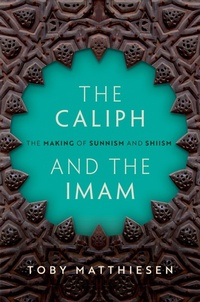
The Caliph and the Imam
The Making of Sunnism and Shiism
Published on 9. March 2023
Book
Hardback
944 pages
978-0-19-880655-4 (ISBN)
Description
The authoritative account of the sectarian division that for centuries has shaped events in the Middle East and the Islamic world.
In 632, soon after the prophet Muhammad died, a struggle broke out among his followers as to who would succeed him. The majority argued that the new leader of Islam should be elected by the community's elite. Others believed only members of Muhammad's family could lead. This dispute over who should guide Muslims, the appointed Caliph or the bloodline Imam, marks the origin of the Sunni-Shii split in Islam.
Toby Matthiesen explores this hugely significant division from its origins to the present day. Moving chronologically, his book sheds light on the many ways that it has shaped the Islamic world, outlining how over the centuries Sunnism and Shiism became Islams two main branches, particularly after the Muslim Empires embraced sectarian identity. It reveals how colonial rule institutionalised divisions between Sunnism and Shiism both on the Indian subcontinent and in the greater Middle East, giving rise to pan-Islamic resistance and Sunni and Shii revivalism. It then focuses on the fall-out from the 1979 revolution in Iran and the US-led military intervention in Iraq. As Matthiesen shows, however, though Sunnism and Shiism have had a long and antagonistic history, most Muslims have led lives characterised by confessional ambiguity and peaceful co-existence. Tensions arise when sectarian identity becomes linked to politics.
Based on a synthesis of decades of scholarship in numerous languages, The Caliph and the Imam will become the standard text for readers looking for a deeper understanding of contemporary sectarian conflict and its historical roots.
In 632, soon after the prophet Muhammad died, a struggle broke out among his followers as to who would succeed him. The majority argued that the new leader of Islam should be elected by the community's elite. Others believed only members of Muhammad's family could lead. This dispute over who should guide Muslims, the appointed Caliph or the bloodline Imam, marks the origin of the Sunni-Shii split in Islam.
Toby Matthiesen explores this hugely significant division from its origins to the present day. Moving chronologically, his book sheds light on the many ways that it has shaped the Islamic world, outlining how over the centuries Sunnism and Shiism became Islams two main branches, particularly after the Muslim Empires embraced sectarian identity. It reveals how colonial rule institutionalised divisions between Sunnism and Shiism both on the Indian subcontinent and in the greater Middle East, giving rise to pan-Islamic resistance and Sunni and Shii revivalism. It then focuses on the fall-out from the 1979 revolution in Iran and the US-led military intervention in Iraq. As Matthiesen shows, however, though Sunnism and Shiism have had a long and antagonistic history, most Muslims have led lives characterised by confessional ambiguity and peaceful co-existence. Tensions arise when sectarian identity becomes linked to politics.
Based on a synthesis of decades of scholarship in numerous languages, The Caliph and the Imam will become the standard text for readers looking for a deeper understanding of contemporary sectarian conflict and its historical roots.
Reviews / Votes
Ambitious...undoubtedly an admirable study...an accessible introduction to the historical context that underpins the modern Middle East * Tariq Mir, BBC History Magazine * a remarkable, ambitious and successful survey of Sunni-Shii relations that will be the definitive single-volume study of the subject for years to come. * Eamonn Gearon, Times Literary Supplement * clearly written, nuanced and meticulously documented * Malise Ruthven, Literary Review * a truly ambitious book in its historical and geographic scope...This book should be read by any expert who deals in the Middle East * Francis Ghiles, Esglobal * A useful correction to religious pigeonholes about Muslims, and to the easy-going prejudice that sectarian differences can never make things right with the Islamic world. * Michiel Leezenberg, NRC Handelsblad * Matthiesen's masterful survey of Sunni-Shiite relations in history is firmly grounded in the primary sources and ranges more widely geographically than is common in other works on the subject, including South Asia. The author avoids the glib truisms that have come to dominate discussion of this subject, while giving us thought-provoking, contextual insights into one of the key flash points within Islamic civilization. * Juan Cole, Richard P. Mitchell Collegiate Professor of History and Director, Program in Arab and Muslim American Studies, University of Michigan * Ambitious in its historical as well as geographical scope, this is the first truly global account of the intimate and sometimes also violent relationship of Sunni and Shia in the making and remaking of Islam. * Faisal Devji, Professor of Indian History, University of Oxford * The Caliph and the Imam is an ambitious book .... The book will be of interest to those readers seeking a comprehensive in-depth historical survey of sectarian relations in Islam and Middle Eastern and South Asian history. * Christopher Anzalone, The Muslim World Book Review * The Caliph and the Imam is an ambitious book...The book will be of interest to those readers seeking a comprehensive in-depth historical survey of sectarian relations in Islam and Middle Eastern and South Asian history. * The Muslim World Book Review * The Caliph and the Imam is a hefty read, but all too rewarding for those who wish to understand how we got here. * Survival * Toby Matthiesen is quickly establishing himself as one of the more interesting historians of the Middle East. He has widened his lens in The Caliph and the Imam, grappling with the sectarian divisions that have plagued the region starting when the Prophet Muhammad was alive and continuing through to the Arab Spring. His thesis, that the sectarian divide was present from the beginning but became much more toxic after European colonial powers carved up the Middle East, is as provocative as it is insightful. * Ray Takeyh, Survival: Global Politics and Strategy * The book's thoroughly researched content, compelling documents and evidence, anddelightful blend of detailed analysis with a broader perspective make it accessible to scholars, students, and general audiences alike. It not only raises important questions and inspires new avenues of study but is also highly relevant to those interested in the history of religion, theological developments, Islamic studies, Political Islam, identity politics, and modernization in the MENA region and Indian Subcontinent. Additionally, it helps curious readers explore the roots of many contemporary misunderstandings between the West and Muslims and the reactionaryand radically polarized currents in the MENA region. * Sayed Hassan Akhlaq, Religion * This book is highly recommended for its comprehensive historical analysis, offering a global historical and post-colonial perspective on the intricate relationship between Sunnism and Shiism. * Muhammad Adiz Wasisto, Religious Studies Review * The book remains a milestone for students of Shia-Sunnirelations, as it provides an extensive guide to the subject and offers plenty of references and suggestions for readers to delve deeper into issues that are only briefly touched upon. * Giulia Daga, The International Spectator *More details
Language
English
Place of publication
Oxford
United Kingdom
Dimensions
Height: 243 mm
Width: 156 mm
Thickness: 56 mm
Weight
1538 gr
ISBN-13
978-0-19-880655-4 (9780198806554)
Copyright in bibliographic data and cover images is held by Nielsen Book Services Limited or by the publishers or by their respective licensors: all rights reserved.
Schweitzer Classification
Other editions
Additional editions
E-Book
05/2023
1st Edition
OUP eBook
€27.49
Available for download
E-Book
02/2023
1st Edition
OUP eBook
€27.49
Available for download
Person
Toby Matthiesen is Senior Lecturer in Global Religious Studies at the University of Bristol. He is the author of several award-winning books and a frequent commentator in the media. He has previously held fellowships at the Universities of Venice, Stanford, Oxford, Cambridge, and the LSE.
Content
Prologue: From Karbala to Damascus
PART I THE FORMATION OF SUNNISM AND SHIISM, 632-1500
Chapter 1 After the Prophet
Chapter 2 Sunni Reassertion and the Crusades
Chapter 3 Polemics and Confessional Ambiguity
PART II THE SHAPING OF MUSLIM EMPIRES, 1500-1800
Chapter 4 The Age of Confessionalisation
Chapter 5 Muslim Dynasties on the Indian Subcontinent
Chapter 6 Reform and Reinvention in the 18th Century
PART III EMPIRE AND THE STATE, 1800-1979
Chapter 7 British India and Orientalism
Chapter 8 Ottoman Reorganisation and European Intervention
Chapter 9 The Mandates
Chapter 10 The Muslim Response
PART IV REVOLUTION AND RIVALRY, 1979-
Chapter 11 The Religion of Martyrdom
Chapter 12 Export and Containment of Revolution
Chapter 13 Regime Change
Chapter 14 The Arab Uprisings
Conclusion: Every Place is Karbala
BIBLIOGRAPHY
ENDNOTES
PART I THE FORMATION OF SUNNISM AND SHIISM, 632-1500
Chapter 1 After the Prophet
Chapter 2 Sunni Reassertion and the Crusades
Chapter 3 Polemics and Confessional Ambiguity
PART II THE SHAPING OF MUSLIM EMPIRES, 1500-1800
Chapter 4 The Age of Confessionalisation
Chapter 5 Muslim Dynasties on the Indian Subcontinent
Chapter 6 Reform and Reinvention in the 18th Century
PART III EMPIRE AND THE STATE, 1800-1979
Chapter 7 British India and Orientalism
Chapter 8 Ottoman Reorganisation and European Intervention
Chapter 9 The Mandates
Chapter 10 The Muslim Response
PART IV REVOLUTION AND RIVALRY, 1979-
Chapter 11 The Religion of Martyrdom
Chapter 12 Export and Containment of Revolution
Chapter 13 Regime Change
Chapter 14 The Arab Uprisings
Conclusion: Every Place is Karbala
BIBLIOGRAPHY
ENDNOTES