

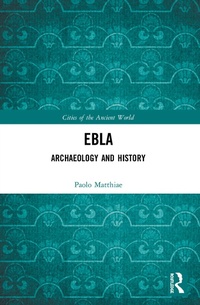
Ebla
Archaeology and History
1st Edition
Published on 1. August 2022
Book
Paperback/Softback
484 pages
978-0-367-49440-7 (ISBN)
Description
In Ebla , Paolo Matthiae presents the results of 47 years of excavations at this fascinating site, providing a detailed account of Ebla's history and archaeology.
Ebla grew from a small Early Bronze Age settlement into an important trading and political centre, which endured until its final destruction in c. 1600 BC . The destruction of its royal palace c. 2300 BC was particularly significant as it preserved the city's rich archives, offering a wealth of information on its history, economy, religion, administration, and daily life. The discovery of Ebla is a pivotal moment in the history of archaeological investigations of the twentieth century, and this book is the result of all the excavation campaigns at Tell Mardikh- Ebla from 1964 until 2010, when field operations stopped due to the war in Syria.
Available for the first time in English, Ebla offers a complete account of one of the largest pre-classical urban centres by its discoverer, making it an essential resource for students of Ancient Near Eastern archaeology and history.
Ebla grew from a small Early Bronze Age settlement into an important trading and political centre, which endured until its final destruction in c. 1600 BC . The destruction of its royal palace c. 2300 BC was particularly significant as it preserved the city's rich archives, offering a wealth of information on its history, economy, religion, administration, and daily life. The discovery of Ebla is a pivotal moment in the history of archaeological investigations of the twentieth century, and this book is the result of all the excavation campaigns at Tell Mardikh- Ebla from 1964 until 2010, when field operations stopped due to the war in Syria.
Available for the first time in English, Ebla offers a complete account of one of the largest pre-classical urban centres by its discoverer, making it an essential resource for students of Ancient Near Eastern archaeology and history.
More details
Series
Language
English
Place of publication
London
United Kingdom
Publishing group
Taylor & Francis Ltd
Target group
College/higher education
Product notice
Paperback (trade)
Unsewn / adhesive bound
Illustrations
261 s/w Abbildungen, 46 farbige Abbildungen, 261 s/w Photographien bzw. Rasterbilder, 46 Farbfotos bzw. farbige Rasterbilder
46 Halftones, color; 261 Halftones, black and white; 46 Illustrations, color; 261 Illustrations, black and white
Dimensions
Height: 234 mm
Width: 155 mm
Thickness: 25 mm
Weight
862 gr
ISBN-13
978-0-367-49440-7 (9780367494407)
Copyright in bibliographic data and cover images is held by Nielsen Book Services Limited or by the publishers or by their respective licensors: all rights reserved.
Schweitzer Classification
Other editions
Additional editions
Book
09/2020
1st Edition
Routledge
€193.13
Shipment within 10-20 days
E-Book
09/2020
1st Edition
Routledge
€60.49
Available for download
E-Book
09/2020
1st Edition
Routledge
€60.49
Available for download
Person
Paolo Matthiae is Emeritus Professor of Archaeology and Art History of the Ancient Near East at Sapienza University of Rome, and Fellow of the Accademia dei Lincei (Rome), the Academie des Inscriptions et Belles- Lettres (Paris), the Akademie der Wissenschaften (Vienna), the Royal Swedish Academy (Stockholm), and the Deutsches Archaeologisches Institut (Berlin). From the beginning of excavations at Tell Mardikh in 1964 to the suspension of work in 2010, he was Director of the excavations at Ebla in northern Syria.
Content
1. From Tell Mardikh to Ebla: archaeological exploration 2. Ebla and early urbanization in Syria 3. Ebla, Mari, Akkad: from city-states to empire 4. The Royal Palace in the age of the Archives space and function 5. Early Syrian religion, the Red Temple, and the Temple of the Rock 6. The State Archives: Economy, Culture, and Society 7. Artistic expressions and material culture in the mature Early Syrian period 8. The crisis in the Early Syrian world and the archaic Old Syrian renaissance 9. From Ebla to Yamkhad: the territorial states of the Amorite Age 10. Town planning and architecture in the Old Syrian city 11. Old Syrian artistic culture: originality and continuity 12. Old Syrian material culture: characteristics and development 13. From Ebla to Tell Mardikh: decline of a great urban centre