

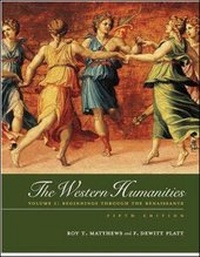
The Western Humanities: v. 1
Beginnings Through the Renaissance
5th Edition
Published on 15. May 2003
Book
Paperback/Softback
416 pages
978-0-07-255630-8 (ISBN)
Description
This chronologically organized introduction to the Western humanities (art, music, history, literature, and drama) establishes the historical context of each era before the arts are discussed. Hundreds of illustrations appear throughout the text, "Personal Perspectives" boxes bring to life the events of the day, and brief sections at the end of each chapter describe the cultural legacy of the era discussed. "Volume I" of The "Western Humanities" covers prehistory through the Renaissance.
More details
Edition
5th Revised edition
Language
English
Place of publication
London
United States
Publishing group
McGraw-Hill Education - Europe
Target group
College/higher education
Edition type
Revised edition
Dimensions
Height: 274 mm
Width: 213 mm
Thickness: 18 mm
Weight
1138 gr
ISBN-13
978-0-07-255630-8 (9780072556308)
Copyright in bibliographic data and cover images is held by Nielsen Book Services Limited or by the publishers or by their respective licensors: all rights reserved.
Schweitzer Classification
Content
The Western Humanities, 5/e Preface Introduction: Why Study Cultural History? A Humanities Primer: How to Understand the Arts Chapter 1 PREHISTORY AND NEAR EASTERN CIVILIZATIONS Prehistory and Early Cultures The Civilizations of the Tigris and Euphrates River Valley: Mesopotamia The Sumerian, Akkadian, and Babylonian Kingdoms The Cradle of Civilization Writing Religion Literature Personal Perspective: "A Sumerian Father Lectures His Son" Law Art and Architecture The Civilization of the Nile River Valley: Egypt Continuity and Change over Three Thousand Years A Quest for Eternal Cultural Values Religion Writing and Literature Personal Perspective: "The Instruction of Amenemope" Architecture Sculpture, Painting, and Minor Arts Heirs to the Mesopotamian and Egyptian Empires The Legacy of Early Near Eastern Civilizations Key Cultural Terms Suggestions for Further Reading Chapter 1 Highlights Windows on the World: 5000 - 500 B.C. Chapter 2 AEGEAN CIVILIZATIONS: THE MINOANS, THE MYCENAEANS, AND THE GREEKS OF THE ARCHAIC AGEPrelude: Minoan Civilization, 3000 - 1300 B.C. Beginnings: Mycenaean Civilization, 1900 - 1100 B.C. Interlude: The Dark Ages, 1100 - 800 B.C. The Archaic Age, 800 - 479 B.C. Political, Economic, and Social Structures The Greek Polis: Sparta and Athens The Persian Wars The Emergence of Greek Genius: The Mastery of Form Religion Epic Poetry Personal Perspective: Sappho, "He Seems to Be a God"; Alcaeus, "Longing for Home and Drinking Song" Lyric Poetry Natural Philosophy Architecture Sculpture The Legacy of Archaic Greek Civilization Key Cultural Terms Suggestions for Further Reading Chapter 2 Highlights Chapter 3 CLASSICAL GREEK CIVILIZATION: THE HELLENIC AGE General Characteristics of Hellenic Civilization Domestic and Foreign Affairs: War, Peace, and the Triumph of Macedonia The Perfection of the Tradition: The Glory of Hellenic Greece Theater: Tragedy Features of the Greek Theater Encounter: The Representation of Blacks in Greek Art Tragic Drama Aeschylus Sophocles Euripides Theater: Comedy Music History Natural Philosophy The Pre-Socratics The Sophists The Socratic Revolution Plato Aristotle Architecture Sanctuaries The Temple: The Perfection of the Form Personal Perspective: Xenophon, "Secrets of a Successful Marriage" Sculpture The Legacy of Hellenic Civilization Key Cultural Terms Suggestions for Further Reading Chapter 3 Highlights Windows on the World: 500 - 300 B.C. Chapter 4 CLASSICAL GREEK CIVILIZATION: THE HELLENISTIC AGE The Stages of Hellenistic History The End of the Empire and the Rise of the States The Arrival and Triumph of Rome The Cities of Hellenistic Civilization Pergamum Alexandria in Egypt Personal Perspective: Theocritus, "Getting to the Concert on Time" The Elaboration of the Greek Tradition: The Spread of Classicism to the Hellenistic World Drama and Literature Philosophy and Religion Cynicism Skepticism Epicureanism Stoicism Fate and the Mystery Cults Architecture The Corinthian Temple The Altar Sculpture Rhodes: Late Hellenistic Style The Legacy of the Hellenistic World Key Cultural Terms Suggestions for Further Reading Chapter 4 Highlights Chapter 5 ROMAN CIVILIZATION: THE PRE-CHRISTIAN CENTURIES The Colossus of the Mediterranean World General Characteristics of Roman Civilization The Etruscan and Greek Connections Rome in the Age of Kings, 753-509 B.C. The Roman Republic, 509-31 B.C. The Early Republic, 509-264 B.C. The Middle Republic, 264-133 B.C. The Late Republic, 133-31 B.C. Growing Autocracy: Imperial Rome, 31 B.C.-A.D. 284 Pax Romana, 31 B.C.-A.D. 193 Civil Wars, A.D. 193-284 The Style of Pre-Christian Rome: From Greek Imitation to Roman Grandeur Roman Religion Language, Literature, and Drama The First Literary Period, 250-31 B.C. The Second Literary Period: The Golden Age, 31 B.C.-A.D. 14-200 Personal Perspective: Marcus, Son of Cicero, "Changing My Ways" The Third Literary Period: The Silver Age, A.D. 14-200 Philosophy Stoicism Neo-Platonism Law The Visual Arts Architecture Encounter: Roman Conquests and Romance Languages Sculpture Painting and Mosaics Music The Legacy of Pre-Christian Rome Key Cultural Terms Suggestions for Further Reading Chapter 5 Highlights Windows on the World: 300 B.C. - A.D. 500 Chapter 6 JUDAISM AND THE RISE OF CHRISTIANITY Judaism The People and Their Religion Egypt, Exodus, and Moses The Kingdom of Israel The Babylonian Captivity and the Postexilic Period The Hellenistic and Roman Periods Societal and Family Relationships Personal Perspective: Flavius Josephus, "The Destruction of the Temple at Jerusalem" The Bible Early Jewish Art and Architecture Christianity The Life of Jesus Christ and the New Testament Christians and Jews Christianity and Greco-Roman Religions and Philosophies Christians in the Roman Empire Personal Perspective: Vibia Perpetua, "Account of Her Last Days Before Martyrdom" Early Christian Literature Early Christian Art The Legacy of Biblical Judaism and Early Christianity Key Cultural Terms Suggestions for Further Reading Chapter 6 Highlights Chapter 7 THE CIVILIZATIONS OF LATE ROME, BYZANTIUM, AND THE EARLY MEDIEVAL WESTThe Last Days of the Roman Empire Diocletian's Reforms and the Triumph of Christianity, 284-395 The Great Persecution and Christian Toleration Early Christian Developments Christian Rome and the End of the Western Empire, 395-476 Personal Perspective: Paulina, "Epitaph for Agorius Praetextatus" The Transition from Classical Humanism to Christian Civilization Literature, Theology, and History The Fathers of the Church Personal Perspective: St. Jerome, "Secular Education; The Fall of Rome" Church History The Visual Arts Architecture Sculpture Painting and Mosaics Music The Eastern Roman Empire and Byzantine Civilization, 476-1453 History of the Byzantine Empire Byzantine Culture: Christianity and Classicism The Orthodox Religion Law and History Architecture and Mosaics The Early Medieval West The Early Middle Ages: A Romano-Germanic Christianized World Religion and Culture in the Early Middle Ages Christianity: Leadership and Organization Personal Perspective: Anna Comnena, "The Arrival of the First Crusade in Constantinople"; Liudprand of Cremona, "A Mission to the Byzantine Court" Literature, History, and Learning Music Architecture Painting: Illuminated Manuscripts The Legacy of Late Rome, Byzantium, and the Early Medieval West Key Cultural Terms Suggestions for Further Reading Chapter 7 Highlights Windows on the World: 500-1000 Chapter 8 THE WORLD OF ISLAM, 630-1517Muhammad, The Prophet Imperial Islam The Post-Muhammad Years The Umayyad Dynasty The Abbasid Dynasty The Seljuk Turk Empire Imperial Decline Islam as Religion Encounter: An International Community of Scholars Medieval Islamic Culture Scholarship Literature Poetry Prose Art and Architecture Architecture Painting Personal Perspective: Abu'l-Faraj al-Isfahani, "Marketing a Product" Music The Legacy of Medieval Islam Key Cultural Terms Suggestions for Further Reading Chapter 8 Highlights Chapter 9 THE HIGH MIDDLE AGES: THE CHRISTIAN CENTURIESFeudalism The Feudal System and the Feudal Society Peasant Life The Rise of Towns The Feudal Monarchy The French Monarchy The English Monarchy The Holy Roman Empire The Papal Monarchy Medieval Christianity and the Church Encounter: Pagan Vikings versus Christian Europeans Christian Beliefs and Practices Religious Orders and Lay Piety Personal Perspective: Abelard and Heloise, "My Sorrow and My Loss" The Age of Synthesis: Equilibrium Between the Spiritual and the Secular Learning and Theology Cathedral Schools and the Development of Scholasticism Peter Abelard The Rise of the Universities Intellectual Controversy and Thomas Aquinas Literature Monastic and Feudal Writing Vernacular and Courtly Writing Dante Architecture and Art Romanesque Churches and Related Arts Gothic Churches and Related Arts Early Gothic Style, 1145-1194 High Gothic Style, 1194-1300 Music The Legacy of the Christian Centuries Key Cultural Terms Suggestions for Further Reading Chapter 9 Highlights Windows on the World: 1000 - 1300 Chapter 10 THE LATE MIDDLE AGES: 1300 - 1500 Hard Times Come to Europe Ordeal by Plague, Famine, and War Depopulation, Rebellion, and Industrialization The Secular Monarchies The Papal Monarchy The Cultural Flowering of the Late Middle Ages Religion Personal Perspective: Henry Knighton,"Political and Religious Rebels" Theology, Philosophy, and Science The Via Antiqua Versus the Via Moderna Duns Scotus and William of Ockham Developments in Science Literature Northern Italian Literature: Petrarch and Boccacio English Literature: Geoffrey Chaucer French Literature: Christine de Pizan Art and Architecture Late Gothic Architecture Late Gothic Sculpture Late Gothic Painting and the Rise of New Trends Illuminated Manuscripts The Print New Trends in Italy: Giotto Flemish Painting: Jan Van Eyck and Hans Memling Music The Legacy of the Late Middle Ages Key Cultural Terms Suggestions for Further Reading Suggestion for Listening Chapter 10 Highlights Windows on the World: 1300 - 1500 **Chapter 11 THE EARLY RENAISSANCE: RETURN TO CLASSICAL ROOTS, 1400 - 1494 The Renaissance: Schools of Interpretation Early Renaissance History and Institutions Italian City-States During the Early Renaissance Florence, the Center of the Renaissance The Resurgent Papcy, 1450-1500 The Spirit and Style of the Early Renaissance Humanism, Scholarship, and Schooling Personal Perspective: Laura Cereta, "Defense of the Liberal Instruction of Women" Thought and Philosophy Architecture, Sculpture, and Painting Artistic Ideals and Innovations Architecture Sculpture Painting Music The Legacy of the Early Renaissance Key Cultural Terms Suggestions for Further Reading Suggestion for Listening Chapter 11 Highlights **Chapter 12 THE HIGH RENAISSANCE AND EARLY MANNERISM, 1494 - 1564The Rise of the Modern Sovereign State The Struggle for Italy, 1494-1529 Charles V and the Hapsburg Empire Economic Expansion and Social Developments From High Renaissance to Early Mannerism Literature Gaspara Stampa Castiglione Machiavelli Painting Leonardo da Vinci Michelangelo Raphael The Venetian School: Giorgione and Titian The School of Parma: Parmigianino Sculpture Personal Perspective: Giorgio Vasari, "Michelangelo Has the Last Word" Architecture Music The Legacy of the High Renaissance and Early Mannerism Key Cultural Terms Suggestions for Further Reading Suggestions for Listening Chapter 12 Highlights APPENDIX Writing for the Humanities: Research Papers and Essay Examinations GLOSSARY CREDITS INDEX** NOTE: Chapters 11 and 12 are repeated in both Volumes 1 and 2.