

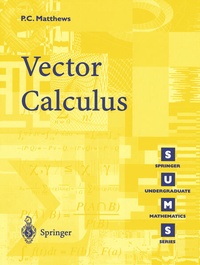
Vector Calculus
Published on 14. January 1998
Book
Paperback/Softback
X, 182 pages
978-3-540-76180-8 (ISBN)
Description
Vector calculus is the fundamental language of mathematical physics. It pro vides a way to describe physical quantities in three-dimensional space and the way in which these quantities vary. Many topics in the physical sciences can be analysed mathematically using the techniques of vector calculus. These top ics include fluid dynamics, solid mechanics and electromagnetism, all of which involve a description of vector and scalar quantities in three dimensions. This book assumes no previous knowledge of vectors. However, it is assumed that the reader has a knowledge of basic calculus, including differentiation, integration and partial differentiation. Some knowledge of linear algebra is also required, particularly the concepts of matrices and determinants. The book is designed to be self-contained, so that it is suitable for a pro gramme of individual study. Each of the eight chapters introduces a new topic, and to facilitate understanding of the material, frequent reference is made to physical applications. The physical nature of the subject is clarified with over sixty diagrams, which provide an important aid to the comprehension of the new concepts. Following the introduction of each new topic, worked examples are provided. It is essential that these are studied carefully, so that a full un derstanding is developed before moving ahead. Like much of mathematics, each section of the book is built on the foundations laid in the earlier sections and chapters.
Reviews / Votes
P.C. Matthews
Vector Calculus
"Written for undergraduate students in mathematics, the book covers the material in a comprehensive but concise manner, combining mathematical rigor with physical insight. There are many diagrams to illustrate the physical meaning of the mathematical concepts, which essential for a full understanding of the subject." - ZENTRALBLATT MATH
More details
Series
Edition
1st ed. 1998. Corr. 3rd printing 2000
Language
English
Place of publication
London
United Kingdom
Publishing group
Springer Berlin
Target group
Lower undergraduate
Illustrations
1 s/w Abbildung
X, 182 p. 1 illus.
Dimensions
Height: 235 mm
Width: 178 mm
Thickness: 11 mm
Weight
352 gr
ISBN-13
978-3-540-76180-8 (9783540761808)
DOI
10.1007/978-1-4471-0597-8
Schweitzer Classification
Other editions
Additional editions
Person
Paul C. Matthews was on the faculty of the University of Nottingham for more than two decades. A specialist of dynamical systems and their numerical analysis, he is the author of the bestselling textbook Vector Calculus (Springer, 1998).
Content
1. Vector Algebra.- 1.1 Vectors and scalars.- 1.2 Dot product.- 1.3 Cross product.- 1.4 Scalar triple product.- 1.5 Vector triple product.- 1.6 Scalar fields and vector fields.- 2. Line, Surface and Volume Integrals.- 2.1 Applications and methods of integration.- 2.2 Line integrals.- 2.3 Surface integrals.- 2.4 Volume integrals.- 3. Gradient, Divergence and Curl.- 3.1 Partial differentiation and Taylor series.- 3.2 Gradient of a scalar field.- 3.3 Divergence of a vector field.- 3.4 Curl of a vector field.- 4. Suffix Notation and its Applications.- 4.1 Introduction to suffix notation.- 4.2 The Kronecker delta ?ij.- 4.3 The alternating tensor ?ijk.- 4.4 Relation between ?ijk and ?ij.- 4.5 Grad, div and curl in suffix notation.- 4.6 Combinations of grad, div and curl.- 4.7 Grad, div and curl applied to products of functions.- 5. Integral Theorems.- 5.1 Divergence theorem.- 5.2 Stokes's theorem.- 6. Curvilinear Coordinates.- 6.1 Orthogonal curvilinear coordinates.- 6.2 Grad, div and curl in orthogonal curvilinear coordinate systems.- 6.3 Cylindrical polar coordinates.- 6.4 Spherical polar coordinates.- 7. Cartesian Tensors.- 7.1 Coordinate transformations.- 7.2 Vectors and scalars.- 7.3 Tensors.- 7.4 Physical examples of tensors.- 8. Applications of Vector Calculus.- 8.1 Heat transfer.- 8.2 Electromagnetism.- 8.3 Continuum mechanics and the stress tensor.- 8.4 Solid mechanics.- 8.5 Fluid mechanics.- Solutions.